
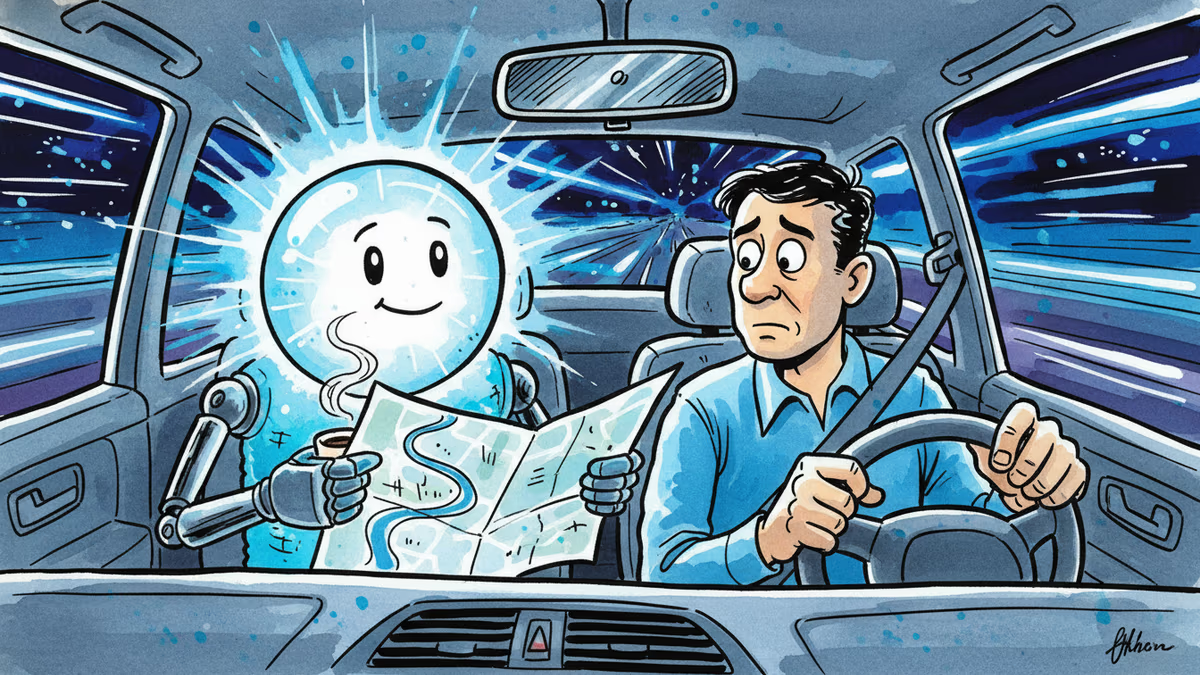
Gemini Gets Behind the Wheel — And It's Not Just for New Cars
Google is replacing Assistant with Gemini in cars with Google built-in, starting in the U.S. GM's 4 million vehicles are first. But the real story is what happens when your car becomes a Google device.
Your next car upgrade might not require buying a new car. It might just be a software update.
What Google Just Announced
On Thursday, Google confirmed it's rolling out Gemini to vehicles equipped with Google Built-in — the Android-based in-car platform that's been quietly installed in cars since 2020. The initial rollout covers the U.S. in English, with more languages and regions to follow over the coming months.
The announcement landed one day after General Motors revealed that Gemini is coming to roughly 4 million vehicles from model year 2022 and newer — spanning Cadillac, Chevrolet, Buick, and GMC. Google's own statement didn't name GM specifically, signaling the rollout extends well beyond a single automaker partnership.
The upgrade replaces Google Assistant as the primary in-car voice interface. And unlike most automotive tech upgrades, this one doesn't require a trip to the dealership — compatible existing vehicles will receive it via over-the-air software update.
What Actually Changes for Drivers
The gap between current voice assistants and what Gemini promises is less about raw capability and more about conversational fluency. Today's in-car AI handles discrete commands: "Navigate home." "Call Mom." "Turn up the heat." Gemini is designed to handle layered, natural requests.
Google's example: a driver says they want to stop for lunch at a highly rated sit-down restaurant with outdoor seating along their route. Gemini pulls from Google Maps data, surfaces options, then fields follow-up questions about parking and menu items — including dietary preferences — without the driver needing to reframe the request each time.

Beyond navigation, Gemini handles climate controls, music recommendations, vehicle information, and hands-free message summaries and replies. Currently in beta, Gemini Live takes it further — open-ended, real-time conversation activated by saying "Hey Google, let's talk." Brainstorming a work problem on the highway. Learning something new during a commute. It's designed to fill the dead time of driving with something closer to a thinking partner than a command-line interface.
Drivers signed into their Google accounts in compatible vehicles will be prompted to opt in. Once enabled, Gemini is accessible via voice, the on-screen microphone, or steering wheel controls. Future updates will deepen integration with Gmail, Google Calendar, and Google Home.
Three Ways to Read This Move
For consumers, the pitch is straightforward: your existing car gets meaningfully smarter without a new purchase. That's a compelling value proposition, especially as the average new vehicle price in the U.S. sits above $48,000.
For automakers, the calculus is more complicated. Google Built-in already gives Google a foothold in the vehicle's core interface. With Gemini now connecting to email, calendar, and smart home systems, the car is increasingly becoming another node in the Google ecosystem — one that automakers don't fully control. The tension between offering best-in-class software and ceding platform leverage to a tech giant is one the auto industry has been wrestling with since Apple CarPlay arrived in 2014.
For privacy advocates, the picture is worth scrutinizing. A system that knows your route, your lunch preferences, your incoming messages, your calendar, and your home devices is extraordinarily useful. It's also an extraordinarily detailed behavioral profile. How that data is stored, shared, and used — and how regulators in the EU and elsewhere respond — remains an open question Google hasn't fully addressed in this announcement.
The Competitive Landscape
Amazon has Alexa Auto. Apple has CarPlay, with its own AI ambitions. Domestic Chinese automakers like BYD are building deeply integrated AI assistants of their own. But Google's advantage is the depth of the existing ecosystem: Maps, Search, Gmail, Calendar — the services people already use most in their daily lives.
The question for competitors isn't whether they can build a capable in-car AI. It's whether they can match the data network effects Google has spent two decades assembling.
This content is AI-generated based on source articles. While we strive for accuracy, errors may occur. We recommend verifying with the original source.
Related Articles
In a post-Google I/O interview, Sundar Pichai acknowledged flawed search results, real AI anxiety, and an AGI timeline that makes the label irrelevant. Here's what he said — and what it means.
Google is building AI agents that search the web proactively, without user prompting. That's not just a product update — it's a fundamental shift in who controls the information you receive.
Google unveiled the 'Googlebook' platform to replace Chromebook and ChromeOS—but revealed zero hardware specs. What's the strategy, and what does it mean for users, manufacturers, and the education market?
After 15 years of fragmented mobile messaging, Apple and Google are rolling out end-to-end encrypted RCS messaging between iPhones and Android devices. Here's what changed, why it took so long, and what it means for your privacy.
In a post-Google I/O interview, Sundar Pichai acknowledged flawed search results, real AI anxiety, and an AGI timeline that makes the label irrelevant. Here's what he said — and what it means.
Google is building AI agents that search the web proactively, without user prompting. That's not just a product update — it's a fundamental shift in who controls the information you receive.
Google unveiled the 'Googlebook' platform to replace Chromebook and ChromeOS—but revealed zero hardware specs. What's the strategy, and what does it mean for users, manufacturers, and the education market?
After 15 years of fragmented mobile messaging, Apple and Google are rolling out end-to-end encrypted RCS messaging between iPhones and Android devices. Here's what changed, why it took so long, and what it means for your privacy.
Thoughts
Share your thoughts on this article
Sign in to join the conversation