
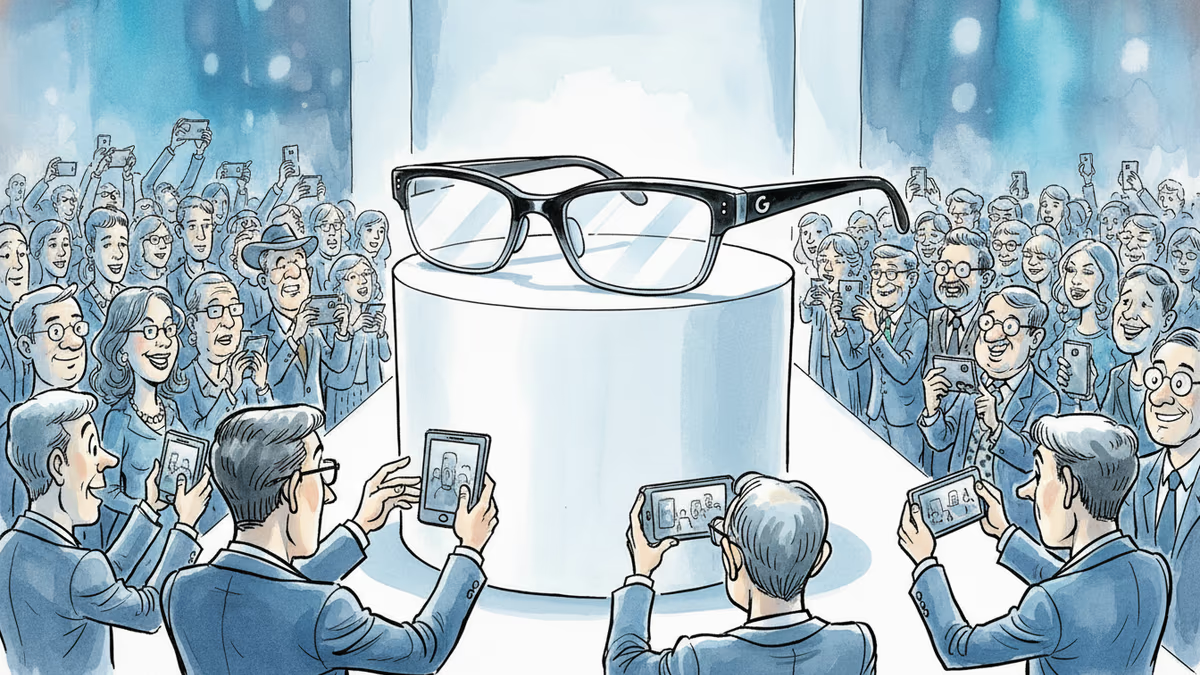
Google Wants Gucci to Solve What Tech Never Could
Google is partnering with Gucci to make AI smart glasses people actually want to wear. But can luxury branding fix the social stigma that killed Google Glass a decade ago?
The last time Google tried to put a computer on your face, it invented a new insult: "Glasshole." This time, they're bringing a fashion house.
What's Actually Happening
According to Reuters, Google is partnering with Kering — the luxury conglomerate behind Gucci — to develop a pair of AI-powered smart glasses, with a launch expected sometime in 2027. Before that, Google plans to release its first Android XR glasses this year under the codename Project Aura, featuring chunky black plastic frames that look strikingly similar to Meta's Ray-Ban smart glasses.
This isn't Google's only fashion bet. The company has also announced partnerships with Warby Parker and Gentle Monster, the South Korean eyewear brand with a cult following. The pattern is deliberate: Google isn't building one pair of glasses. It's building a platform and letting designers dress it.
Why Google Glass Failed — And Why That Still Matters
In 2013, Google Glass launched to enormous hype and quiet humiliation. Cafés posted "no Glass" signs. Wearers got confronted in public. The device looked odd, felt invasive, and the $1,500 price tag made it a conspicuous symbol of Silicon Valley tone-deafness. By 2015, Google pulled the consumer version.
The failure wasn't primarily technical. The camera worked. The display worked. What didn't work was the social contract — nobody wanted to be the person in the room who might be recording everything. That discomfort never really went away. It just got overshadowed by smartphones, which normalized cameras everywhere.

Meta quietly proved the market could exist: its Ray-Ban smart glasses have sold over 1 million units as of 2024, largely because they look like regular sunglasses. The lesson Google absorbed: the hardware has to disappear into the fashion.
Three Ways to Read This Move
For consumers, the pitch is seductive — AI assistance woven into something you'd wear anyway. Real-time translation, navigation, hands-free calls, a camera that doesn't scream "surveillance device" because it's sitting on a Gucci frame. But the same camera is still there. The microphone is still on. The data still flows to Google's servers.
For the luxury industry, this is uncharted territory. Gucci attaches its name to handbags, shoes, and fragrances — objects with no data exhaust. A smart glasses collaboration means the brand is now implicitly endorsing a data collection device. If a privacy scandal hits Google's glasses line, does Kering absorb reputational damage too?
For competitors, the pressure is real. Meta has a head start in consumer smart glasses. Apple is betting on spatial computing with Vision Pro at the premium end. Samsung is developing its own XR hardware. Google is trying to thread a needle: mass-market appeal through fashion partnerships, premium positioning through luxury branding, and platform lock-in through Android XR. Whether that triangle holds is the open question.
The Price Problem Nobody's Talking About
Here's a practical tension: Gucci doesn't do affordable. A standard Gucci eyeglass frame runs $300–$500 before lenses. Add Google's hardware, AI processing, and the inevitable margin for a tech-fashion collaboration, and these glasses could easily land above $1,000. That's a different consumer than the one buying Ray-Ban smart glasses at $299.
At that price point, you're not selling a gadget. You're selling a status object that happens to have a computer in it. Which raises an uncomfortable question about who this technology is actually designed for — and who gets left out of the AI-augmented future.
Authors
Related Articles
In a post-Google I/O interview, Sundar Pichai acknowledged flawed search results, real AI anxiety, and an AGI timeline that makes the label irrelevant. Here's what he said — and what it means.
Xreal's Project Aura debuted at Google I/O with OLED displays, hand tracking, and an IPO on the horizon. The industry has burned billions for a decade. So why does it feel like something has actually shifted?
Google is building AI agents that search the web proactively, without user prompting. That's not just a product update — it's a fundamental shift in who controls the information you receive.
Google unveiled the 'Googlebook' platform to replace Chromebook and ChromeOS—but revealed zero hardware specs. What's the strategy, and what does it mean for users, manufacturers, and the education market?
In a post-Google I/O interview, Sundar Pichai acknowledged flawed search results, real AI anxiety, and an AGI timeline that makes the label irrelevant. Here's what he said — and what it means.
Xreal's Project Aura debuted at Google I/O with OLED displays, hand tracking, and an IPO on the horizon. The industry has burned billions for a decade. So why does it feel like something has actually shifted?
Google is building AI agents that search the web proactively, without user prompting. That's not just a product update — it's a fundamental shift in who controls the information you receive.
Google unveiled the 'Googlebook' platform to replace Chromebook and ChromeOS—but revealed zero hardware specs. What's the strategy, and what does it mean for users, manufacturers, and the education market?
Thoughts
Share your thoughts on this article
Sign in to join the conversation