
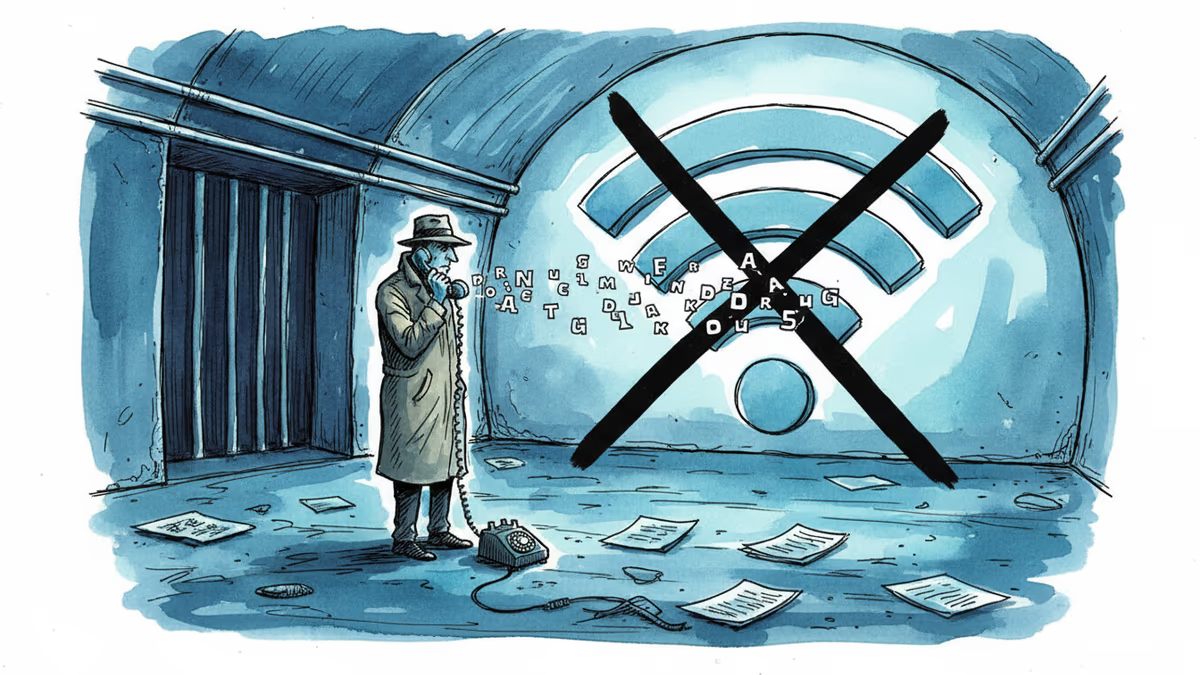
Google's Quiet App That Works Without Wi-Fi
Google quietly launched an offline-first AI dictation app called Eloquent on iOS. Built on Gemma, it cleans up your speech on-device — no internet required. Here's what it signals.
No press release. No keynote. No countdown timer. Google just quietly slipped a new AI app onto the iOS App Store — and it might be the most interesting thing the company has launched in months.
The app is called Google AI Edge Eloquent. It's free. And crucially, once you download the AI models to your phone, it works entirely without an internet connection.
What It Actually Does
The premise is simple but the execution is what matters. You speak. The app transcribes in real time. When you pause, it automatically strips out filler words — "um," "uh," half-finished sentences — and hands you clean, usable prose. No editing required.
Under the hood, it runs on Gemma, Google's family of lightweight, on-device AI models. That's the reason it can work offline: the speech recognition happens entirely on your phone, not on a server somewhere in Iowa. If you want extra polish, you can flip on cloud mode, which routes text cleanup through Gemini models. But the default is local.
The app also lets you pull in contact names and jargon from your Gmail account to improve accuracy — useful if you regularly dictate emails full of industry terms or colleague names. You can add custom vocabulary too. It keeps a searchable history of every session, and tracks stats like words per minute and total words spoken. Transformation options — "Key points," "Formal," "Short," "Long" — let you reshape the same dictation into different formats with a tap.
As of now, it's iOS only. An Android version and a system-wide keyboard feature were mentioned in the App Store listing, but Google quietly removed those references on the evening of April 7th, adding only that an iOS keyboard is "coming soon."

Why This Matters Beyond the App Itself
AI dictation isn't new. Wispr Flow, SuperWhisper, and Willow have been building this market for the past couple of years, mostly on paid subscriptions. What's changed is the underlying model quality — speech-to-text has crossed a threshold where it's genuinely faster and less annoying than typing for many people.
What Google is doing here is different from those competitors in one significant way: it's free, and it's offline-first. That combination is a direct challenge to the subscription model that indie developers in this space depend on. A $10–15/month app becomes a harder sell when Google ships equivalent functionality for nothing.
The stealth launch is also worth noting. No announcement means this is a test. Google is watching whether users adopt it, and the results will likely inform whether Eloquent's features get folded into Google Docs, Gboard, or Android itself. Think of it less as a finished product and more as a public beta with real stakes.
For users in regions with unreliable connectivity — large parts of Southeast Asia, Sub-Saharan Africa, rural Europe — offline AI processing isn't a nice-to-have. It's the difference between a tool that works and one that doesn't. An on-device dictation app that runs without Wi-Fi has genuine utility in those markets in a way that cloud-dependent competitors simply don't.
The Privacy Calculation
On-device processing is often framed as the privacy-friendly option, and in a narrow sense it is: your voice never leaves your phone when cloud mode is off. But the Gmail integration adds a wrinkle. Importing names and vocabulary from your inbox means granting the app access to your communication data — a tradeoff worth thinking about, even if the feature is optional.
There's also the question of defaults. If cloud mode is on by default, most users will never change it. The "offline-first" framing can obscure what's actually happening for the majority of users who don't dig into settings.
For enterprise users — lawyers, doctors, journalists, executives — the on-device option is genuinely meaningful. Sensitive conversations staying on the device, not transiting Google's servers, is a real compliance and confidentiality consideration. That use case could drive adoption in ways that casual consumer use won't.
Authors
Related Articles

Samsung and SK unveiled a chip and AI investment package worth thousands of trillions of won on June 29. The headline number swings wildly by outlet, but the real contest isn't capital — it's water and power.
In a post-Google I/O interview, Sundar Pichai acknowledged flawed search results, real AI anxiety, and an AGI timeline that makes the label irrelevant. Here's what he said — and what it means.
Google is building AI agents that search the web proactively, without user prompting. That's not just a product update — it's a fundamental shift in who controls the information you receive.
Viral videos show 2026 graduates jeering executives who praise AI at commencement ceremonies. It's not just rudeness — it's a signal about who pays for technological optimism.
Samsung and SK unveiled a chip and AI investment package worth thousands of trillions of won on June 29. The headline number swings wildly by outlet, but the real contest isn't capital — it's water and power.
In a post-Google I/O interview, Sundar Pichai acknowledged flawed search results, real AI anxiety, and an AGI timeline that makes the label irrelevant. Here's what he said — and what it means.
Google is building AI agents that search the web proactively, without user prompting. That's not just a product update — it's a fundamental shift in who controls the information you receive.
Viral videos show 2026 graduates jeering executives who praise AI at commencement ceremonies. It's not just rudeness — it's a signal about who pays for technological optimism.
Thoughts
Share your thoughts on this article
Sign in to join the conversation