
One Flaw, Millions of AI Agents Exposed
A critical vulnerability in Starlette—downloaded 325 million times per week—puts millions of AI agent servers at risk, exposing stored credentials for email, databases, and third-party services.
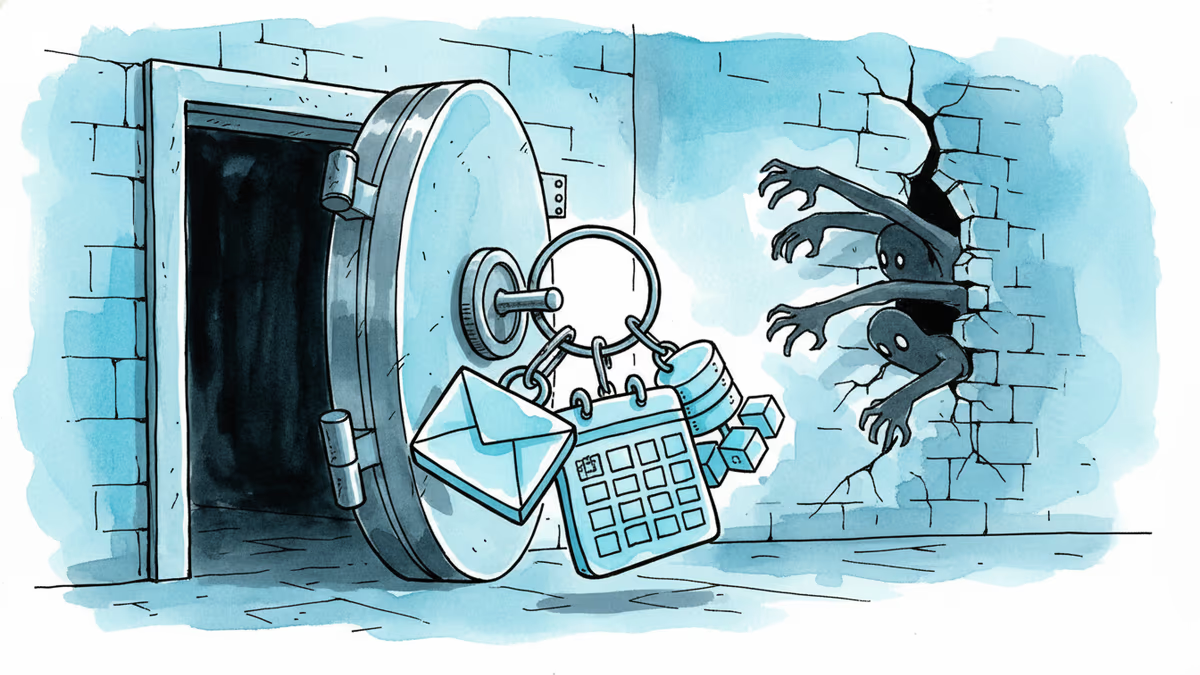
Every AI agent you've given access to your email, your calendar, your company database—they're all storing the keys to those accounts somewhere. Turns out, that somewhere has a door that's been left unlocked.
A security researcher has disclosed a critical vulnerability in Starlette, an open-source Python framework that its own developer reports is downloaded 325 million times per week. Because Starlette is the foundation of FastAPI and thousands of other widely used frameworks, the blast radius extends far beyond a single project. Millions of servers running AI agents are potentially exposed—and the flaw is described as trivial to exploit.
What's Actually at Stake
To understand why this matters, you need to understand what MCP (Model Context Protocol) does. It's the plumbing that lets AI agents from providers like Anthropic, OpenAI, and Google reach into external systems—your inbox, your calendar, your internal databases, your SaaS tools. To make those connections work, MCP servers store the credentials for every system they touch: API keys, login tokens, access grants.
That makes an MCP server an extraordinarily attractive target. Breach one, and you don't just get data—you get the keys to every service that agent was connected to. The Starlette vulnerability, sitting beneath the ASGI layer that handles all those simultaneous requests, gives attackers a potential path straight to that credential store. And because the exploit requires no sophisticated technique, the threat isn't limited to nation-state actors or elite hacking groups.
A Pattern Security Has Seen Before

This isn't the first time a single shared dependency turned into a systemic crisis. Log4Shell in 2021 exploited a logging library so ubiquitous that security teams spent weeks just trying to inventory where it lived in their stacks. SolarWinds in 2020 showed how a compromised build component could silently reach into thousands of organizations at once.
The difference now is the target layer. Those earlier incidents hit general-purpose infrastructure. This one hits the emerging AI agent layer—systems that, by design, have been granted broad permissions to act on users' behalf. The more capable we make AI agents, the more access we hand them. The more access they hold, the more valuable they become to compromise.
Three Perspectives Worth Holding Simultaneously
Developers using FastAPI or any Starlette-dependent framework face an immediate operational question: patch now, or assess first? In large production environments, framework updates carry their own risks—compatibility breaks, regression testing, deployment windows. The vulnerability creates urgency; the remediation creates friction.
Enterprise security teams face a harder architectural question. The MCP model centralizes credentials by design—that's what makes it convenient. An AI agent that can seamlessly pull your calendar data and cross-reference your email doesn't ask you to re-authenticate every time because it's holding those tokens somewhere. Is that design choice—convenience over credential distribution—one the industry is prepared to revisit?
AI providers are caught in a structural tension. The competitive differentiation for AI agents is how many things they can connect to and act on. More integrations, more permissions, more capability. But each new integration is another credential in that vault. The incentive structure of the AI agent market pushes directly against the security principle of least privilege.
This content is AI-generated based on source articles. While we strive for accuracy, errors may occur. We recommend verifying with the original source.
Related Articles

A small but growing group of developers has gone all-in on AI coding agents like Claude Code and OpenClaw. History suggests the rest of us won't be far behind.
Google is building AI agents that search the web proactively, without user prompting. That's not just a product update — it's a fundamental shift in who controls the information you receive.

GitHub confirmed hackers stole data from 3,800 internal repositories via a poisoned VS Code extension. Here's why developer tools are now the most dangerous attack surface in tech.

OpenAI has reorganized for the second time in a month, merging ChatGPT and Codex into a single agentic platform under president Greg Brockman's unified product leadership.
A small but growing group of developers has gone all-in on AI coding agents like Claude Code and OpenClaw. History suggests the rest of us won't be far behind.
Google is building AI agents that search the web proactively, without user prompting. That's not just a product update — it's a fundamental shift in who controls the information you receive.
GitHub confirmed hackers stole data from 3,800 internal repositories via a poisoned VS Code extension. Here's why developer tools are now the most dangerous attack surface in tech.
OpenAI has reorganized for the second time in a month, merging ChatGPT and Codex into a single agentic platform under president Greg Brockman's unified product leadership.
Thoughts
Share your thoughts on this article
Sign in to join the conversation