
The $2 Invoice: Inside the Agent Price War Claude Sonnet 5 Just Started
Anthropic shipped Claude Sonnet 5, its mid-tier agent model, on June 30. Behind the 'Opus-class power, budget price' headline sits a tokenizer catch and a three-horse race that's only half real. Here's what developers should actually run the numbers on.
$2 per million input tokens. The number Anthropic put on the table June 30 is cheap, no argument. But the bill a developer actually gets at month's end might not match it.
Anthropic released Claude Sonnet 5, its mid-tier agent model, on June 30. It's now the default model for Free and Pro users, and it's live in Claude Code and the API right away. The company set an introductory price of $2 per million input tokens and $10 per million output tokens, good through August 31. On September 1 it steps up to the standard rate: $3 input, $15 output. TechCrunch framed the launch as “a cheaper way to run your agents.”
The headline is performance. The real story is unit price.
On the surface the message is simple: the kind of autonomous agent work that used to require a flagship model now runs in the mid-tier. Zimu Li, a member of Anthropic's technical staff, said “Claude Sonnet 5 gives our agents a powerful execution layer for multi-step software engineering tasks.” The pitch is that the model plans and drives tools like a browser and a terminal on its own, and sees long-running jobs through to the end without stalling out midway.
Anthropic shipped a safety number alongside it. The company reported a 0.0% success rate at developing working exploits against Firefox vulnerabilities — meaning the model failed to produce functional attack code, offered as evidence that its high-risk cyber capabilities are held in check.
Read the performance figures with a hand on the brake. Several outlets report Sonnet 5 scoring 63.2% on SWE-bench Pro, an agentic coding benchmark. But Anthropic's own announcement carried no hard numbers — only comparison charts — so the specific figures are secondhand, lifted from those charts and the model card by reporters. It's worth remembering that vendors tend to surface the benchmarks that flatter them.
Nominal price: frozen. Actual spend: another story.
Here's the gap most of the breaking coverage skated past. The standard rate — $3 and $15 — is identical to the previous Sonnet 4.6. On paper, there's no price hike. The catch is that the way tokens get counted changed.
Analysts point out that Sonnet 5's new tokenizer produces roughly 30% more tokens for the same text. Billing runs on token count. So even with the per-token rate held flat, if the same prompt now racks up more tokens, the total on your month-end invoice can climb. That's why “nominal price freeze” doesn't mean “cost freeze.” And the inflation tends to run larger on non-English text — for European teams working across French, German, or Spanish, and for anyone processing CJK content, the only reliable number is the one you measure yourself.
The invoice, not the rate card
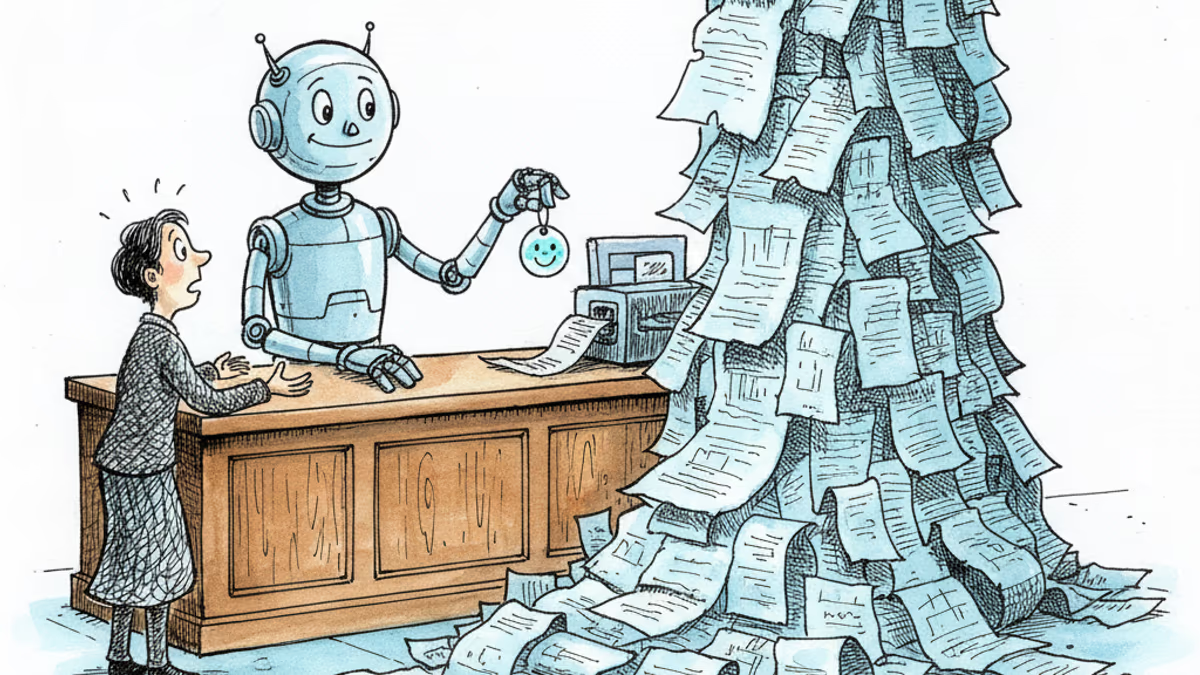
For developers, the real story here isn't the “$2” figure — it's that the new tokenizer charges roughly 30% more tokens for the same prompt. A per-token rate matching the last model doesn't mean your bill stays flat. The number that decides this isn't the vendor's rate card. It's the dollar total you get from running your own real prompts through both models.

The three-way race is half a mirage
State matters when you sketch the competitive map. Sonnet 5 is a real, generally available product you can use today. The two rivals it gets bracketed with are in a different position.
OpenAI's GPT-5.6 Sol landed June 26, but it's still in preview. Access is limited to roughly 20 organizations plus the U.S. government and a handful of partners; general availability is only teased. Its top tier is reported around $5 input, $30 output. Google's Gemini 3.5 Pro hasn't shipped at all. A June 29 report said only that it had cleared “approval for a July launch,” with pricing still unset. The Google model that's actually out is Gemini 3.5 Flash, released May 19. And the Google entry that keeps showing up in benchmark comparison tables often isn't the unshipped 3.5 Pro — it's the existing flagship, Gemini 3.1 Pro, which has been available for a while.
Put plainly: the “Sonnet 5 vs. GPT-5.6 vs. Gemini 3.5 Pro” three-way frame is half preview and vaporware. The mid-and-budget options a developer can actually put into production right now narrow down to Sonnet 5 and Gemini 3.5 Flash.
Cost collapse vs. the quiet increase
Two readings of this launch pull hard against each other.
One is the cost-collapse case. Once flagship-grade autonomous agent performance drops into the mid-tier, the cost of running agents falls structurally for enterprises and startups alike. The picture where companies deploy agents in bulk — rather than sparingly, as a scarce resource — starts to look real. The fact that Sonnet 5 is also offered on Google Cloud's enterprise platform reads as one more sign that adoption friction is coming down.
The other side raises three objections. First, the tokenizer inflation above means actual spend can rise even as the sticker price holds. Second, on public benchmarks, Sonnet 5's SWE-bench Pro score (63.2%) still trails the flagship Opus 4.8 (69.2%) by about six points — meaning the hardest jobs will keep pulling you back to the pricier top model. Third, margin pressure. China's homegrown coding-model ecosystem is shipping solutions compatible with Anthropic's API protocol at roughly one-seventh the cost, dragging the price floor down. The deeper the low-end competition runs, the more it squeezes the frontier labs' own profitability.
The performance-up, price-down supercycle
Sonnet 5's introductory cut looks less like a one-off promotion and more like a signal that the axis of the 2026 frontier race has shifted — from “capability” to “unit cost and reliability.” If autonomous agents keep dropping from flagship-only into the mid-tier within a single generation, the enterprise question stops being “can this model do it?” and becomes “what does it cost to finish the same job?”
Where the math splits by region
The calculator reads differently depending on where you're standing.
For Western enterprises, the pitch lands squarely on the procurement line. A large share of AI startups on both sides of the Atlantic build on GPT and Claude API calls rather than models of their own, so a mid-tier model's effective unit cost feeds straight into the P&L. In the EU and UK, there's an extra layer: data residency and the AI Act's transparency obligations mean the choice isn't purely about dollars per token — it's also about which vendor's deployment terms clear compliance. As more Opus-class-for-cheap models arrive, pressure builds on regional and sovereign LLM efforts — from Europe's Mistral to national-champion projects across Asia — to justify their own price and performance. So far none of those players has responded directly, so the industry impact stays in the forecast column.
In Greater China the axis is different altogether. Taiwan is a supported region, so developers there can use Sonnet 5 as a first-class option. Mainland China, given Anthropic's access restrictions, is a “launched but you might not be able to use it” model. Domestic substitutes — Alibaba's Qwen3-Coder, Zhipu's GLM, DeepSeek — are filling that gap fast. Here the story isn't a price war so much as a geopolitical one, running on access and localization.
What's still open
Sonnet 5 raised the floor for agent performance a notch. What it didn't close: the distance between the headline rate and the actual invoice, the pull back to the top model on the hardest tasks, and the pace at which domestic and open-source substitutes are gaining. Whether “Opus-class performance, budget price” is true in your particular setup is something you only learn by running your own prompts and reading the total. The price tag is a starting point, not the bill.
This content is AI-generated based on source articles. While we strive for accuracy, errors may occur. We recommend verifying with the original source.
Related Articles

A small but growing group of developers has gone all-in on AI coding agents like Claude Code and OpenClaw. History suggests the rest of us won't be far behind.

OpenAI's new Daybreak initiative uses the Codex AI agent to find and patch security vulnerabilities before attackers do—putting it in direct competition with Anthropic's secretive Claude Mythos.

Anthropic is closing what may be its final private fundraise at a $900B valuation, surpassing OpenAI. Investors have 48 hours to commit to the ~$50B round.

Anthropic's tightly restricted Mythos AI—designed to find security flaws—was accessed by Discord sleuths without a single line of exploit code. Meanwhile, North Korean hackers used AI to steal $12M in three months. The security paradox of 2026.
A small but growing group of developers has gone all-in on AI coding agents like Claude Code and OpenClaw. History suggests the rest of us won't be far behind.
OpenAI's new Daybreak initiative uses the Codex AI agent to find and patch security vulnerabilities before attackers do—putting it in direct competition with Anthropic's secretive Claude Mythos.
Anthropic is closing what may be its final private fundraise at a $900B valuation, surpassing OpenAI. Investors have 48 hours to commit to the ~$50B round.
Anthropic's tightly restricted Mythos AI—designed to find security flaws—was accessed by Discord sleuths without a single line of exploit code. Meanwhile, North Korean hackers used AI to steal $12M in three months. The security paradox of 2026.
Thoughts
Share your thoughts on this article
Sign in to join the conversation