
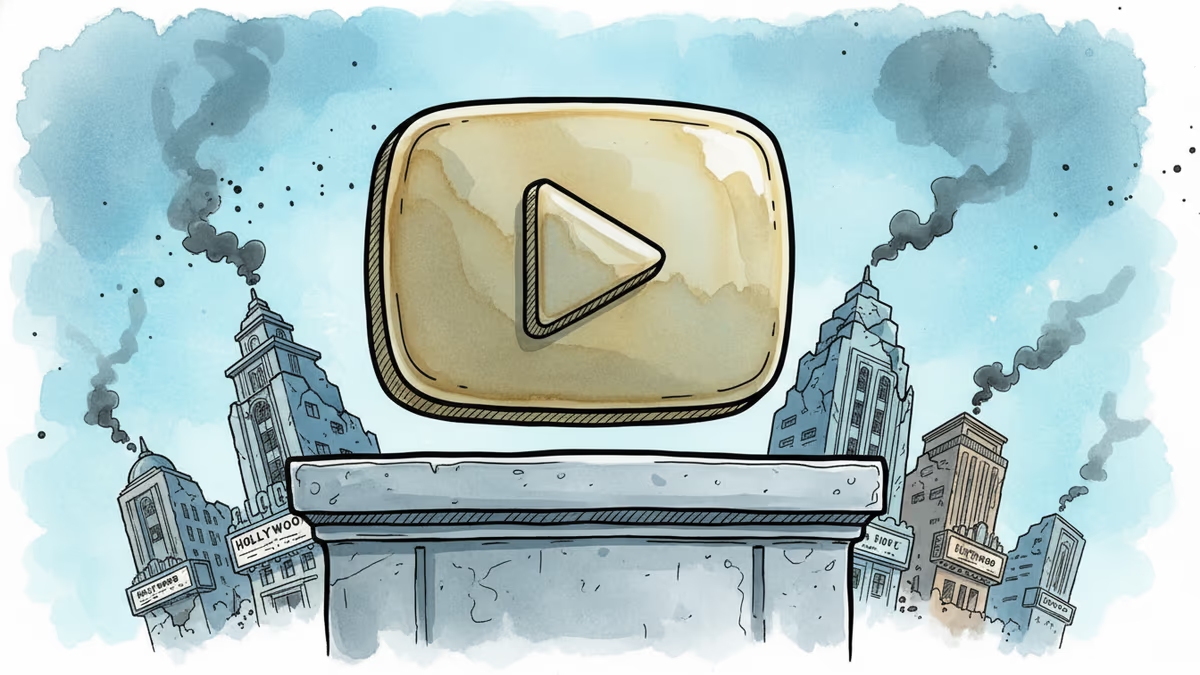
YouTube Just Out-Earned All of Hollywood. Now What?
YouTube's 2025 ad revenue hit $40.4B, surpassing Disney, NBC, Paramount, and Warner Bros. Discovery combined. What this means for advertisers, creators, and the future of media.
The Check Cleared. Hollywood Lost.
Forget the Oscars. The real verdict on who runs entertainment in 2025 came from a spreadsheet.
YouTube pulled in $40.4 billion in ad revenue last year. Disney, NBC Universal, Paramount, and Warner Bros. Discovery — combined — managed $37.8 billion. For the first time, a single platform built on cat videos, bedroom vlogs, and reaction content out-earned four of the most storied names in American media. The data comes from research firm Moffett Nathanson, as reported by The Hollywood Reporter, and it marks a turning point that's been quietly building for years.
Just twelve months earlier, the math looked different. In 2024, YouTube's $36.1 billion in ad revenue fell short of the studios' combined $41.8 billion. The gap closed — and then reversed — in a single year.
Why Advertisers Followed the Eyeballs
This isn't a story about YouTube doing something clever. It's a story about where people are spending their time.
Younger audiences — particularly Gen Z and Millennials — have largely abandoned linear TV. They're on YouTube. Advertisers, who are fundamentally in the business of buying attention, followed. The traditional studios, meanwhile, are caught in a costly squeeze: linear TV viewership is shrinking, production budgets keep climbing, and their own streaming platforms (Disney+, Peacock, Paramount+, Max) are expensive bets that haven't yet compensated for the losses elsewhere.
YouTube's structural advantage is harder to replicate than it looks. The platform doesn't produce its content — millions of creators do. That effectively externalizes production costs while keeping the ad inventory growing. No studio can match that economics.

Zoom out further and the numbers get even more striking. Alphabet reported YouTube's total 2025 revenue — ads plus subscriptions from YouTube TV, YouTube Premium, YouTube Music, and NFL Sunday Ticket — at $60 billion. That's comfortably ahead of Netflix's $45.2 billion for the same period. YouTube isn't just beating Hollywood at advertising. It's competing with the entire streaming industry on revenue.
That said, context matters. Meta generated $196.2 billion in ad revenue in 2025 — nearly five times YouTube's haul. In the broader digital advertising landscape, YouTube is a formidable player, not the dominant one.
Three Ways to Read This Shift
For advertisers, the calculus is straightforward: go where the audience is. YouTube's $11.4 billion Q4 alone signals that ad spend isn't a trend — it's a structural reallocation. Brands that still anchor their media buys around primetime slots are increasingly betting on a shrinking audience.
For the studios, the situation is more complicated than the headline suggests. Disney's total media revenue, including subscriptions, reached $60.9 billion in 2025 — comparable to YouTube's full revenue figure. The traditional players aren't collapsing; they're restructuring. But their leverage over advertisers is weakening, and that changes negotiating power in ways that compound over time.
For creators, this milestone is double-edged. YouTube's dominance means more ad dollars flowing through the platform — but the share that reaches individual creators remains a persistent tension. The platform sets the terms, controls the algorithm, and can change monetization rules unilaterally. A bigger pie doesn't automatically mean a bigger slice.
The AI Angle Nobody's Talking About Enough
This week, YouTube announced it's expanding its AI-powered likeness-detection technology — designed to identify deepfakes — to a pilot group of politicians, government officials, and journalists. Users can request removal of AI-generated content they believe violates platform policy.
The timing is deliberate. As YouTube's ad revenue and cultural footprint grow, so does regulatory scrutiny. Proactively deploying trust-and-safety tools serves two purposes: it addresses genuine harm, and it signals to lawmakers in Washington and Brussels that the platform can self-regulate. Whether that's sufficient — or whether it's a strategic delay of harder conversations about platform accountability — is an open question.
Authors
Related Articles
Google's Gmail Live lets you ask your inbox questions out loud. Announced at I/O 2026, it's AI's pitch to skeptics — and a reminder of how much Google already knows about you.

OpenAI has reorganized for the second time in a month, merging ChatGPT and Codex into a single agentic platform under president Greg Brockman's unified product leadership.
AI sustainability researcher Sasha Luccioni is launching a new venture to push for energy transparency in AI. Here's why Big Tech keeps the numbers hidden—and what's starting to change.

Emails revealed in the Musk v. Altman trial show Microsoft executives were deeply skeptical of OpenAI in 2017–2018. What actually changed their minds?
Google's Gmail Live lets you ask your inbox questions out loud. Announced at I/O 2026, it's AI's pitch to skeptics — and a reminder of how much Google already knows about you.
OpenAI has reorganized for the second time in a month, merging ChatGPT and Codex into a single agentic platform under president Greg Brockman's unified product leadership.
AI sustainability researcher Sasha Luccioni is launching a new venture to push for energy transparency in AI. Here's why Big Tech keeps the numbers hidden—and what's starting to change.
Emails revealed in the Musk v. Altman trial show Microsoft executives were deeply skeptical of OpenAI in 2017–2018. What actually changed their minds?
Thoughts
Share your thoughts on this article
Sign in to join the conversation