
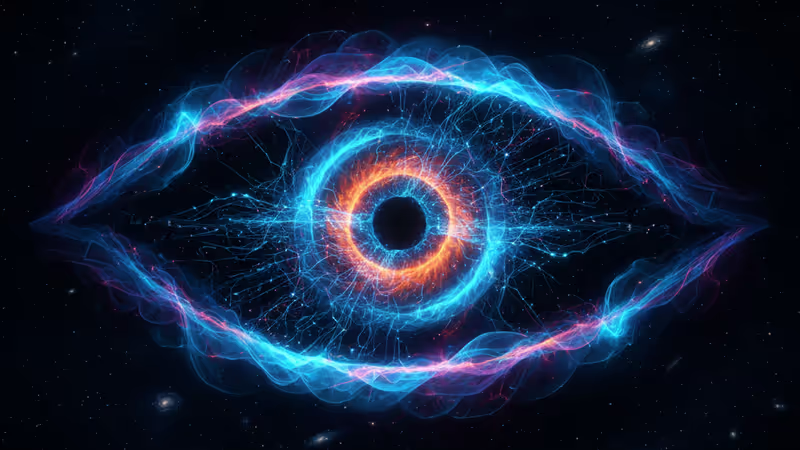
Watching from 655 Light-Years Away: The Helix Nebula Eye of Sauron
Explore the Helix Nebula, known as the 'Eye of Sauron,' located 655 light-years away. Learn how this planetary nebula offers a glimpse into the Sun's future.
Is the universe watching us? Located approximately 655 light-years from our Solar System, a massive cosmic structure glows like a giant iris. This is the Helix Nebula, famously known as the 'Eye of Sauron' for its uncanny resemblance to the fiery gaze from Middle-earth.
The Helix Nebula Eye of Sauron Mystery
Despite its confusing classification as a 'planetary nebula,' it doesn't involve planets. Instead, it's the spectacular death shroud of a star similar to our Sun. As these stars reach the end of their lives, they shed vast amounts of gas into space, creating an expanding shell that puts on a grand, albeit brief, show in cosmological time.

The Hubble Space Telescope has captured iconic images of this phenomenon over the decades. These photos reveal intricate layers of gas and dust, providing a vivid map of how matter is recycled in the galaxy.
A Glimpse into the Sun's Dramatic Future
By studying the Helix Nebula, astronomers aren't just looking at a distant object; they're looking at a mirror of our own future. In about 5 billion years, our Sun is expected to undergo a similar transformation, shedding its outer layers and leaving behind a beautiful, glowing remnant in the void.
Authors
Related Articles
The Vera C. Rubin Observatory's automated alert system went live, flooding astronomers with 800,000 alerts about asteroids, supernovas, and black holes on its first night. The age of astronomical big data has begun.

The first major astronomical event of 2026 unfolds March 3rd as a total lunar eclipse paints the moon red for just 12 minutes. Why this rare 'blood moon' matters more than you think.

As the Kuiper Belt comes into focus with next-generation telescopes, astronomers prepare to discover 10 times more objects than the 4,000 found over 30 years—and possibly solve the Planet X mystery.
Astronomers have achieved the first direct rogue planet mass measurement using gravitational microlensing. Learn how this Saturn-mass orphan was discovered.
The Vera C. Rubin Observatory's automated alert system went live, flooding astronomers with 800,000 alerts about asteroids, supernovas, and black holes on its first night. The age of astronomical big data has begun.
The first major astronomical event of 2026 unfolds March 3rd as a total lunar eclipse paints the moon red for just 12 minutes. Why this rare 'blood moon' matters more than you think.
As the Kuiper Belt comes into focus with next-generation telescopes, astronomers prepare to discover 10 times more objects than the 4,000 found over 30 years—and possibly solve the Planet X mystery.
Astronomers have achieved the first direct rogue planet mass measurement using gravitational microlensing. Learn how this Saturn-mass orphan was discovered.
Thoughts
Share your thoughts on this article
Sign in to join the conversation