
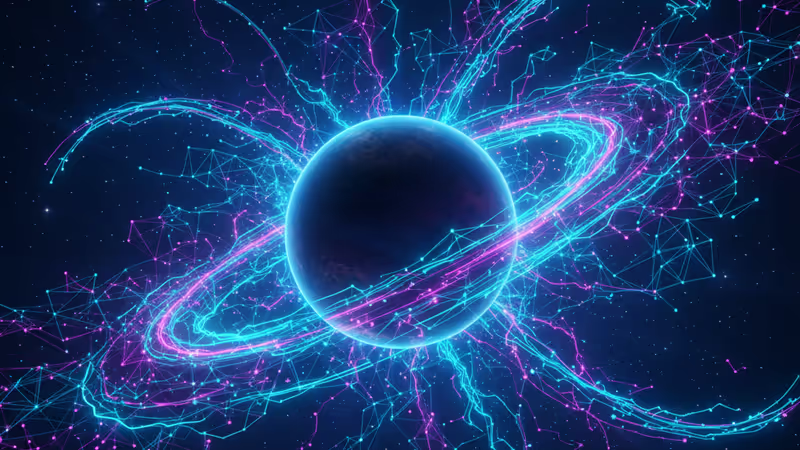
A Saturn-Mass Drifter: First Direct Rogue Planet Mass Measurement Confirmed
Astronomers have achieved the first direct rogue planet mass measurement using gravitational microlensing. Learn how this Saturn-mass orphan was discovered.
They're dark, lonely, and drifting through the abyss—and for the first time, we know exactly how heavy one is. According to Reuters, astronomers have confirmed the existence of a rogue planet through direct mass measurement, moving beyond the statistical guesswork that has dominated the field for a decade.
Rogue Planet Mass Measurement: Beyond Statistical Guesswork
The finding, published in the journal Science, identifies this cosmic orphan as being in the same weight class as Saturn. Researchers found the object is about 22 percent of Jupiter’s mass and lies roughly 9,800 light-years away from Earth. This discovery strengthens the case that our galaxy teems with castaway worlds that were once part of solar systems.
"For the first time, we have a direct measurement of a rogue planet candidate’s mass," said Subo Dong, a professor at Peking University who led the study. "We know for sure it's a planet." The data suggests that these planets form normally before being violently expelled from their home systems through gravitational encounters.

Gravitational Microlensing Meets Parallax
Detection of these rogues is notoriously difficult since they emit no light and orbit no stars. The team relied on gravitational microlensing, an event where a foreground object briefly magnifies the light of a distant star. During an event in May 2024, ground-based telescopes and the European Space Agency'sGaia spacecraft both observed the flicker.
Located 1 million miles from Earth, Gaia saw the peak of the event about two hours apart from ground observatories. This delay allowed scientists to use the principle of parallax—similar to human depth perception—to extract separate information about the planet's mass and distance. Because brown dwarfs (failed stars) are usually much heavier, the Saturn-like weight of this object confirms it was almost certainly born in a protoplanetary disk before being cast out.
Authors
Related Articles
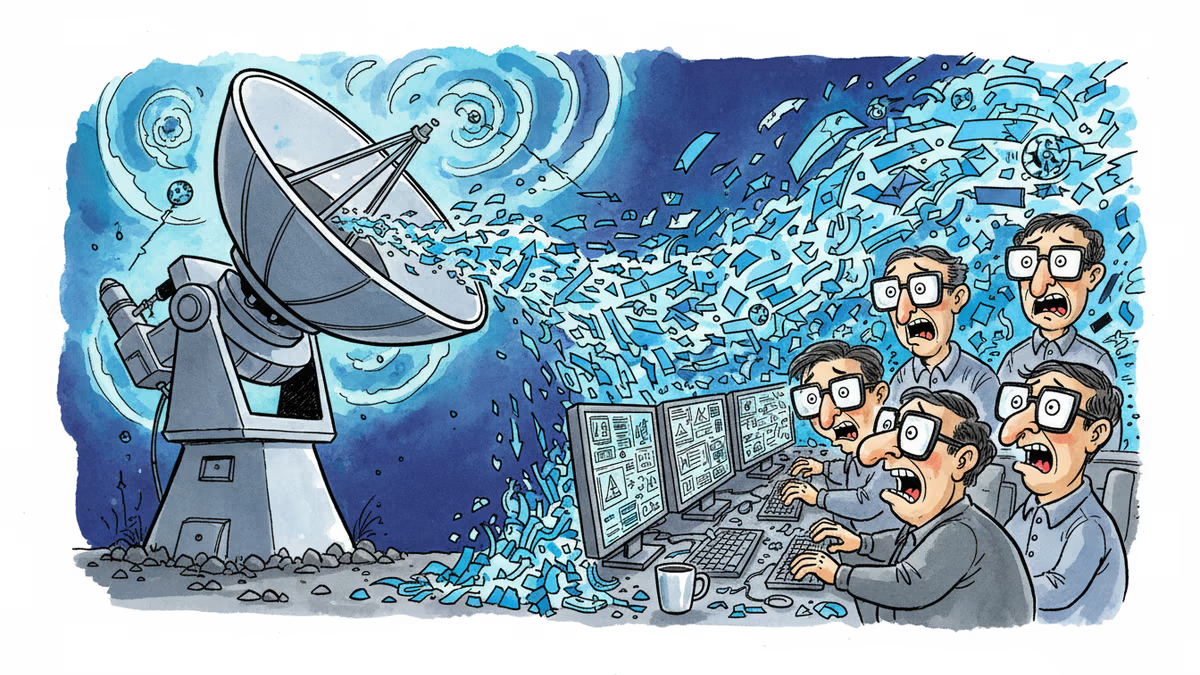
The Vera C. Rubin Observatory's automated alert system went live, flooding astronomers with 800,000 alerts about asteroids, supernovas, and black holes on its first night. The age of astronomical big data has begun.

The first major astronomical event of 2026 unfolds March 3rd as a total lunar eclipse paints the moon red for just 12 minutes. Why this rare 'blood moon' matters more than you think.
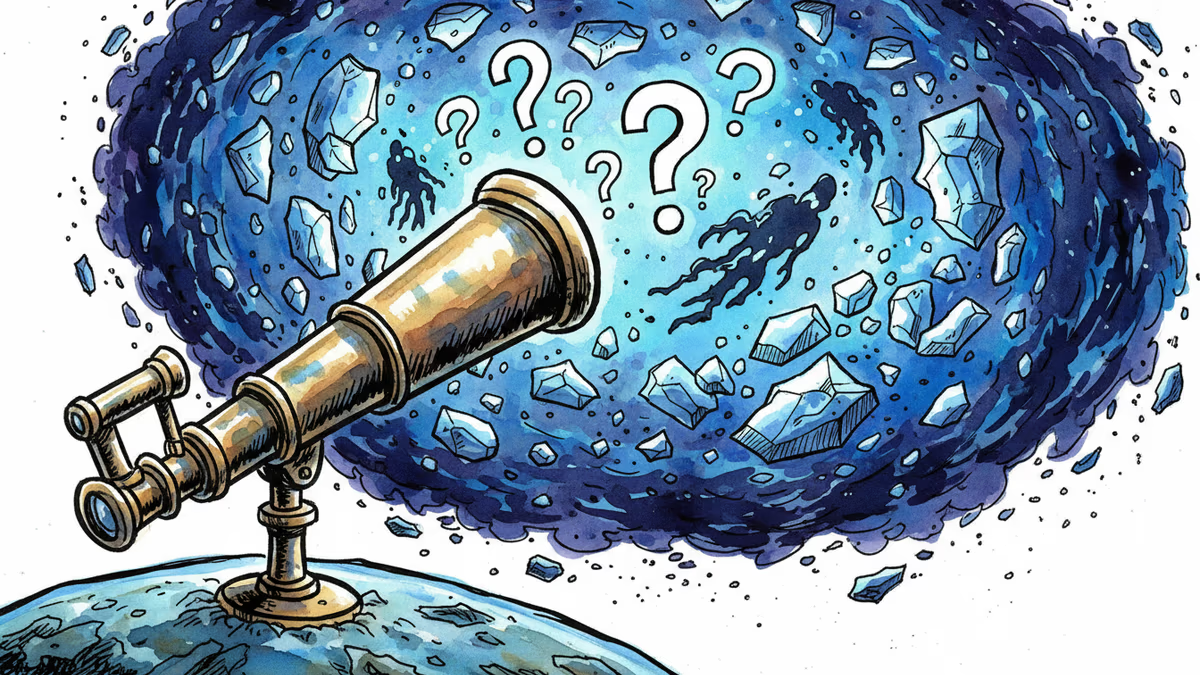
As the Kuiper Belt comes into focus with next-generation telescopes, astronomers prepare to discover 10 times more objects than the 4,000 found over 30 years—and possibly solve the Planet X mystery.

A new report in Science warns that AI swarms disinformation 2026 is becoming a reality, allowing one person to command thousands of AI agents to manipulate elections.
The Vera C. Rubin Observatory's automated alert system went live, flooding astronomers with 800,000 alerts about asteroids, supernovas, and black holes on its first night. The age of astronomical big data has begun.
The first major astronomical event of 2026 unfolds March 3rd as a total lunar eclipse paints the moon red for just 12 minutes. Why this rare 'blood moon' matters more than you think.
As the Kuiper Belt comes into focus with next-generation telescopes, astronomers prepare to discover 10 times more objects than the 4,000 found over 30 years—and possibly solve the Planet X mystery.
A new report in Science warns that AI swarms disinformation 2026 is becoming a reality, allowing one person to command thousands of AI agents to manipulate elections.
Thoughts
Share your thoughts on this article
Sign in to join the conversation