

The Solar System's Final Frontier May Hide More Than We Ever Imagined
As the Kuiper Belt comes into focus with next-generation telescopes, astronomers prepare to discover 10 times more objects than the 4,000 found over 30 years—and possibly solve the Planet X mystery.
40,000. That's how many Kuiper Belt objects astronomers expect to catalog in the coming decade. Compare that to the 4,000 we've found over the past 30 years, and you start to grasp the magnitude of what's about to unfold at the edge of our solar system.
The Kuiper Belt—a vast ring of frozen debris stretching from 30 to 50 times Earth's distance from the sun, possibly farther—is having its moment. What started as a theoretical concept in the 1950s and became observable reality in the 1990s is now poised to revolutionize our understanding of planetary formation, and maybe answer one of astronomy's most tantalizing questions: Is there a hidden planet lurking in the outer darkness?
The Cosmic Deep Freeze Gets a Close-Up
Think of the Kuiper Belt as the solar system's attic—a place where 4.6-billion-year-old leftovers from planetary formation have been stored in cosmic deep freeze. Unlike the inner solar system, where heat and gravitational chaos have erased most traces of our origins, the Kuiper Belt preserves the original recipe.
The Vera C. Rubin Observatory in Chile, which began operations last year, is about to change everything. Its Legacy Survey of Space and Time (LSST) will scan the southern sky nightly for a decade, capturing objects 100 times fainter than current surveys can detect. Meanwhile, the James Webb Space Telescope adds unprecedented infrared vision, revealing not just what's out there, but what it's made of.
"We're moving from the era of discovery to the era of characterization," explains one project scientist. "Instead of just finding objects, we're going to understand them."
The Planet X Puzzle Deepens
Here's where things get interesting. Since 2016, a growing body of evidence suggests something massive—perhaps 5 to 10 times Earth's mass—might be shepherding objects in the outer Kuiper Belt. The evidence? Eerily similar orbital alignments among distant objects that, statistically speaking, shouldn't exist by chance.

Some of the most distant Kuiper Belt objects have their elliptical orbits pointing in the same direction, as if an unseen gravitational force is corralling them. The odds of this happening randomly? About 1 in 15,000, according to Caltech researchers who first proposed Planet Nine.
Skeptics argue it could be observational bias—we tend to find objects where we're looking. Others suggest the clustering might result from the combined gravitational influence of multiple smaller objects rather than one large planet. The debate has raged for nearly a decade, but the flood of new data should settle it within the next few years.
Beyond Planet Hunting: What's Really at Stake
The implications stretch far beyond adding another planet to textbooks. Understanding the Kuiper Belt's structure could rewrite theories of how planetary systems form and evolve. If Planet X exists, it would represent a "failed" gas giant that got kicked to the outer reaches during the solar system's chaotic early years.
This matters for more than academic curiosity. As we discover thousands of exoplanets around other stars, we need to understand how common our solar system's architecture really is. Are we typical, with small rocky planets near the star and gas giants farther out? Or are we an oddball case with a hidden super-Earth in the suburbs?
The economic implications aren't trivial either. The technologies being developed for Kuiper Belt surveys—advanced imaging sensors, AI-powered object recognition, massive data processing systems—have applications from autonomous vehicles to medical imaging. The Rubin Observatory alone will generate 20 terabytes of data every night, pushing the boundaries of what's possible in real-time analysis.
The View from Here
There's something almost philosophical about humanity's obsession with the solar system's edge. We've mapped every continent, plumbed the ocean depths, and even landed on other worlds. Yet this frozen frontier, just a few light-hours away, remains largely mysterious.
Perhaps that's fitting. The Kuiper Belt represents both our cosmic past and our future as an exploring species. Its objects are time capsules from the solar system's birth, while its vastness reminds us how much we still don't know about our own neighborhood.
Authors
Related Articles

The Vera C. Rubin Observatory's automated alert system went live, flooding astronomers with 800,000 alerts about asteroids, supernovas, and black holes on its first night. The age of astronomical big data has begun.
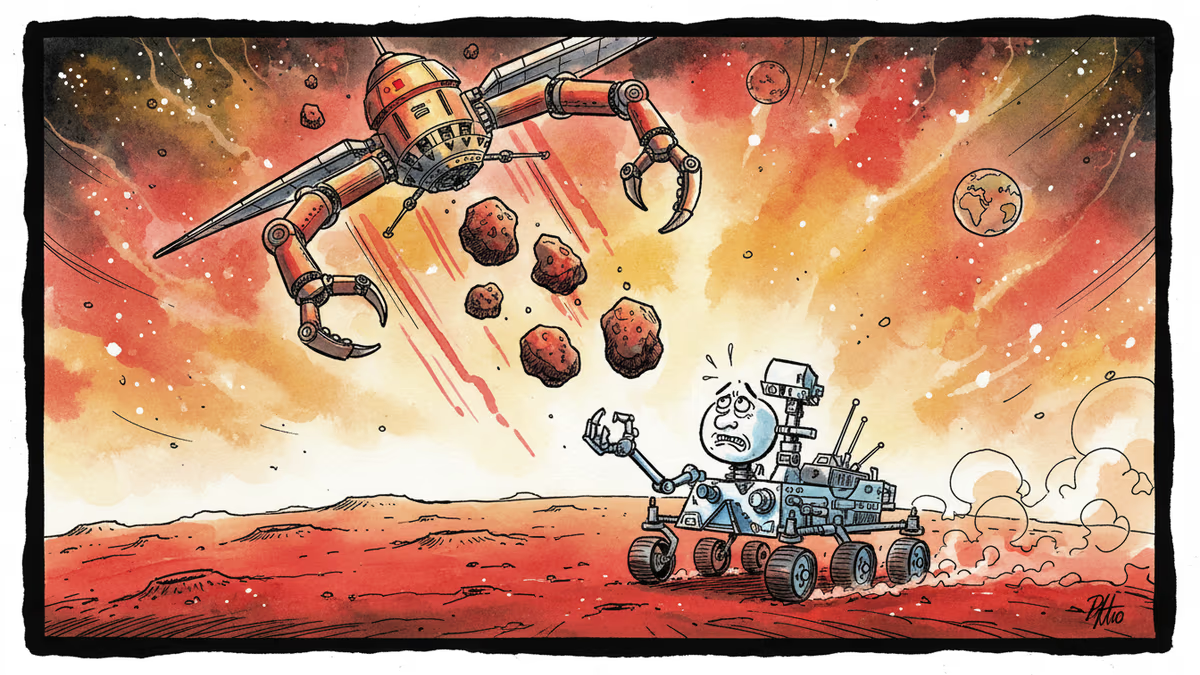
While the US abandons its Mars Sample Return mission after 50 years of preparation, China races toward bringing Martian rocks home by 2031. What went wrong with America's $11 billion bet?

The first major astronomical event of 2026 unfolds March 3rd as a total lunar eclipse paints the moon red for just 12 minutes. Why this rare 'blood moon' matters more than you think.
Explore the Helix Nebula, known as the 'Eye of Sauron,' located 655 light-years away. Learn how this planetary nebula offers a glimpse into the Sun's future.
The Vera C. Rubin Observatory's automated alert system went live, flooding astronomers with 800,000 alerts about asteroids, supernovas, and black holes on its first night. The age of astronomical big data has begun.
While the US abandons its Mars Sample Return mission after 50 years of preparation, China races toward bringing Martian rocks home by 2031. What went wrong with America's $11 billion bet?
The first major astronomical event of 2026 unfolds March 3rd as a total lunar eclipse paints the moon red for just 12 minutes. Why this rare 'blood moon' matters more than you think.
Explore the Helix Nebula, known as the 'Eye of Sauron,' located 655 light-years away. Learn how this planetary nebula offers a glimpse into the Sun's future.
Thoughts
Share your thoughts on this article
Sign in to join the conversation