
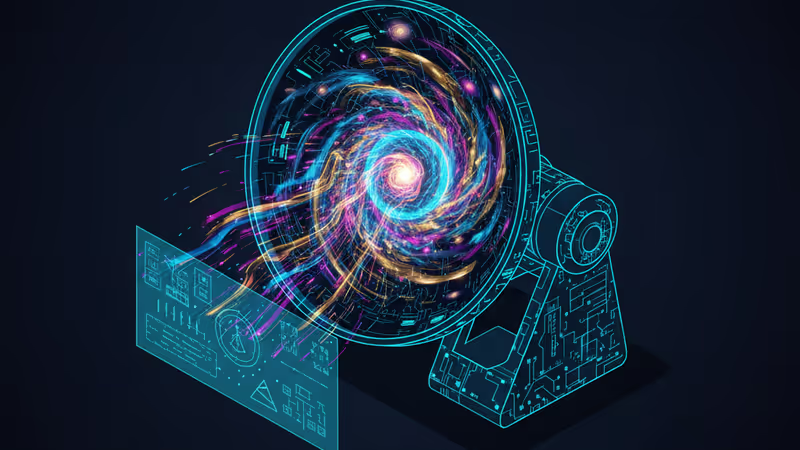
Beyond JWST: Why NASA’s Assembled Roman Telescope Is A Cosmic Data Engine, Not Just a Camera
NASA's Roman Telescope is assembled, but it's no JWST. Discover why its wide-angle view and big data approach will transform astronomy and AI.
The Lede
NASA has just bolted together its next great observatory, the Nancy Grace Roman Space Telescope. While the headlines focus on the engineering milestone, the real story isn't the hardware—it's the paradigm shift this represents. Roman isn't just another deep-space camera like Hubble or JWST; it's a high-speed, wide-angle data engine designed to map the universe at an unprecedented scale. For tech leaders, scientists, and investors, this marks the transition of astronomy into a true big data industry, where AI and data science will be as critical as the optics themselves.
Why It Matters
For three decades, our view of the cosmos has been shaped by the Hubble and James Webb space telescopes—instruments that operate like cosmic snipers, taking incredibly deep, narrow-focus images of specific targets. The Roman Telescope flips that script. With a field of view 100 times larger than Hubble's, it will operate like a satellite mapping the entire globe. In a single snapshot, Roman will capture an area of the sky larger than the full moon.
This isn't about capturing another single, stunning 'Pillars of Creation.' It's about creating a statistical foundation for cosmology. Its prime directives are to hunt for two of the universe's most profound mysteries:
- Dark Energy: By surveying billions of galaxies, Roman will measure how the universe's expansion is accelerating, providing the most precise data yet on the mysterious force driving it.
- Exoplanets: Using a technique called gravitational microlensing, Roman will conduct a galactic census, detecting thousands of new exoplanets, including potentially rocky worlds in orbits similar to Earth's. This method is sensitive to planets that other techniques miss.
The Analysis
From Portrait Mode to Panoramic View

Think of Hubble and JWST as the world's greatest portrait photographers, capturing breathtaking detail of a single subject. Roman, in contrast, is a landscape photographer, capturing the entire scene in one epic shot. This shift from 'deep' to 'wide' is a fundamental change in strategy. While JWST can study the atmosphere of a single known exoplanet in exquisite detail, Roman will find thousands of new ones, creating a statistical map of planetary systems across our galaxy. It provides the context—the 'where to look next'—for its more focused cousins.
The Coming Data Deluge: An AI Challenge
The true disruption of the Roman mission lies in its data output. It is projected to generate over 20 petabytes of data over its five-year primary mission—an order of magnitude more than Hubble has produced in its entire 30+ year lifetime. This isn't a challenge that can be solved by adding more graduate students. The sheer volume and complexity of Roman's datasets will necessitate a heavy reliance on artificial intelligence and machine learning to find the faint signals of distant supernovae or the subtle brightening of a star caused by a planet passing in front of it. The discoveries will be made by algorithms as much as by human eyes. This positions the mission as a major driver for innovation in scientific data analysis, with implications for cloud computing and AI development.
PRISM Insight
Investment and Industry Impact
The Roman mission signals the 'industrialization' of cosmic discovery. Its success hinges on a robust data pipeline, creating opportunities for tech companies specializing in cloud storage, AI-driven analytics, and large-scale data processing. The astronomical community will require new tools and platforms to handle this firehose of information, moving beyond traditional analysis methods. For investors, the downstream applications of the AI tools developed for Roman could be significant, finding use in other data-intensive fields like genomics, climate modeling, and financial analysis.
The Future of Exploration
This telescope represents a mature phase in space exploration. The early phase was about seeing what's out there (Hubble). The current phase is about deep analysis of specific targets (JWST). The next phase, led by Roman, is about systematic, large-scale surveying to test fundamental models of the universe. It's less about serendipitous 'wow' moments and more about building the massive, statistically robust datasets needed to answer foundational questions about our cosmic origins and destiny.
PRISM's Take
The completion of the Nancy Grace Roman Space Telescope assembly is more than an engineering victory for NASA; it's the dawn of a new astronomical era. We are moving from artisanal cosmic photography to an industrial-scale mapping of the heavens. Roman's legacy won't be a single iconic photo, but rather a colossal digital archive of the universe that will fuel scientific discovery for decades. It solidifies the fact that the future of understanding the cosmos lies in the intersection of brilliant optics and powerful code, making the astronomer of tomorrow as much a data scientist as an observer of the stars.
Authors
Related Articles
NASA's Artemis III has been redesigned as an Earth-orbit mission. SpaceX and Blue Origin say their landers won't be ready until late 2027. What does this mean for the future of lunar exploration?

Artemis II splashed down successfully in the Pacific, marking humanity's first crewed deep space mission in over 50 years. But the harder question isn't whether we can go back — it's why we should.

NASA's Orion capsule splashed down safely after humanity's first crewed lunar voyage in 54 years. The mission succeeded. Now the harder questions begin.

Artemis II's four astronauts are returning to Earth Friday night. The splashdown off Southern California isn't the anticlimax it sounds—it's the most technically perilous moment of the entire lunar journey.
NASA's Artemis III has been redesigned as an Earth-orbit mission. SpaceX and Blue Origin say their landers won't be ready until late 2027. What does this mean for the future of lunar exploration?
Artemis II splashed down successfully in the Pacific, marking humanity's first crewed deep space mission in over 50 years. But the harder question isn't whether we can go back — it's why we should.
NASA's Orion capsule splashed down safely after humanity's first crewed lunar voyage in 54 years. The mission succeeded. Now the harder questions begin.
Artemis II's four astronauts are returning to Earth Friday night. The splashdown off Southern California isn't the anticlimax it sounds—it's the most technically perilous moment of the entire lunar journey.
Thoughts
Share your thoughts on this article
Sign in to join the conversation