
The Most Dangerous 8 Minutes of the Entire Moon Mission
Artemis II's four astronauts are returning to Earth Friday night. The splashdown off Southern California isn't the anticlimax it sounds—it's the most technically perilous moment of the entire lunar journey.
The hardest part of going to the Moon isn't getting there. It's the last eight minutes coming home.
Falling at 25,000 Miles Per Hour
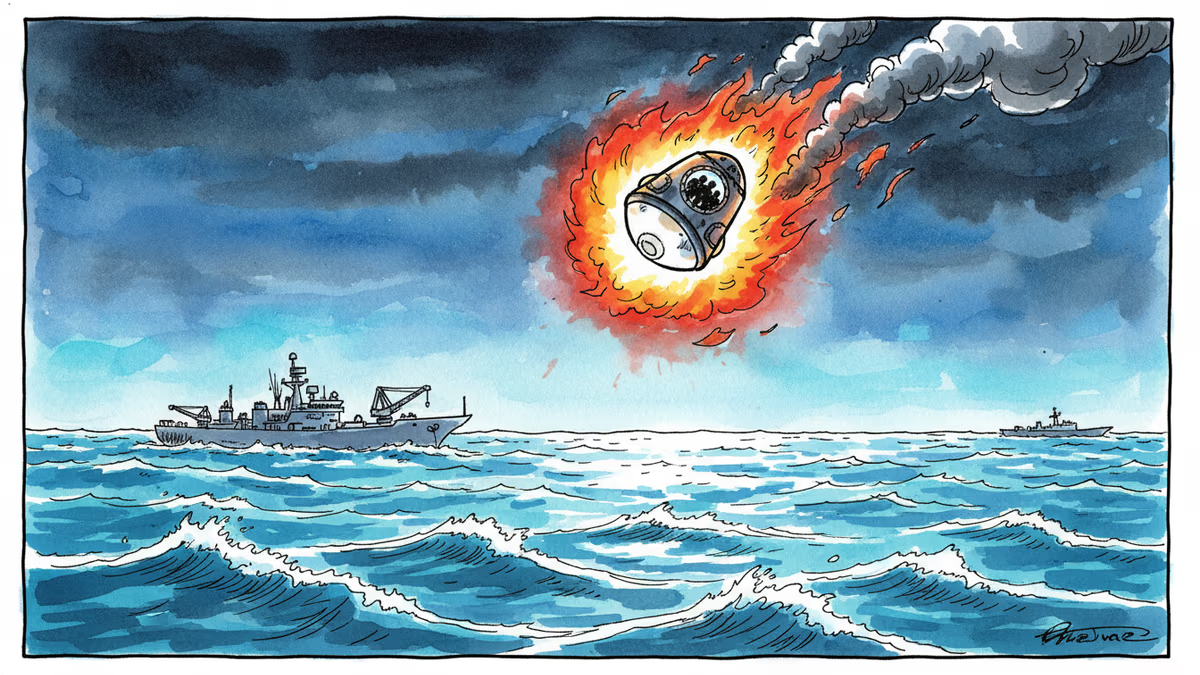
At 8:07 pm ET on Friday (00:07 UTC Saturday), the Orion capsule carrying four astronauts will slam into Earth's atmosphere a few hundred miles off the Southern California coast. NASA engineers have reviewed the latest imagery and say the spacecraft looks fine. But here's the thing: it doesn't matter anymore. The trajectory is locked. Gravity has already made the decision. They're coming home one way or another.
That's not a figure of speech. The physics of orbital mechanics means that once Orion commits to its return path, there is no meaningful course correction available. The crew is, in the most literal sense, along for the ride.
What makes that ride so consequential: the capsule will hit the upper atmosphere at roughly 25,000 mph (40,000 km/h). Friction will push the heat shield's surface temperature to approximately 5,000°F (2,760°C)—about half the temperature of the Sun's surface. For roughly eight minutes, ground controllers will lose all radio contact as superheated plasma surrounds the capsule. Then parachutes deploy. Then splashdown. Then it's over.
This is the most critical phase of the entire mission. Not the launch. Not the lunar flyby. This.
Why This Particular Splashdown Matters More Than Most
Artemis II is the first crewed mission to travel to lunar distance since Apollo 17 in 1972—52 years ago. The mission's primary goal was never to land on the Moon; it was to prove that Orion and the Space Launch System can carry humans safely around the Moon and bring them back alive.
That proof hinges entirely on what happens Friday night.

The stakes are higher than they might appear. During the uncrewed Artemis I mission in 2022, engineers discovered the heat shield had ablated—burned away—more than expected in certain areas. NASA spent over a year analyzing the data, made design and procedural adjustments, and cleared Artemis II for flight. But this is the first time those fixes will be tested with human lives on board. Every sensor reading from reentry will feed directly into the design of Artemis III, currently targeting a crewed lunar landing at the Moon's south pole in 2027.
If the heat shield data comes back clean, Artemis III stays on track. If it doesn't, the entire program timeline shifts—again.
The Stakeholders Watching Most Closely
For NASA, a clean splashdown is existential in a bureaucratic sense. The agency is already navigating significant budget pressure, with the current administration scrutinizing large government programs. A successful Artemis II keeps the political coalition behind lunar exploration intact.
SpaceX is watching for different reasons. The company's Starship is contracted to serve as the Human Landing System for Artemis III—the vehicle that will actually touch down on the Moon. Starship's own development timeline has been turbulent, with multiple test flights and regulatory delays. A smooth Artemis II return keeps pressure on SpaceX to deliver Starship on schedule rather than giving NASA a reason to slow down.
For the four astronauts themselves—Commander Reid Wiseman, Pilot Victor Glover, Mission Specialist Christina Koch, and Canadian Space Agency astronaut Jeremy Hansen—Friday night is the culmination of years of training for a mission that was delayed multiple times. They've spent roughly 10 days in space. In eight minutes, it ends.
And for the broader commercial space sector, every successful Artemis milestone makes the economic case for lunar infrastructure—fuel depots, communication relays, eventually surface habitats—slightly more credible to investors.
What Comes After the Splash
Assuming a nominal splashdown, recovery crews aboard naval vessels will retrieve the capsule and crew within roughly an hour. The astronauts will undergo medical evaluations, and Orion will eventually be transported for detailed inspection.
The real work then begins quietly in engineering labs. Heat shield samples will be analyzed under microscopes. Structural data will be compared against models. That analysis—not the splashdown itself—will determine whether humanity returns to the Moon's surface in 2027 or sometime further down the road.
The Artemis program was conceived as a return, but it's increasingly becoming something else: a test of whether the institutional, commercial, and political infrastructure needed for sustained human presence beyond Earth actually exists. The technology, it turns out, may be the easier part.
Authors
Related Articles
NASA's Artemis III has been redesigned as an Earth-orbit mission. SpaceX and Blue Origin say their landers won't be ready until late 2027. What does this mean for the future of lunar exploration?

Flying to Mars means navigating without trees, wind, or GPS. Here's the surprisingly elegant physics behind how spacecraft measure their own velocity in the void.
Artemis II splashed down successfully in the Pacific, marking humanity's first crewed deep space mission in over 50 years. But the harder question isn't whether we can go back — it's why we should.
NASA's Orion capsule splashed down safely after humanity's first crewed lunar voyage in 54 years. The mission succeeded. Now the harder questions begin.
NASA's Artemis III has been redesigned as an Earth-orbit mission. SpaceX and Blue Origin say their landers won't be ready until late 2027. What does this mean for the future of lunar exploration?
Flying to Mars means navigating without trees, wind, or GPS. Here's the surprisingly elegant physics behind how spacecraft measure their own velocity in the void.
Artemis II splashed down successfully in the Pacific, marking humanity's first crewed deep space mission in over 50 years. But the harder question isn't whether we can go back — it's why we should.
NASA's Orion capsule splashed down safely after humanity's first crewed lunar voyage in 54 years. The mission succeeded. Now the harder questions begin.
Thoughts
Share your thoughts on this article
Sign in to join the conversation