
No GPS, No Air, No Problem: How Spacecraft Know How Fast They're Going
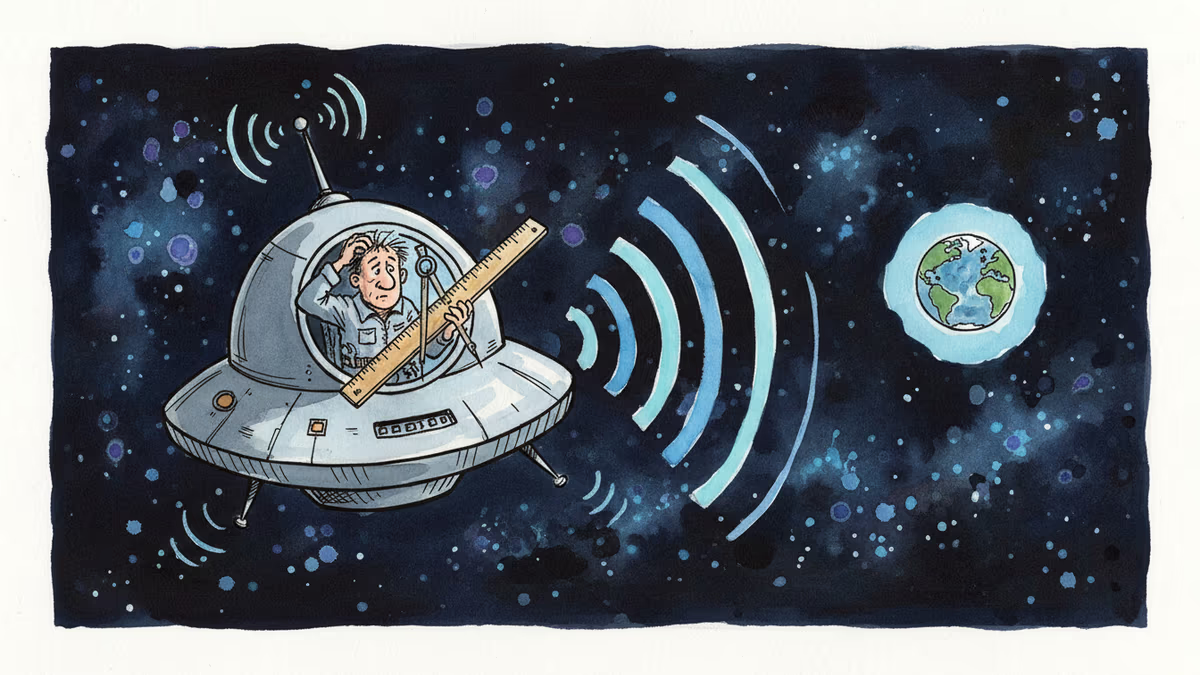
Flying to Mars means navigating without trees, wind, or GPS. Here's the surprisingly elegant physics behind how spacecraft measure their own velocity in the void.
You're hurtling through deep space at tens of thousands of kilometers per hour. There are no trees blurring past the window, no air rushing over the wings, no GPS satellites pinging your position. And yet, if you're off by even a fraction of a percent, you'll miss Mars entirely — sailing past a planet the size of half the Earth into an endless void. So how does a spacecraft know how fast it's going?
The answer involves some of the most elegant physics humans have ever put to practical use.
Speed Is Easy. Velocity in Space Is Not.
On the ground, measuring speed is almost trivially simple. Your car's speedometer counts tire rotations. A plane measures how fast air moves over its wings. With GPS, you just divide distance by time. In space, none of these work. No tires, no atmosphere, no satellites.
Before getting into the solutions, it's worth pausing on a distinction that matters enormously once you leave Earth: speed versus velocity. Speed is just a magnitude — how fast. Velocity is speed plus direction. A bumblebee flying at a constant 10 mph has a constantly changing velocity because it keeps turning. For a spacecraft threading the needle of interplanetary orbital mechanics, direction is everything. You need vectors, not just numbers.
There's a deeper complication: in space, there is no fixed reference point. Anywhere. The universe has no "stationary." Everything is moving relative to everything else. NASA's Artemis IV mission, scheduled to land on the lunar surface in 2028, illustrates this perfectly. A lander could have a positive velocity relative to Earth and simultaneously be stationary relative to the Moon. For landing maneuvers, only the Moon's reference frame matters. Using the wrong one isn't just an academic error — it's a crash.
Two Ways to Know Where You Stand (When You're Moving)
Method One: The Doppler Trick
Stand near a railroad track. As a train approaches, the pitch of its horn rises; as it passes and recedes, the pitch drops. The sound waves compress as the source moves toward you, and stretch as it moves away. This is the Doppler effect, and it works just as well with radio waves as it does with sound.

Here's how mission controllers use it: NASA's Deep Space Network — three clusters of giant dish antennas in California, Spain, and Australia — beams a radio signal at a spacecraft. The signal bounces back. If the returning signal has a slightly higher frequency than what was sent, the spacecraft is moving toward Earth. Lower frequency means it's moving away.
The math is precise enough that a shift from 100 MHz to 100.001 MHz reveals a closing speed of 1,000 meters per second. That's measuring a frequency difference of one part in 100,000 — reliably, across hundreds of millions of kilometers.
But this method has two real limitations. First, it only captures motion directly toward or away from the observer. A spacecraft moving perpendicular to Earth's line of sight produces no Doppler shift at all. The fix: use multiple ground stations. A spacecraft can't be moving sideways relative to all of them simultaneously.
The second limitation is more fundamental: it requires line of sight. When Orion passed behind the Moon on April 6th, radio contact with Earth cut out completely. For those hours, mission control was blind. The spacecraft was on its own.
Method Two: Feel Your Way Through
Close your eyes in a moving car. You can still feel acceleration — the push into your seat when it speeds up, the lurch forward when it brakes, the lean into a curve. Those sensations are data. If you know your starting speed and you carefully track every acceleration since then, you can calculate your current velocity without ever looking out the window.
Spacecraft use exactly this principle with Inertial Measurement Units (IMUs) — devices that measure acceleration along every axis. Since acceleration is the rate of change of velocity, integrating those measurements over time gives you velocity. No external signal required. No line of sight needed. The spacecraft computes its own motion from the inside.
The catch: measurement errors accumulate. A tiny sensor drift, repeated over months of deep-space travel, compounds into a meaningful positional error. That's why real missions use both methods together — Doppler tracking from the ground cross-checks the IMU's internal calculations, and the two systems correct each other continuously.
Why the Margin for Error Is Essentially Zero
Mars ranges from 55 million to 400 million kilometers from Earth depending on where both planets are in their orbits. A velocity error of just 0.01% over a months-long transit can translate to a miss of thousands of kilometers. Mars's diameter is 6,779 kilometers. Miss by more than that and you don't just fail to land — you lose the spacecraft.
This is why NASA's Deep Space Network operates around the clock, and why its three sites are spaced roughly 120 degrees apart around the globe. As Earth rotates, one station hands off to the next, maintaining near-continuous contact with spacecraft across the solar system. The infrastructure is as much about redundancy as it is about reach.
For future crewed missions — to Mars, to asteroids, eventually perhaps beyond — the challenge only grows. At greater distances, signal round-trip times lengthen from seconds to tens of minutes, making real-time ground correction increasingly impractical. Spacecraft will need to navigate more autonomously, relying more heavily on their own inertial systems and onboard computation.
Authors
Related Articles

NASA's Artemis III has been redesigned as an Earth-orbit mission. SpaceX and Blue Origin say their landers won't be ready until late 2027. What does this mean for the future of lunar exploration?

Artemis II splashed down successfully in the Pacific, marking humanity's first crewed deep space mission in over 50 years. But the harder question isn't whether we can go back — it's why we should.

NASA's Orion capsule splashed down safely after humanity's first crewed lunar voyage in 54 years. The mission succeeded. Now the harder questions begin.
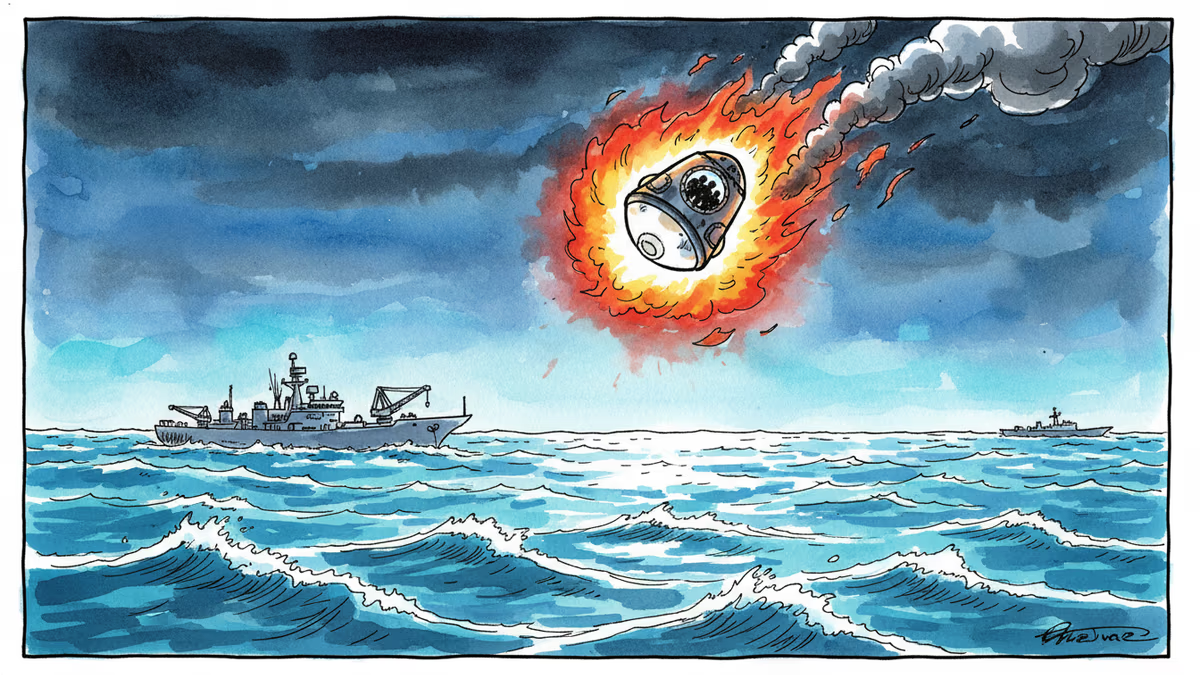
Artemis II's four astronauts are returning to Earth Friday night. The splashdown off Southern California isn't the anticlimax it sounds—it's the most technically perilous moment of the entire lunar journey.
NASA's Artemis III has been redesigned as an Earth-orbit mission. SpaceX and Blue Origin say their landers won't be ready until late 2027. What does this mean for the future of lunar exploration?
Artemis II splashed down successfully in the Pacific, marking humanity's first crewed deep space mission in over 50 years. But the harder question isn't whether we can go back — it's why we should.
NASA's Orion capsule splashed down safely after humanity's first crewed lunar voyage in 54 years. The mission succeeded. Now the harder questions begin.
Artemis II's four astronauts are returning to Earth Friday night. The splashdown off Southern California isn't the anticlimax it sounds—it's the most technically perilous moment of the entire lunar journey.
Thoughts
Share your thoughts on this article
Sign in to join the conversation