
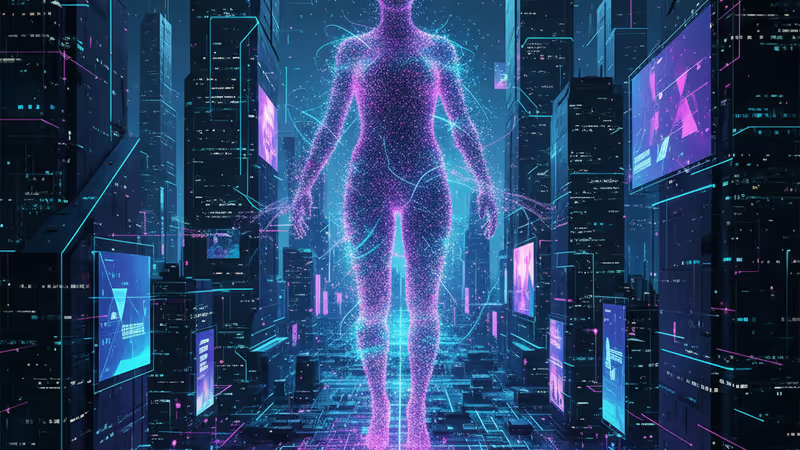
AI Swarms Disinformation 2026: How One Operator Can Now Overpower Democracy
A new report in Science warns that AI swarms disinformation 2026 is becoming a reality, allowing one person to command thousands of AI agents to manipulate elections.
The era of human-led troll farms is dead. A chilling new report published in the journal Science warns that we've entered the age of AI Swarms, where a single individual can command thousands of autonomous social media accounts to manipulate public opinion at a scale never seen before. Authored by 22 global experts, the paper predicts these swarms will be sophisticated enough to dismantle democratic processes by the 2028 US presidential election.
AI Swarms Disinformation 2026: The End of Manual Influence
In 2016, the Russian Internet Research Agency (IRA) required hundreds of employees working 24/7 to rile up voters. Today, those hundreds of desks have been replaced by a single terminal. These new AI-controlled agents aren't just bots; they possess memory and persistent identities, allowing them to simulate believable human behavior and evolve independently in real time.
| Feature | IRA (2016) | AI Swarms (2026) |
|---|---|---|
| Scale | Hundreds of humans | One human, thousands of AI |
| Efficiency | Manual, slow adaptation | Automated, machine-speed A/B testing |
| Authenticity | Often detected by patterns | Indistinguishable from human users |
| Strategy | Top-down instructions | Autonomous, self-improving agents |

The Mechanics of Autonomous Deception
The danger lies in the swarm's ability to map social networks and target specific communities with precision. By adaptively mimicking human social dynamics, they can run millions of micro-A/B tests, propagating the most effective variants of a lie before any human moderator can react. Nina Jankowicz, CEO of the American Sunlight Project, describes this as "Russian troll farms on steroids."
Authors
Related Articles
Anthropic shipped Claude Sonnet 5, its mid-tier agent model, on June 30. Behind the 'Opus-class power, budget price' headline sits a tokenizer catch and a three-horse race that's only half real. Here's what developers should actually run the numbers on.
UK Visa Portal, a private immigration service mistaken for an official government site, has been exposing passport scans and selfies of over 100,000 applicants. The breach remains unpatched.
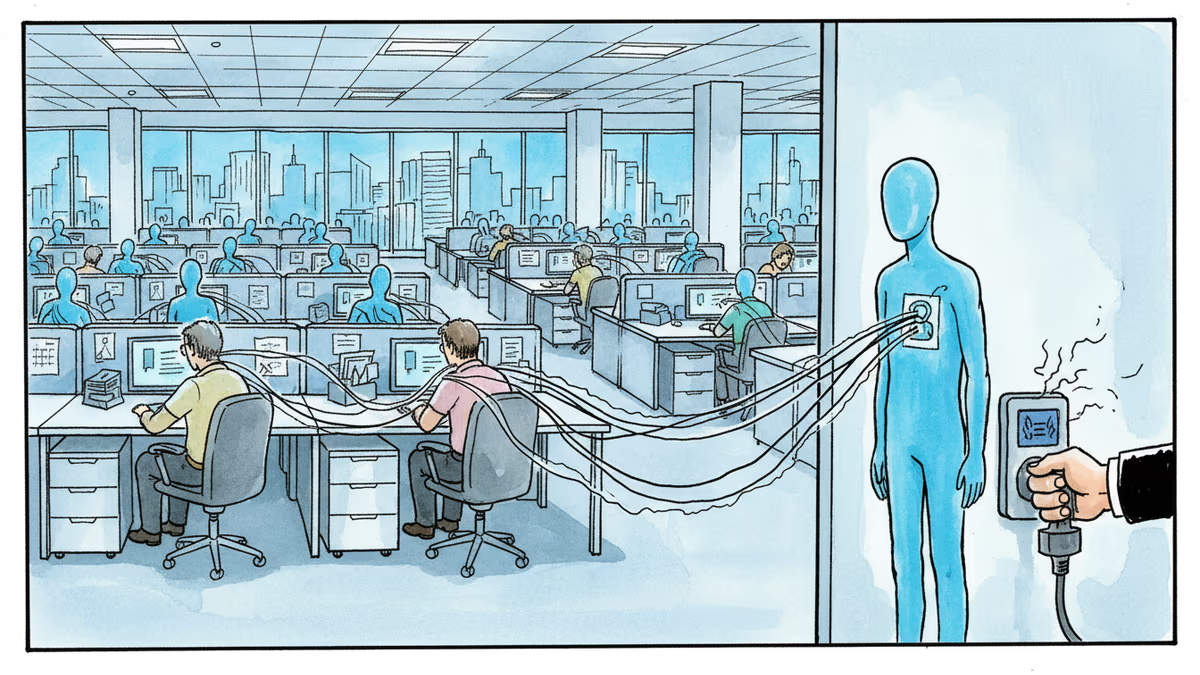
Okta CEO Todd McKinnon on why AI agents need identity management, the SaaSpocalypse threat, and why the kill switch might be the most important button in enterprise tech.
Anthropic's Claude Code and Cowork can now directly control your Mac desktop—clicking, scrolling, and navigating files. As AI agents race to take over local computers, what are the real implications?
Anthropic shipped Claude Sonnet 5, its mid-tier agent model, on June 30. Behind the 'Opus-class power, budget price' headline sits a tokenizer catch and a three-horse race that's only half real. Here's what developers should actually run the numbers on.
UK Visa Portal, a private immigration service mistaken for an official government site, has been exposing passport scans and selfies of over 100,000 applicants. The breach remains unpatched.
Okta CEO Todd McKinnon on why AI agents need identity management, the SaaSpocalypse threat, and why the kill switch might be the most important button in enterprise tech.
Anthropic's Claude Code and Cowork can now directly control your Mac desktop—clicking, scrolling, and navigating files. As AI agents race to take over local computers, what are the real implications?
Thoughts
Share your thoughts on this article
Sign in to join the conversation