
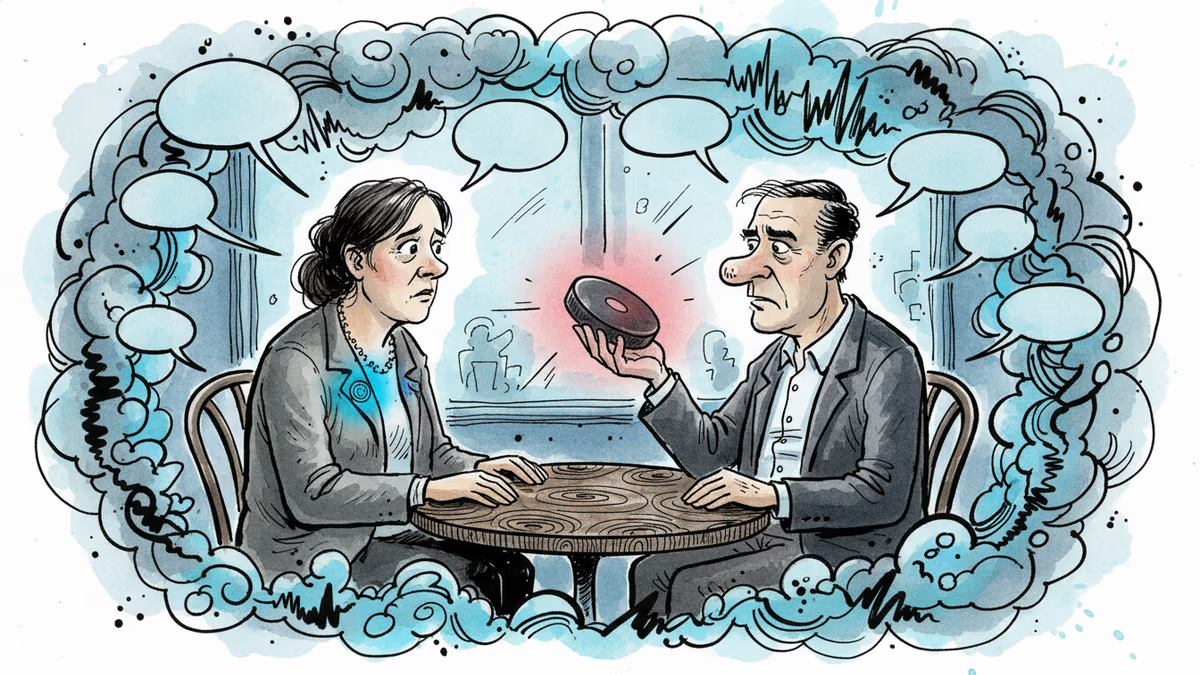
The New Arms Race Happening in Your Pocket
AI wearables that silently record conversations are coming. A look at the escalating battle between surveillance tech and the countermeasures trying to stop it—and why the mouse usually loses.
Before meeting his Mafia boss in 2003, Anthony Arillotta had to surrender his phone, strip naked in a bathroom, and put on a bathrobe. Until recently, that level of paranoia about being recorded was reserved for spies and criminals. That window may be closing.
The Ears You Can't See
A quiet shift is underway in personal technology. AI-enabled wearables—lapel pins, pendants, glasses—can already record ambient conversation, transcribe it, and analyze it in real time. They're marketed as silent note-takers, personal assistants, even quasi-therapists. Apple is rumored to be developing an AI pin or pendant designed to serve as the constant eyes and ears of an iPhone. Other companies are racing to the same finish line. The scenario where someone across the bar is wearing a device that's logging your conversation is no longer science fiction.
In March 2026, a startup called Deveillance announced Spectre I, a hockey-puck-shaped device designed to prevent nearby microphones from capturing your voice. Its founder, Aida Baradari, a recent college graduate, said she built it out of genuine alarm at how quickly AI recorders were proliferating. The device joins a lineage of audio jammers stretching back decades—early versions blasted white noise, later ones emitted ultrasonic frequencies that exploited a quirk in microphone hardware. In 2020, a University of Chicago team led by Yuxin Chen mounted 23 ultrasonic transducers on a single bracelet to jam in all directions at once.
The problem is that the technology being jammed has gotten smarter.
The Algorithm That Listens Through the Noise
DeLiang Wang, a computer scientist at Ohio State, has spent decades teaching neural networks to do what the human brain does effortlessly at a crowded party: isolate one voice from a wall of competing sound. Originally developed for hearing aids, his models learn the frequencies and rhythms of speech so well that they can now infer missing syllables the way a reader fills in a redacted word from context. Microsoft has been running an annual Deep Noise Suppression Challenge since 2020, pouring resources into the same problem for Teams calls and teleconferencing. Every advance in de-noising is, by definition, also an advance in recovering speech from a jammed recording.

The countermeasures are evolving too. In 2023, a team led by Ming Gao at Nanjing University developed MicFrozen, a jammer that doesn't just emit generic ultrasonic noise. It listens to the speaker in real time and generates a customized stream of "anti-speech" tuned specifically to that person's voice—the same principle as noise-canceling headphones, but applied to human conversation. Baradari says Spectre I uses a similar approach, with signals that mimic the shape of speech rather than brute-force noise.
Finn Brunton, a historian at UC Davis and co-author of Obfuscation: A User's Guide for Privacy and Protest, points to a third strategy: don't block the data, flood it with fakes. Artist Adam Harvey designed makeup and clothing to defeat facial-recognition algorithms. A browser plug-in called TrackMeNot hides real Google searches inside a continuous stream of randomized decoy queries. Defense attorneys once played "babble tapes"—40 layered tracks of voices in different accents—to obscure jailhouse conversations they feared were being recorded.
Why the Mouse Usually Loses
None of these countermeasures come with guarantees. Woodrow Hartzog, a law professor at Boston University who studies privacy and surveillance, puts it plainly: "The thing about cat-and-mouse games is that we know how they usually end up for the mouse. And in this case, the cat includes some of the most powerful corporations to ever exist."
The resource asymmetry is stark. The speech-processing industry—fed by investment in smart speakers, hearing aids, teleconferencing, and AI assistants—generates billions of dollars annually. The privacy countermeasure space is populated by a handful of academics and small startups. Spectre I's launch video claims the device will eventually detect nearby microphones; when pressed, Baradari acknowledged her team is "still working on that part."
The trajectory of AI wearables points toward capabilities that no jammer can address. In 2001: A Space Odyssey, HAL 9000 reads the lips of astronauts through a porthole after they retreat to a soundproofed pod. A wearable trained on sufficient conversation footage could, in principle, do the same. Researchers have demonstrated that speech can theoretically be reconstructed from the vibrations of a glass of water sitting between two people.
The most instructive cautionary tale may be the FBI's operation Anom. Starting in 2018, the bureau secretly ran its own encrypted-phone company, selling 12,000 devices through criminal informants to members of Mafia families and motorcycle gangs. The phones became a status symbol in those communities. Every message sent through them went straight to federal agents. The harder criminals tried to evade surveillance, the more completely they walked into it.
This content is AI-generated based on source articles. While we strive for accuracy, errors may occur. We recommend verifying with the original source.
Related Articles
The average U.S. retirement age has climbed from 57 to well past 65. As people live longer and social bonds outside work erode, the old script for stepping away no longer holds. Here's why.
AI looks like liberation, threat, or environmental disaster depending on where you stand. A framework of nine competing narratives reveals why single-lens thinking is the real danger.
The Wizard of the Kremlin isn't really about Putin's evil. It's about the clever people who thought they could manage him—and what that says about how power actually works.

A five-year study of 2,000+ Americans found bipartisan consensus on what makes a great teacher—until a party name was attached. The results reveal something deeper than an education debate.
The average U.S. retirement age has climbed from 57 to well past 65. As people live longer and social bonds outside work erode, the old script for stepping away no longer holds. Here's why.
AI looks like liberation, threat, or environmental disaster depending on where you stand. A framework of nine competing narratives reveals why single-lens thinking is the real danger.
The Wizard of the Kremlin isn't really about Putin's evil. It's about the clever people who thought they could manage him—and what that says about how power actually works.
A five-year study of 2,000+ Americans found bipartisan consensus on what makes a great teacher—until a party name was attached. The results reveal something deeper than an education debate.
Thoughts
Share your thoughts on this article
Sign in to join the conversation