
Billie Eilish Said Something Logical. The Internet Lost Its Mind.
When Billie Eilish said eating meat is "inherently wrong," the fiercest pushback came from the left. What that reveals about ideology, identity, and the psychology of the meat paradox.
The most-liked rebuttal to Billie Eilish's veganism argument cited Inuit seal hunters. The second-most-liked blamed capitalism. Neither had much to do with what she actually said.
What Happened
Late April, in a video interview with Elle magazine, Billie Eilish was asked what hill she'd die on. Her answer was blunt: "Eating meat is inherently wrong." She went further — you can love some animals and eat others, she said, but you cannot claim to love all animals while eating some of them.
Logically, the argument holds. Emotionally, it detonated.
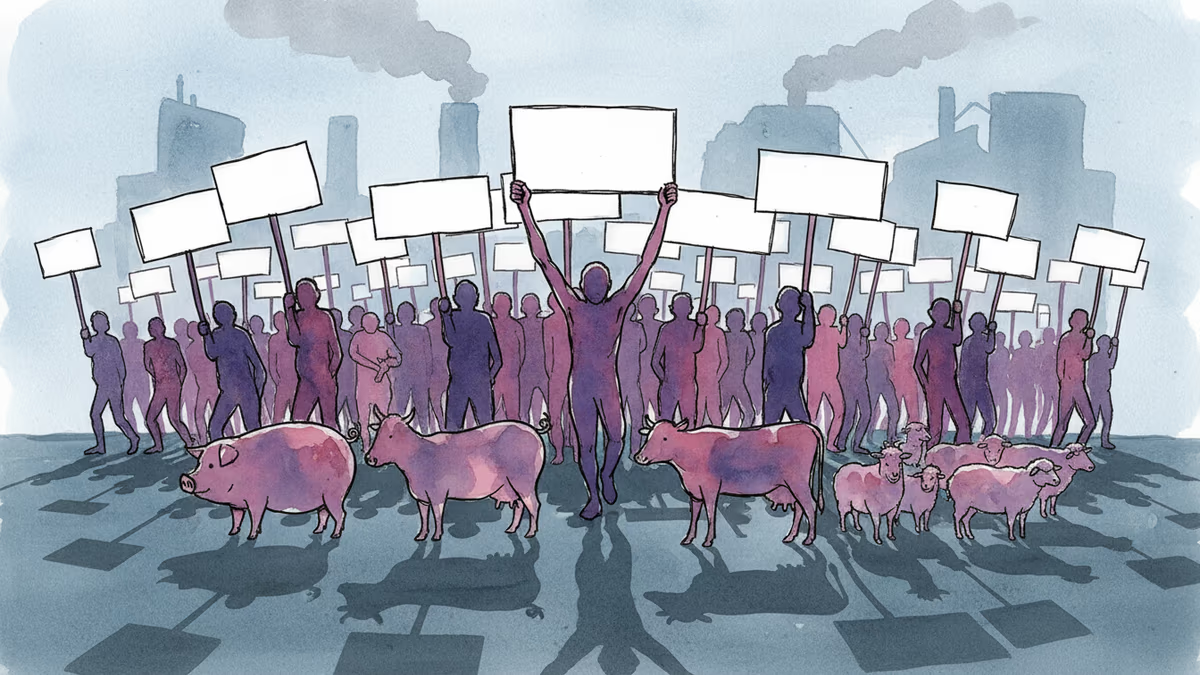
Within days, the clip had triggered a firestorm on X. Thousands of users pushed back. The numbers behind the controversy are worth sitting with for a moment: the average American consumes 37 individual animals per year. Include shrimp, and that figure climbs to 174. And 99 percent of those animals are raised in industrial factory farm conditions that most people, if shown footage of, would find difficult to watch.
Eilish wasn't making a fringe argument. She was making a straightforward one.
The Surprising Source of the Backlash
What made the response notable wasn't its intensity — any vegan who's spent time online knows that dietary criticism triggers fast and fierce reactions. What was unusual was who was doing the criticizing.
The loudest opposition didn't come from carnivore influencers or conservative commentators. It came predominantly from users who identify with the political left — the same ideological space Eilish herself occupies.
The most-liked reply, with over 130,000 engagements, invoked a documentary about Inuit communities who hunt marine mammals as part of a centuries-old cultural practice. The implication: white vegans shouldn't lecture anyone about eating animals. A second post, with 80,000 likes, argued that veganism holds no moral high ground because the fruits and vegetables vegans eat "are also harvested via immense cruelty and exploitation" — and concluded that the correct position, if you care about animals, is anti-capitalism.

Both posts went viral. Both arguments, under even mild scrutiny, fall apart.
Eilish's comments were plainly directed at the average American consumer cycling through 174 factory-farmed animals a year — not at Indigenous communities for whom subsistence hunting is a cultural cornerstone with no industrial equivalent. And while farmworker exploitation is a genuine and serious issue, vegan diets are built primarily around beans, lentils, tofu, and tempeh — crops harvested by combine tractors, not by the hand-picked labor force the post was describing. As for the anti-capitalism argument: East Germany and other socialist states adopted intensive factory farming in the latter half of the 20th century. The cruelty of industrial animal agriculture is not a feature exclusive to free markets.
The Meat Paradox, and Why It Cuts Across Politics
Psychologists have a name for what's happening when people feel the tension between loving animals and eating them: the meat paradox. The cognitive dissonance is real, and so is the human impulse to resolve it — not by changing behavior, but by constructing justifications that make the discomfort go away.
What's revealing is that the justifications are politically inflected. Conservatives might reach for religious authority ("God gave us dominion over animals"), personal freedom, or human exceptionalism. Progressives, as the Eilish episode showed, reach for a different toolkit: colonial critique, structural anti-capitalism, the exploitation of farmworkers. The language is different. The psychological function is identical.
The slogan "there is no ethical consumption under capitalism" deserves particular attention here. As a structural critique of markets, it has intellectual merit. As a personal behavioral guide, it tends to resolve into something more convenient: therefore, nothing I do individually matters, so I don't need to change anything. But 10 tortured animals represent less harm than 174 tortured animals under any economic system. The gap between those numbers doesn't disappear because capitalism exists.
Why the Left, Specifically
The tension runs deeper than one pop star's interview. For years, left-leaning animal advocates have noted with frustration that the meat industry intersects with nearly every cause the progressive left claims to care about.
Slaughterhouse work is among the most dangerous jobs in the United States. Meat companies have a documented history of suppressing unionization efforts. Animal agriculture is the leading driver of global deforestation, accounts for close to one-fifth of global greenhouse gas emissions, and is the top source of water pollution in the US. Large-scale factory farms and processing plants are disproportionately sited in low-income communities — a textbook case of environmental injustice. And major meat companies overwhelmingly donate to Republican candidates, lobby against pollution regulations, and have pushed for so-called "ag-gag" laws that criminalize undercover journalism inside farms.
The structural case for the left to engage seriously with animal agriculture is, on paper, overwhelming. The actual engagement has been, at best, lukewarm.
Part of the explanation may be structural in a different sense. Progressive political language is calibrated to address systems, institutions, and collective power — not individual consumer choices. Asking someone to change what they eat feels uncomfortably close to the kind of personal responsibility framing that the left typically associates with conservative politics. So structural language gets recruited to do something it wasn't designed for: to provide cover for personal inaction.
This doesn't mean corporations and governments are off the hook. Most US states explicitly exempt farming practices from animal cruelty statutes, which has normalized practices — piglets castrated without anesthesia, hens confined in battery cages for years, chickens bred to grow so fast their legs collapse — that would be illegal if applied to pets. Systemic change matters enormously. But the argument that systemic change is the only thing that matters, and that individual choices are therefore irrelevant, is one that conveniently asks nothing of the person making it.
This content is AI-generated based on source articles. While we strive for accuracy, errors may occur. We recommend verifying with the original source.
Related Articles

The average U.S. retirement age has climbed from 57 to well past 65. As people live longer and social bonds outside work erode, the old script for stepping away no longer holds. Here's why.
AI looks like liberation, threat, or environmental disaster depending on where you stand. A framework of nine competing narratives reveals why single-lens thinking is the real danger.

The Wizard of the Kremlin isn't really about Putin's evil. It's about the clever people who thought they could manage him—and what that says about how power actually works.
AI wearables that silently record conversations are coming. A look at the escalating battle between surveillance tech and the countermeasures trying to stop it—and why the mouse usually loses.
The average U.S. retirement age has climbed from 57 to well past 65. As people live longer and social bonds outside work erode, the old script for stepping away no longer holds. Here's why.
AI looks like liberation, threat, or environmental disaster depending on where you stand. A framework of nine competing narratives reveals why single-lens thinking is the real danger.
The Wizard of the Kremlin isn't really about Putin's evil. It's about the clever people who thought they could manage him—and what that says about how power actually works.
AI wearables that silently record conversations are coming. A look at the escalating battle between surveillance tech and the countermeasures trying to stop it—and why the mouse usually loses.
Thoughts
Share your thoughts on this article
Sign in to join the conversation