
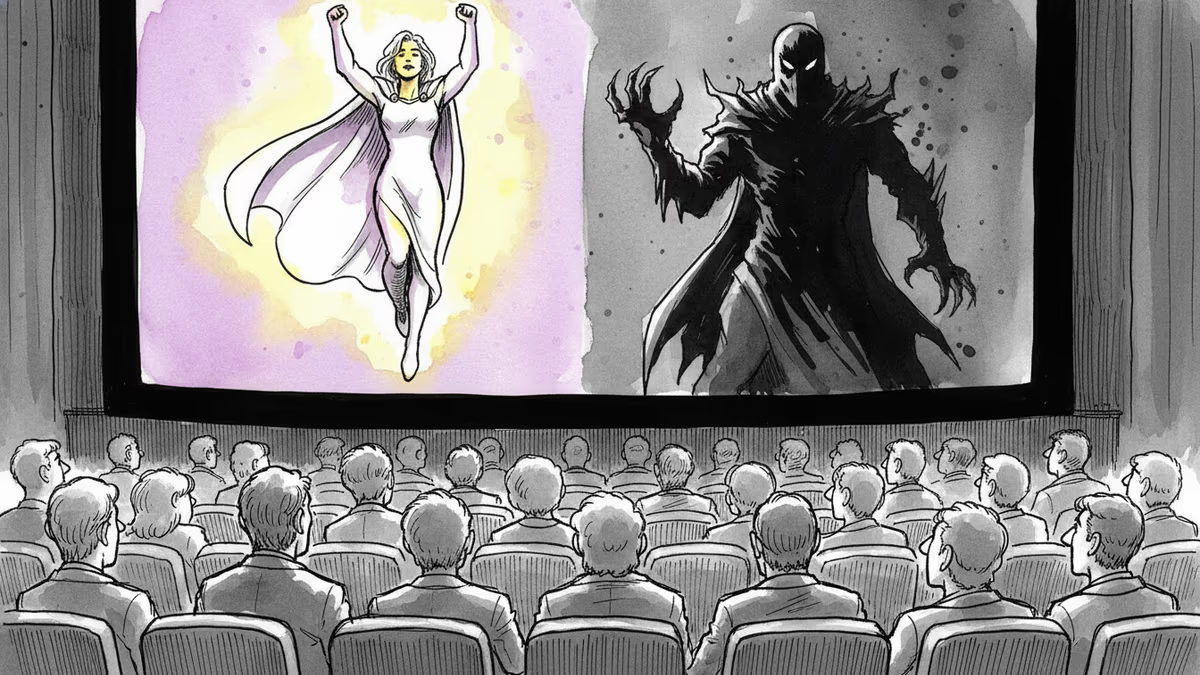
Good vs. Evil Wasn't Always the Story
The clean moral binaries of superhero films and blockbusters aren't ancient storytelling instinct—they're a relatively modern invention built for social cohesion. What does that mean for how we see the world?
Darth Vader didn't have a face. That wasn't an accident.
The black mask, the mechanical breath, the absence of human features—it was a design choice that made evil universal, projectable onto any enemy a viewer needed. Star Wars wasn't just entertainment. It was a moral architecture. And the question a recent Aeon video quietly raises is this: when did we start building stories that way, and what did we lose in the process?
The argument is deceptively simple but worth sitting with. The good-versus-evil paradigm that dominates pop culture—the superhero who saves the world, the villain who must be destroyed—is not some primordial human instinct. It's a relatively recent construction, engineered for social cohesion at a particular moment in history.
Stories Didn't Used to Work This Way
Go back to Homer's Iliad. Achilles, the Greeks' greatest warrior, lets his comrades die out of wounded pride, then mutilates the body of his enemy Hector. Is he the hero? Is Hector the villain? The poem refuses to answer. The gods themselves are petty, self-interested, occasionally cruel. Ancient epic wasn't in the business of sorting people into moral columns.
Shakespeare's tragedies are the same. Macbeth is a murderer, but he's also a man torn apart by ambition and fear—and we understand exactly how he got there. The moral complexity isn't a flaw in the storytelling. It is the storytelling.
So where did the clean binaries come from? Historians and media scholars point to the late 19th and early 20th centuries—the era of mass print and early cinema. For the first time in human history, a single story could reach millions of people simultaneously. And as audiences grew larger and more diverse, stories grew simpler. Villains got darker. Heroes got purer. The middle ground shrank.
Cohesion Was the Point
This wasn't just a concession to popular taste. It was functional. Industrialization and urbanization had fractured traditional communities. People from radically different backgrounds—different languages, religions, class origins—were suddenly living side by side in the same cities, watching the same films. They needed a shared moral vocabulary.

The good-vs-evil narrative provided exactly that. It said: here is what we value, here is what we fear, here is who we are together. The Western genre gave Americans a mythology of righteous frontier justice. Cold War Hollywood gave the free world a villain in the Soviet Union and a hero in the cowboy-soldier-spy. These weren't subtle. They weren't meant to be.
The mechanism was efficient precisely because it was simple. But efficiency has a cost.
When the Frame Becomes the Lens
Stories don't just reflect reality. They construct it. Decades of consuming moral binaries trains the brain to apply that same template to the world outside the theater. Politicians become heroes or villains. Nations become allies or enemies. Anyone who resists easy categorization becomes suspicious—what are they hiding?
Cognitive scientists call this narrative bias: the brain's tendency to impose story structure on experience. Good-vs-evil is the most powerful version of that structure because it's the most emotionally satisfying. Once installed, it's hard to uninstall.
The political consequences are visible everywhere. The same neural reward that fires when the superhero defeats the villain fires when a social media post identifies a clear enemy. Complexity doesn't go viral. Villains do. The architecture of outrage culture and the architecture of the blockbuster are, at a structural level, the same thing.
The Countermovement—and Its Limits
Something interesting is happening in prestige television. Breaking Bad's Walter White. The Roy family in Succession. Carmen Berzatto in The Bear. These characters are not good or evil—they're both, simultaneously, and the discomfort that creates is the entire point. Audiences are being asked to hold moral ambiguity without resolving it.
The rise of streaming has accelerated this. When a platform no longer needs to unify a mass audience around a single broadcast, narrative can afford to splinter, to get strange, to trust viewers with complexity. The social-cohesion function of storytelling is less urgent when the audience is already fragmented.
But here's the tension: the same technological moment that gave us morally complex prestige drama also gave us algorithmic feeds that turbocharge moral binaries. Streaming rewards nuance; social media punishes it. Both exist simultaneously, pulling at the same audience. The question isn't which will win—it's which one is shaping how people actually interpret the world beyond the screen.
And there's a subtler concern. The capacity to sit with moral complexity—to resist the pull of the clean narrative—may not be evenly distributed. It correlates, uncomfortably, with education, leisure time, and access to the kinds of media that reward it. A world where some people consume Succession and others consume algorithmically-sorted outrage isn't just a taste difference. It might be a divergence in how different groups perceive reality itself.
This content is AI-generated based on source articles. While we strive for accuracy, errors may occur. We recommend verifying with the original source.
Related Articles
The average U.S. retirement age has climbed from 57 to well past 65. As people live longer and social bonds outside work erode, the old script for stepping away no longer holds. Here's why.
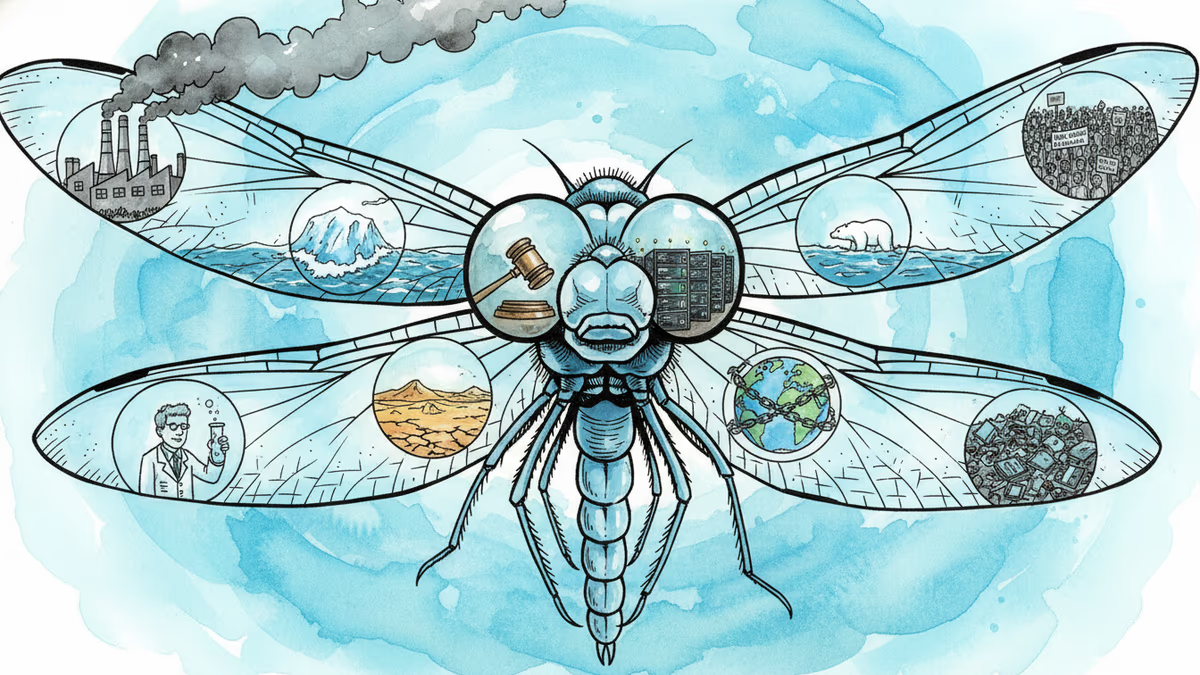
AI looks like liberation, threat, or environmental disaster depending on where you stand. A framework of nine competing narratives reveals why single-lens thinking is the real danger.
The Wizard of the Kremlin isn't really about Putin's evil. It's about the clever people who thought they could manage him—and what that says about how power actually works.
AI wearables that silently record conversations are coming. A look at the escalating battle between surveillance tech and the countermeasures trying to stop it—and why the mouse usually loses.
The average U.S. retirement age has climbed from 57 to well past 65. As people live longer and social bonds outside work erode, the old script for stepping away no longer holds. Here's why.
AI looks like liberation, threat, or environmental disaster depending on where you stand. A framework of nine competing narratives reveals why single-lens thinking is the real danger.
The Wizard of the Kremlin isn't really about Putin's evil. It's about the clever people who thought they could manage him—and what that says about how power actually works.
AI wearables that silently record conversations are coming. A look at the escalating battle between surveillance tech and the countermeasures trying to stop it—and why the mouse usually loses.
Thoughts
Share your thoughts on this article
Sign in to join the conversation