
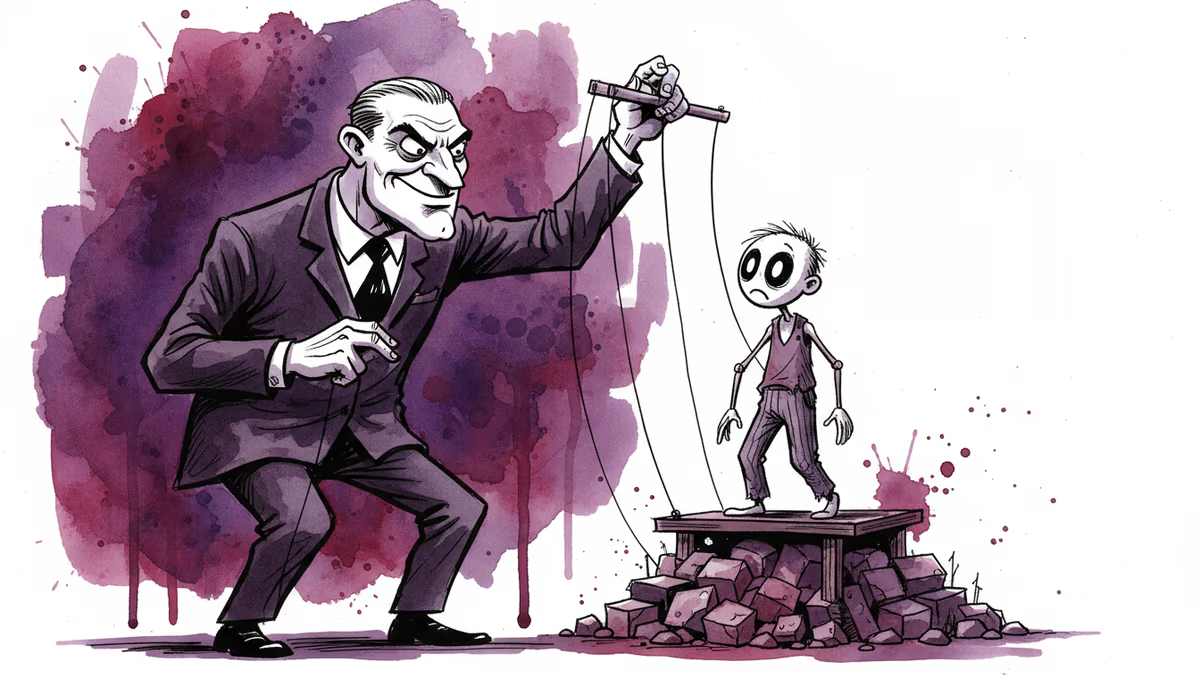
Who Built Putin? A Film Asks the Harder Question
The Wizard of the Kremlin isn't really about Putin's evil. It's about the clever people who thought they could manage him—and what that says about how power actually works.
The monster didn't arrive alone. Someone found him, packaged him, and put him on television.
That's the premise—and the quiet horror—at the heart of Olivier Assayas's new film, The Wizard of the Kremlin. It's a movie about Vladimir Putin that keeps Putin offscreen for its first 45 minutes. That's not an oversight. Assayas wants you to understand what Russia was before Putin filled the frame: the brief, chaotic, cosmopolitan experiment of the 1990s, when the Soviet collapse left a vacuum that oligarchs, artists, and opportunists rushed to fill. You need to see what was lost before you can understand what replaced it.
The Wizard Isn't Who You Think
The film adapts a 2022 French novel of the same name, with a screenplay co-written by Assayas and novelist Emmanuel Carrère. Its title refers not to Putin but to Vadim Baranov (Paul Dano)—a character inspired by Vladislav Surkov, Putin's real-life former political strategist and spin doctor.
Baranov's arc spans three decades: energetic young artist, television executive, kingmaker, exile. Working under oligarch Boris Berezovsky (Will Keen), he arrives at a conviction that shapes everything that follows. Post-Yeltsin Russians, he decides, don't want chaos—they want order. They want a strongman. He finds one in the then-director of the FSB, the KGB's successor agency. The plan, as Baranov and Berezovsky conceive it, is almost elegant in its naivety: Putin projects stern authority, keeps the bureaucracy in line, and the new billionaire class operates freely behind the curtain.
The audience already knows how that arrangement ends. The film's tension comes from watching intelligent people convince themselves otherwise.
The narrative reaches Baranov through layers of flashback, framed by Jeffrey Wright as Rowland, an American writer summoned to Baranov's dacha to hear his story. It's a structure that keeps the viewer at a slight remove—which suits the material, even if it slows the opening act considerably.

What Jude Law Does With Silence
When Putin finally appears, the film shifts register. Jude Law plays him without heavy prosthetics, without a labored accent, without any of the usual biopic signaling. What he deploys instead is stillness—a near-permanent grimace, a voice that rarely rises above conversational volume, and an economy of movement that reads as coiled rather than passive. The danger is always present; it just isn't performed.
It's a career-redefining turn, and it arrives at a particular moment in Law's trajectory. He built his early reputation on charm—rakish, tousled, luminously handsome. But in middle age he's become something more interesting: an actor drawn to men who are opaque, whose inner lives register as threat rather than vulnerability. A precursor arrived as far back as 2009, when he played the cuckolded Karenin in Anna Karenina—another Russian figure, though a far more impotent and pitiable one. Putin is the logical extension of that evolution.
Dano's Baranov operates in deliberate contrast. He's a communicator, a packager, a man who reads rooms and adjusts. Dano plays him with an intentional flatness—a chameleon so committed to adaptation that he seems to have no fixed self underneath. It's a coherent interpretation of a genuinely amoral character. The problem is that the film asks us to follow him for two-plus hours, and the very qualities that make Baranov historically interesting make him emotionally inaccessible on screen.
The Slow Horror of Incremental Control
Assayas has made political films before—Something in the Air tracked the disillusionment after France's 1968 protests; Carlos was a kinetic, sprawling portrait of the Venezuelan terrorist Carlos the Jackal. The Wizard of the Kremlin is slower and more methodical than either. Whether that reflects the director's own evolution—decades in, moving away from showier filmmaking—or a deliberate formal choice to mirror the subject matter is an open question. Authoritarianism, after all, rarely announces itself. It accumulates.
The film's real argument isn't about Putin's particular wickedness. It's about the class of people who built the conditions for his rise: educated, culturally sophisticated men who believed they understood power well enough to manage it. Baranov and Berezovsky weren't cynics exactly—they had a theory, a model, a plan. The plan assumed Putin would remain a tool. What they missed, and what Law's performance makes viscerally clear from his first scene, is that Putin was always reading the situation more carefully than anyone around him.
That's the tragedy the film is actually interested in. Not the strongman, but the smart people who handed him the keys.
This content is AI-generated based on source articles. While we strive for accuracy, errors may occur. We recommend verifying with the original source.
Related Articles
The average U.S. retirement age has climbed from 57 to well past 65. As people live longer and social bonds outside work erode, the old script for stepping away no longer holds. Here's why.
Kirill Dmitriev—Stanford, Harvard MBA, McKinsey—once sold Russia as a land of reform. Now he's selling out Ukraine's sovereignty in Mar-a-Lago backrooms. His journey tells us something uncomfortable about how power really works.
AI looks like liberation, threat, or environmental disaster depending on where you stand. A framework of nine competing narratives reveals why single-lens thinking is the real danger.
AI wearables that silently record conversations are coming. A look at the escalating battle between surveillance tech and the countermeasures trying to stop it—and why the mouse usually loses.
The average U.S. retirement age has climbed from 57 to well past 65. As people live longer and social bonds outside work erode, the old script for stepping away no longer holds. Here's why.
Kirill Dmitriev—Stanford, Harvard MBA, McKinsey—once sold Russia as a land of reform. Now he's selling out Ukraine's sovereignty in Mar-a-Lago backrooms. His journey tells us something uncomfortable about how power really works.
AI looks like liberation, threat, or environmental disaster depending on where you stand. A framework of nine competing narratives reveals why single-lens thinking is the real danger.
AI wearables that silently record conversations are coming. A look at the escalating battle between surveillance tech and the countermeasures trying to stop it—and why the mouse usually loses.
Thoughts
Share your thoughts on this article
Sign in to join the conversation