
Why Waymo Just Opened 4 Cities at Once
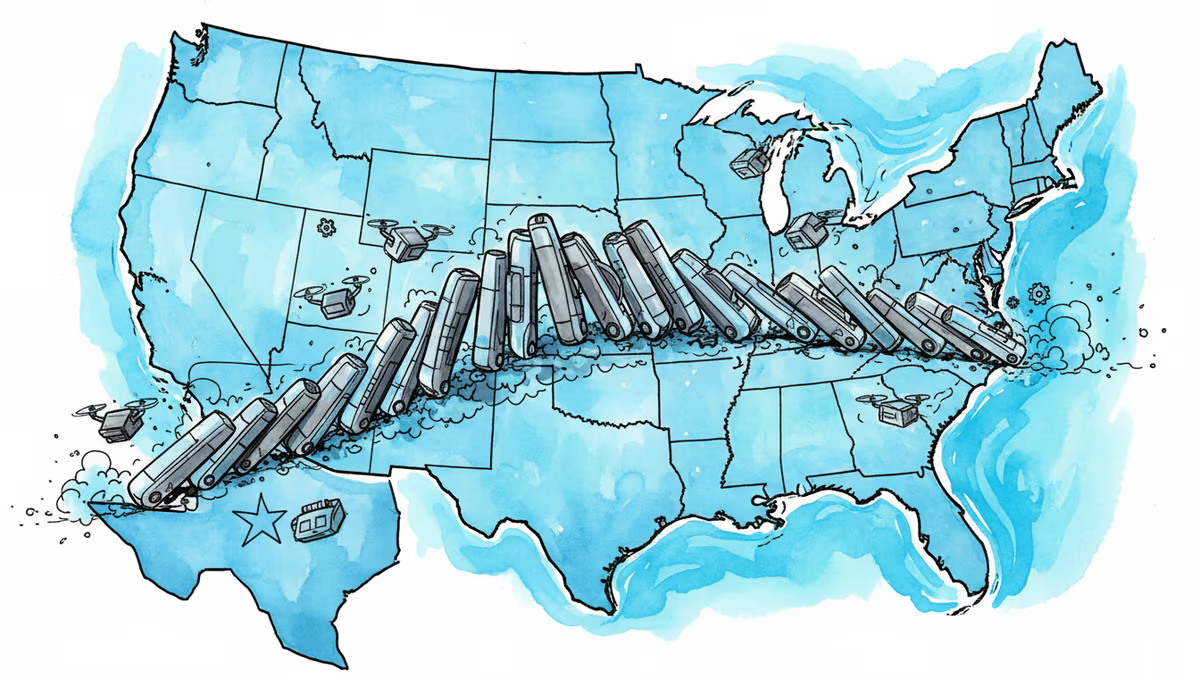
Waymo launches robotaxi services in Dallas, Houston, San Antonio, and Orlando simultaneously, expanding from 3 to 10 cities in just one year. Analyzing the strategy behind this aggressive rollout and what it means for the autonomous vehicle industry.
From 200,000 rides per week to over 1 million by year-end. That's Waymo's audacious goal, and Tuesday's simultaneous launch in Dallas, Houston, San Antonio, and Orlando suggests they're serious about hitting it. Just over a year ago, the Alphabet-owned company operated in three cities. Now it's ten, with plans for "more than 20."
The pace is striking. The strategy behind it even more so.
The Numbers Tell a Story
Waymo's current fleet of 3,000 robotaxis serves six markets, providing over 400,000 rides weekly—though the company admits the actual number is "likely higher." Last month's $16 billion funding round valued the company at $126 billion, giving it serious firepower for expansion.
But here's what's interesting: each new city starts with just "dozens" of vehicles. It's not about flooding markets with cars—it's about proving the model works everywhere.
The rollout follows a familiar pattern. Select riders with the Waymo app get invitations first, then gradual expansion to all users. It's the same playbook used in San Francisco, where service now stretches down Highway 101 to San Jose and covers three airports, including SFO.
The Uber Partnership Signal
Perhaps most telling is Waymo's partnership with Uber in Atlanta and Austin. Remember when these companies were bitter rivals? Uber spent billions trying to develop autonomous vehicles before essentially surrendering to focus on its platform.
Uber CEO Dara Khosrowshahi made the strategic pivot clear: "We're getting out of the technology development race." Now Uber serves as Waymo's distribution channel—a fascinating role reversal that hints at how the industry might consolidate.

For other ride-hailing companies still betting on in-house autonomous development, the message is stark: build or buy, but don't get caught in between.
Safety Regulators Aren't Impressed
The expansion comes amid increased scrutiny. Last month, a Waymo robotaxi struck a child at 6 mph near a Santa Monica school, prompting a National Highway Traffic Safety Administration investigation. The National Transportation Safety Board is also examining how Waymo vehicles behave around school buses.
Waymo employs about 70 remote assistance workers—human monitors who respond when robotaxis encounter tricky scenarios. This workforce will scale with expansion, though the company won't specify how much. It's a reminder that "autonomous" still requires human oversight.
The Regulatory Gamble
Waymo's aggressive expansion strategy carries inherent risks. Each new city means new traffic patterns, weather conditions, and regulatory environments. Texas and Florida offer more permissive regulatory frameworks than California, but that could change quickly if incidents occur.
The company is essentially making a bet: that rapid scale will create regulatory momentum in its favor. Get enough riders dependent on the service, and politicians become reluctant to shut it down. It's a playbook borrowed from the early days of Uber and Lyft.
International Ambitions
London appears on Waymo's expansion list—a significant signal. European markets have stricter data privacy laws and different traffic patterns. Success there would validate the technology's global applicability and open massive new markets.
For competitors like Tesla, Cruise, and international players, the window for market entry is narrowing. Waymo's first-mover advantage compounds with each new city.
Authors
Related Articles
Waymo's new Ojai robotaxi isn't just a vehicle upgrade. It's the company's most serious attempt yet at cracking the cost problem that has kept autonomous vehicles from scaling. Here's what's really at stake.
A U.S. Senate investigation found that seven autonomous vehicle companies — including Waymo and Tesla — refused to disclose how often remote operators intervene in their vehicles. Here's why that silence matters.
Alphabet's new pay deal for Sundar Pichai links his compensation to Waymo and Wing performance—signaling where Google is placing its biggest bets. Here's what investors should actually read into it.
Swedish startup Einride raises $113M ahead of NYSE debut, deploying 200 autonomous trucks for major brands. The logistics revolution accelerates.
Waymo's new Ojai robotaxi isn't just a vehicle upgrade. It's the company's most serious attempt yet at cracking the cost problem that has kept autonomous vehicles from scaling. Here's what's really at stake.
A U.S. Senate investigation found that seven autonomous vehicle companies — including Waymo and Tesla — refused to disclose how often remote operators intervene in their vehicles. Here's why that silence matters.
Alphabet's new pay deal for Sundar Pichai links his compensation to Waymo and Wing performance—signaling where Google is placing its biggest bets. Here's what investors should actually read into it.
Swedish startup Einride raises $113M ahead of NYSE debut, deploying 200 autonomous trucks for major brands. The logistics revolution accelerates.
Thoughts
Share your thoughts on this article
Sign in to join the conversation