
The 120-Year Secret Behind Self-Driving Cars Started in Spain
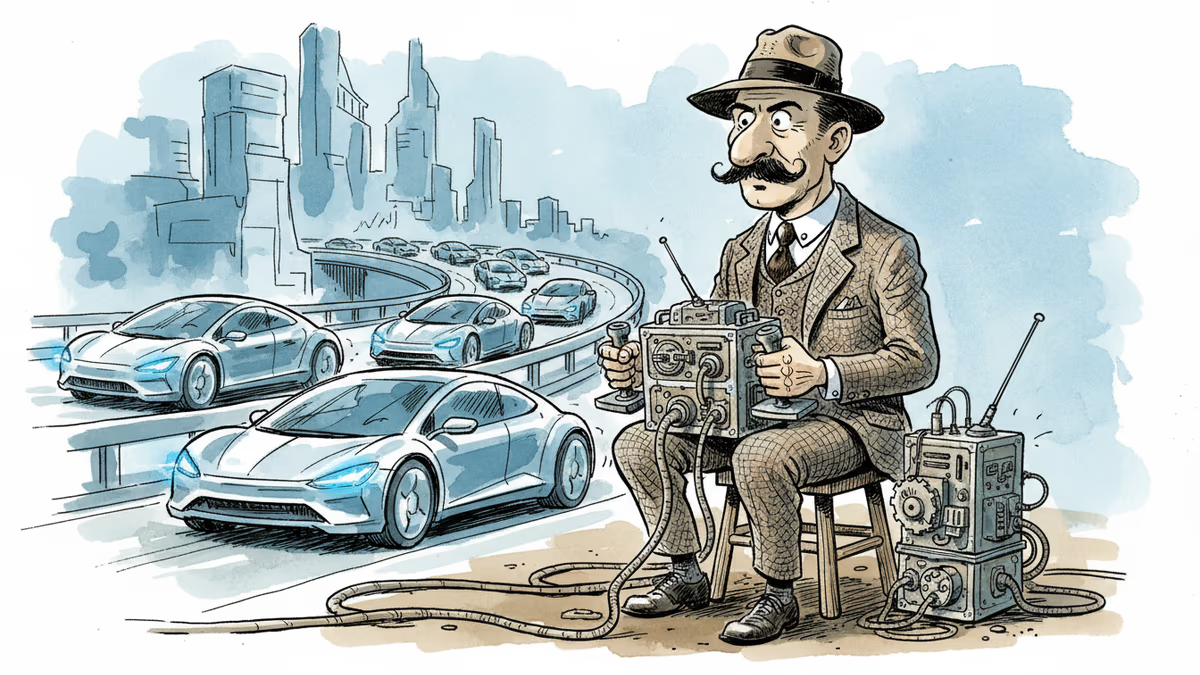
A Spanish engineer's 1903 wireless control invention laid the groundwork for today's autonomous vehicle revolution. Leonardo Torres Quevedo's Telekino changed everything
1903: One Spanish Engineer Changed Everything
No one knows when self-driving cars will finally take the wheel from us. But this revolution isn't some sudden breakthrough—it's a 120-year evolution that started in Spain with a man you've probably never heard of.
Leonardo Torres Quevedo was born in Santa Cruz, Spain, in 1852. Smart enough to build a chess-playing machine by 1914. But more than a decade earlier, he'd already invented something far more revolutionary: the world's first practical wireless control system.
His creation would become the philosophical foundation for every autonomous vehicle rolling off production lines today.
The Greek Roots of Modern Tech
Quevedo called his device the "Telekino"—Greek for "movement at a distance." Patented in Spain, France, and the United States, it was designed to prevent airship accidents through remote control.
The mechanics were elegant in their simplicity. The Telekino transmitted wireless signals to a small receiver called a coherer, which detected electromagnetic waves and converted them into electrical current. This current was amplified and sent to electromagnets that rotated switches controlling servomotors. Quevedo could issue 19 distinct commands to an airship's systems without touching a single control cable.
Sound familiar? It should.

The DNA of Today's Autonomous Systems
Fast-forward to 2026, and the core principles remain unchanged. Tesla's Full Self-Driving, Waymo's autonomous taxis, GM's Cruise—they all rely on the same fundamental concept Quevedo pioneered: machines receiving signals, processing information, and executing commands without human intervention.
The sophistication has exploded, of course. Modern autonomous vehicles process millions of data points per second through LiDAR, cameras, and radar. But strip away the computational complexity, and you'll find Quevedo's basic architecture: sense, process, act.
Why Silicon Valley Missed This Story
Tech companies love origin stories, but they rarely trace their lineage back 120 years. Google didn't invent autonomous navigation—they refined it. Apple's rumored car project isn't revolutionary—it's evolutionary. Even Tesla's Autopilot is essentially Quevedo's Telekino with 21st-century sensors and processing power.
This historical blindness matters. Investors pour billions into "disruptive" autonomous vehicle startups, but the fundamental disruption happened in 1903. What we're witnessing now is incremental improvement, not paradigm shift.
The Real Innovation Timeline
Quevedo's story reveals something uncomfortable about innovation cycles. The technologies we celebrate as "cutting-edge" often have century-old roots. Autonomous vehicles aren't emerging—they've been evolving for 12 decades.
This perspective changes everything. Instead of asking "when will self-driving cars arrive?" we should ask "why did it take 120 years to perfect Quevedo's vision?" The answer involves computing power, sensor technology, and machine learning—but the conceptual breakthrough happened before the Wright brothers flew.
Authors
Related Articles

Swedish startup Einride raises $113M ahead of NYSE debut, deploying 200 autonomous trucks for major brands. The logistics revolution accelerates.

Dubai signs deals with three unproven US transport companies after previous $450M Hyperloop failure and GM Cruise debacle. Will underground tunnels, flying pods, and air taxis work?
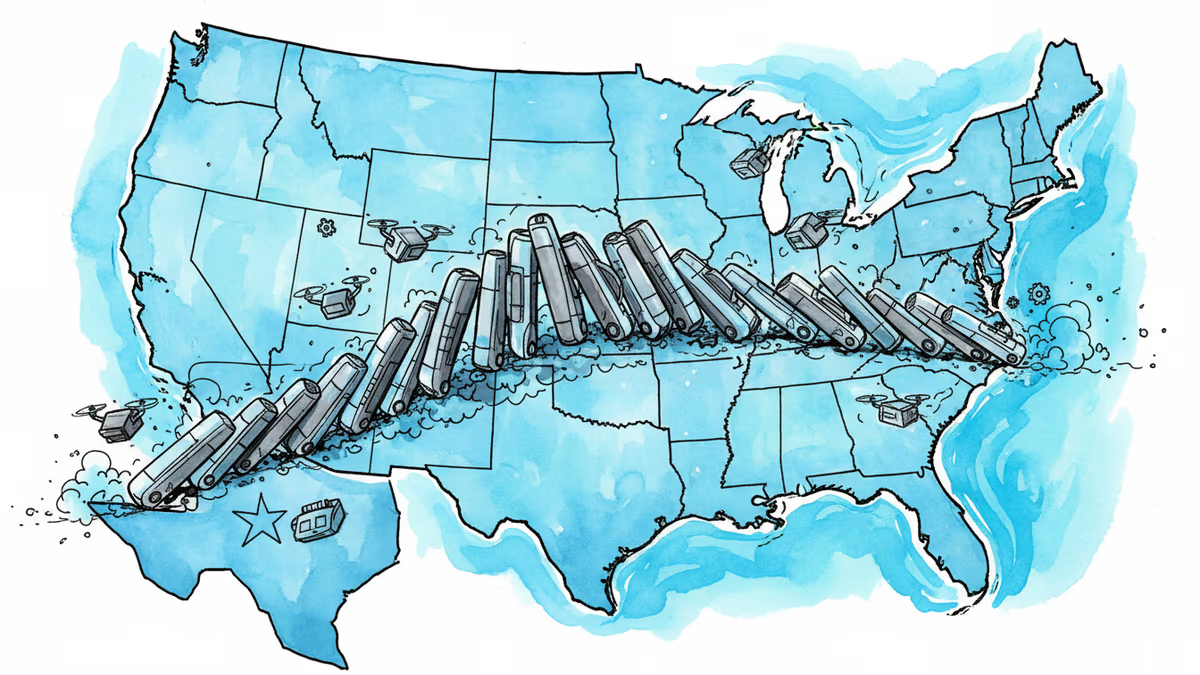
Waymo launches robotaxi services in Dallas, Houston, San Antonio, and Orlando simultaneously, expanding from 3 to 10 cities in just one year. Analyzing the strategy behind this aggressive rollout and what it means for the autonomous vehicle industry.

Waymo reveals 70 remote operators worldwide, including Philippines-based staff, sparking debate about true autonomy in self-driving cars.
Swedish startup Einride raises $113M ahead of NYSE debut, deploying 200 autonomous trucks for major brands. The logistics revolution accelerates.
Dubai signs deals with three unproven US transport companies after previous $450M Hyperloop failure and GM Cruise debacle. Will underground tunnels, flying pods, and air taxis work?
Waymo launches robotaxi services in Dallas, Houston, San Antonio, and Orlando simultaneously, expanding from 3 to 10 cities in just one year. Analyzing the strategy behind this aggressive rollout and what it means for the autonomous vehicle industry.
Waymo reveals 70 remote operators worldwide, including Philippines-based staff, sparking debate about true autonomy in self-driving cars.
Thoughts
Share your thoughts on this article
Sign in to join the conversation