
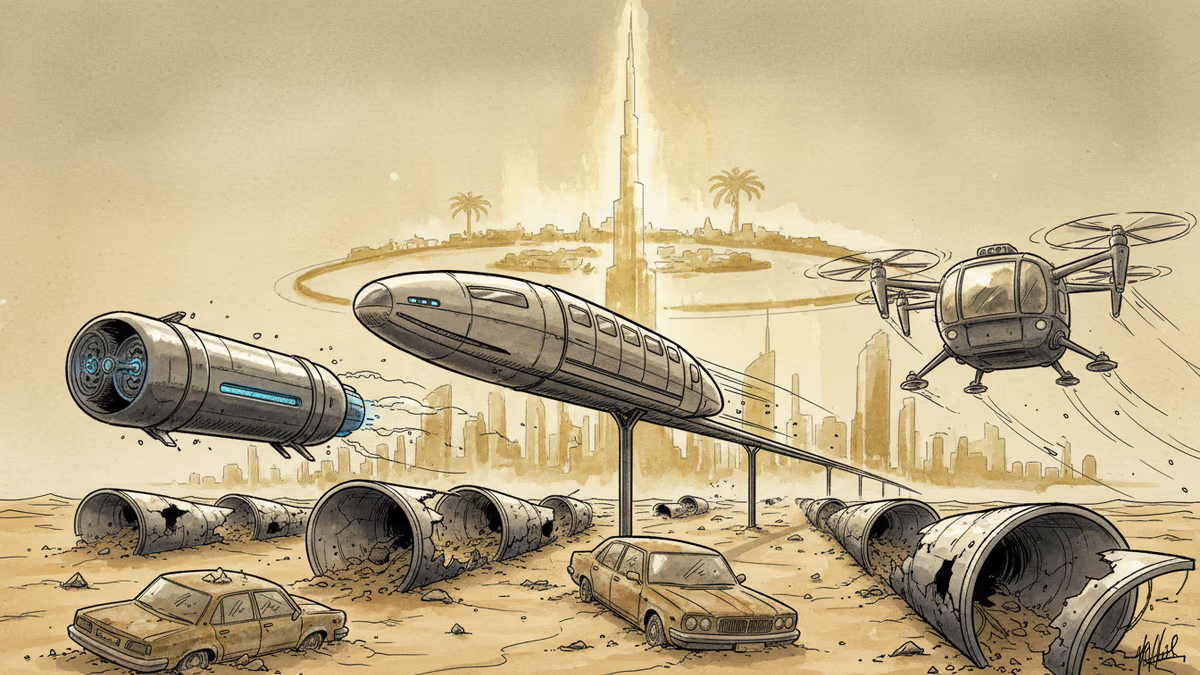
Dubai's $545M Bet on Nonexistent Transport Could Backfire
Dubai signs deals with three unproven US transport companies after previous $450M Hyperloop failure and GM Cruise debacle. Will underground tunnels, flying pods, and air taxis work?
Third Time's the Charm?
Dubai just wrote another massive check to the future. $545 million spread across three American companies building transport systems that don't actually exist yet at any meaningful scale.
Elon Musk's underground tunnels. Glydways' self-driving pods on narrow tracks. Joby Aviation's electric flying taxis. All promising to solve Dubai's traffic nightmare.
But here's the uncomfortable truth: Dubai's track record with transport moonshots is abysmal. Hyperloop One burned through $450 million before shutting down in 2023. GM's Cruise signed an exclusive deal for 4,000 robotaxis in 2021, then imploded without carrying a single Dubai passenger.
So why is Dubai doubling down on unproven tech again?
A City Outgrowing Its Infrastructure
The math is brutal. Dubai's population doubled to 4 million in 15 years. Vehicle registrations climb 10% annually—three times the global rate. Residents lose 35 hours yearly to traffic delays.
"In a city scaling as rapidly as Dubai, there's logic to exploring multiple solutions in parallel rather than relying on linear sequencing," explains Martin Tillman of Dubai-based TMP Consult.
But the risk? "Reputational exposure if expectations run ahead of demonstrated performance."
The three companies offer radically different approaches: The Boring Company goes underground, Glydways builds dedicated tracks above ground, and Joby takes to the skies.
Unproven Technologies, Proven Challenges
The Boring Company's Dubai Loop would shuttle passengers through 4 miles of underground tunnels, serving 13,000 daily riders. Sounds impressive until you examine their only operating system in Las Vegas: human-driven Teslas crawling at 30-40 mph, not the high-speed autonomous vehicles originally promised.
Loughborough University's Marcus Enoch describes the Loop as "a high-end option comparable to helicopter taxis"—great for those who can afford it, meaningless for congestion relief.

Glydways promises even bolder numbers: 10,000 passengers per hour in each direction at 90% less cost than conventional transport. Their small pods would run from a metro station to Bluewaters Island, Dubai's entertainment district.
There's one problem: Glydways has never operated commercially anywhere. They have a test track in California and recently broke ground near Atlanta airport. That's it.
The Gulf Heat Reality Check
Operating in Dubai presents unique engineering challenges that Silicon Valley testing doesn't capture. When pod doors open in 113°F heat, all cooled air escapes and must be replaced—multiplying energy costs at every stop.
"Hundreds of pods making thousands of stops daily would sharply increase cooling costs alone," warns a regional transport infrastructure expert who requested anonymity.
Glydways claims their pods can handle temperatures up to 122°F, but real-world performance remains untested.
The Furthest Along—Still Not There
Joby Aviation leads the pack with over 850 test flights last year across the US, UAE, and Japan. In November, they completed a 17-minute piloted flight from their desert facility to Al Maktoum International Airport.
But Joby still lacks US Federal Aviation Administration certification. President Didier Papadopoulos hinted they might carry UAE passengers before getting FAA approval—a regulatory gamble that could backfire spectacularly.
Different Stakeholders, Different Calculations
Urban planners remain skeptical. These systems serve niche markets rather than addressing mass transit needs.
Tech companies see Dubai as a regulatory sandbox—a place to test technologies stuck in red tape back home.
Dubai officials stay silent on success metrics or timelines. No public benchmarks exist for any project.
Residents face the ultimate question: Will any of this actually improve their daily commute?
The Practical Test
Tillman suggests four key questions: How many people actually ride? Is it safe? Does it cost less to run than it earns? Does it connect to existing buses, metro, and sidewalks?
"None of those benchmarks has yet been publicly set," he notes.
Dubai isn't putting all eggs in experimental baskets. A third metro line is under construction, and Etihad Rail will connect all seven emirates for the first time in 2026.
Authors
Related Articles

Swedish startup Einride raises $113M ahead of NYSE debut, deploying 200 autonomous trucks for major brands. The logistics revolution accelerates.
Waymo launches robotaxi services in Dallas, Houston, San Antonio, and Orlando simultaneously, expanding from 3 to 10 cities in just one year. Analyzing the strategy behind this aggressive rollout and what it means for the autonomous vehicle industry.
A Spanish engineer's 1903 wireless control invention laid the groundwork for today's autonomous vehicle revolution. Leonardo Torres Quevedo's Telekino changed everything

Waymo reveals 70 remote operators worldwide, including Philippines-based staff, sparking debate about true autonomy in self-driving cars.
Swedish startup Einride raises $113M ahead of NYSE debut, deploying 200 autonomous trucks for major brands. The logistics revolution accelerates.
Waymo launches robotaxi services in Dallas, Houston, San Antonio, and Orlando simultaneously, expanding from 3 to 10 cities in just one year. Analyzing the strategy behind this aggressive rollout and what it means for the autonomous vehicle industry.
A Spanish engineer's 1903 wireless control invention laid the groundwork for today's autonomous vehicle revolution. Leonardo Torres Quevedo's Telekino changed everything
Waymo reveals 70 remote operators worldwide, including Philippines-based staff, sparking debate about true autonomy in self-driving cars.
Thoughts
Share your thoughts on this article
Sign in to join the conversation