
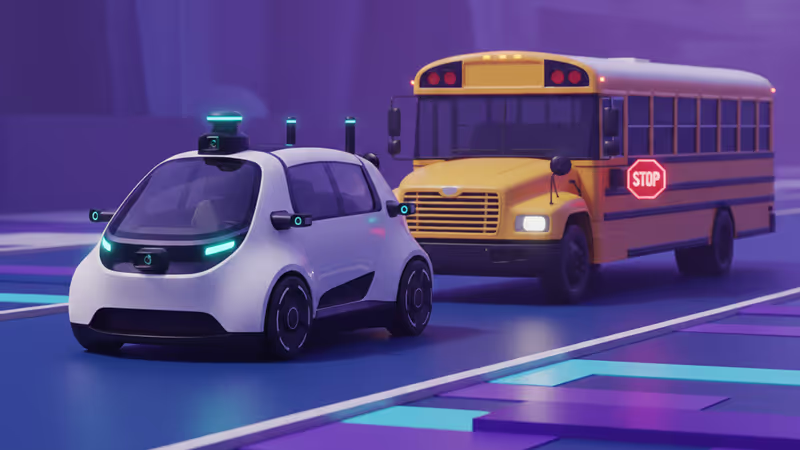
Waymo NTSB school bus investigation: Robotaxis Face Safety Probe After Failures
The NTSB has launched a formal Waymo NTSB school bus investigation following multiple reports of robotaxis failing to stop for students in Austin and Atlanta.
The promise of a safer driver is facing its toughest test yet. The National Transportation Safety Board (NTSB) has opened an investigation into Waymo after its robotaxis were spotted illegally passing stopped school buses numerous times. According to a post on X by the agency on January 23, 2026, investigators are focusing on more than 20 incidents specifically in Austin, Texas.
Waymo NTSB school bus investigation: The Software Gap
It's the first time Waymo has been investigated by the NTSB, though it's already under the microscope of the NHTSA for similar issues. The core problem lies in the vehicle's failure to stop for loading or unloading students—a fundamental traffic law. Despite a software recall in December, reports of violations haven't stopped. In Austin, the school district has even asked the company to suspend operations during pickup and drop-off times to ensure student safety.
Investigators will travel to Austin to gather information on a series of incidents in which the automated vehicles failed to stop for loading or unloading students.

Expansion vs. Accountability
The probe comes at a sensitive time for Waymo. Just this week, the company expanded its robotaxi service to Miami, adding to its growing footprint in cities like Atlanta and Los Angeles. While Waymo's Chief Safety Officer, Mauricio Peña, claims their performance is "superior to human drivers," the persistent nature of these violations suggests a stubborn technical hurdle in identifying school bus signals across different environments.
Authors
Related Articles
Waymo's new Ojai robotaxi isn't just a vehicle upgrade. It's the company's most serious attempt yet at cracking the cost problem that has kept autonomous vehicles from scaling. Here's what's really at stake.
Tesla expanded its driverless robotaxi to Dallas and Houston, even after reporting 14 crashes in Austin. What does this tell us about how autonomous vehicles actually get built?
A U.S. Senate investigation found that seven autonomous vehicle companies — including Waymo and Tesla — refused to disclose how often remote operators intervene in their vehicles. Here's why that silence matters.
Uber and WeRide have launched fully driverless robotaxi service in Dubai — no safety operator, real fares. Here's what it means for the global AV race and your next ride.
Waymo's new Ojai robotaxi isn't just a vehicle upgrade. It's the company's most serious attempt yet at cracking the cost problem that has kept autonomous vehicles from scaling. Here's what's really at stake.
Tesla expanded its driverless robotaxi to Dallas and Houston, even after reporting 14 crashes in Austin. What does this tell us about how autonomous vehicles actually get built?
A U.S. Senate investigation found that seven autonomous vehicle companies — including Waymo and Tesla — refused to disclose how often remote operators intervene in their vehicles. Here's why that silence matters.
Uber and WeRide have launched fully driverless robotaxi service in Dubai — no safety operator, real fares. Here's what it means for the global AV race and your next ride.
Thoughts
Share your thoughts on this article
Sign in to join the conversation