
The Human Behind Your Driverless Car Won't Talk
A U.S. Senate investigation found that seven autonomous vehicle companies — including Waymo and Tesla — refused to disclose how often remote operators intervene in their vehicles. Here's why that silence matters.
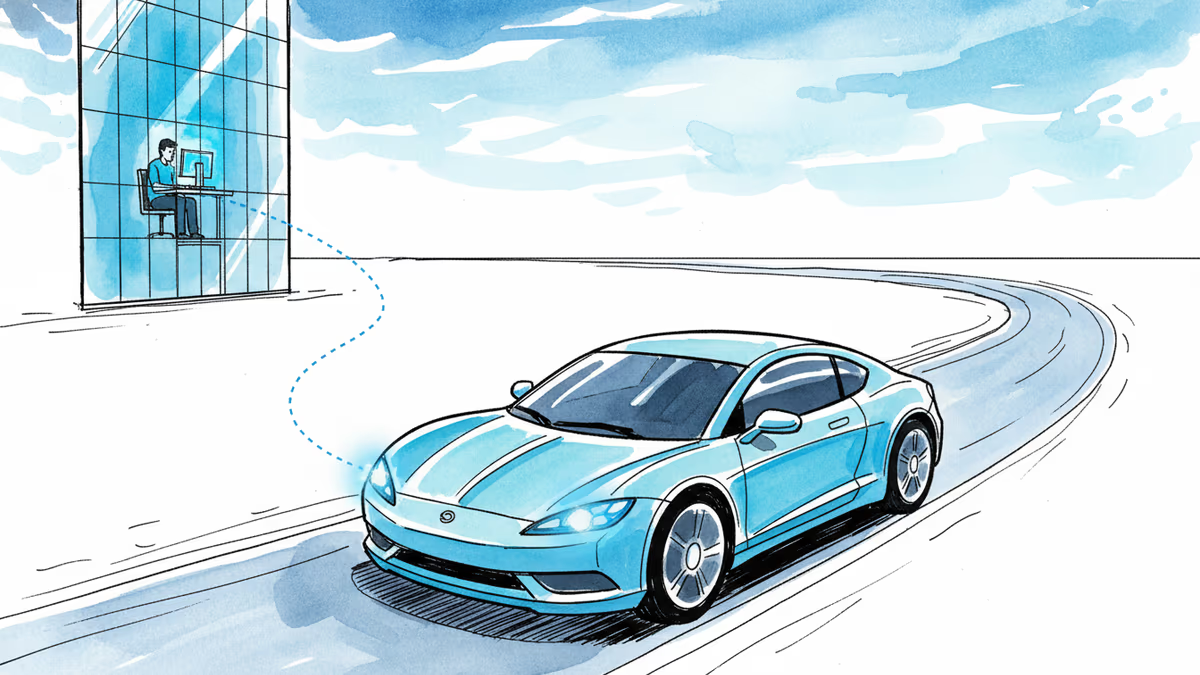
Somewhere in the Philippines, someone is watching your robotaxi.
That detail — casually disclosed by Waymo's chief safety officer at a Senate hearing earlier this year — cracked open a question the autonomous vehicle industry has spent years carefully avoiding: how much does a "self-driving" car actually drive itself?
The answer, it turns out, is something these companies would very much prefer you didn't know.
Seven Companies. One Question. Zero Answers.
In February, Senator Ed Markey (D-MA) sent letters to seven AV companies operating on U.S. public roads: Aurora, May Mobility, Motional, Nuro, Tesla, Waymo, and Zoox. He asked 14 questions about their remote assistance operations — the teams of human workers who monitor fleets and step in when vehicles get confused, stuck, or face scenarios their software can't handle.
The most basic question: how often do remote staff actually intervene?
All seven companies refused to say.
Waymo and May Mobility explicitly labeled the intervention frequency as "confidential business information." Tesla didn't even include the question in its written response — no explanation given. Waymo did claim its system improvements have "materially reduced" the number of help requests per mile, but offered no data to back that up. It also noted that a "vast majority" of requests are resolved by the self-driving system before a remote agent even responds — which raises its own questions about why those requests are being sent at all.
Markey's office called it a "stunning lack of transparency" from an industry experimenting with unproven technology on public roads.
Not All Remote Control Is Created Equal

Beyond the refusals, the investigation surfaced something arguably more troubling: there are no federal standards governing any of this, and the patchwork of practices across companies is wide.
On the question of whether remote operators can directly control vehicles, the companies split sharply. All except Tesla said their staff cannot — or are not allowed to — take direct control. Tesla broke from the pack, acknowledging that its remote operators can temporarily assume direct vehicle control as a "final escalation maneuver," but only when the vehicle is moving at 2 mph or less, and only up to 10 mph. The company framed this as a way to move a stuck vehicle without waiting for a first responder.
Then there's the latency question. May Mobility reported a worst-case response lag of 500 milliseconds — half a second. At highway speeds, that's roughly 45 feet of travel before a human can even begin to respond. Whether that's acceptable depends entirely on what the remote operator is being asked to do — and in what scenario.
On overseas staffing, Waymo was the only company to acknowledge using workers based outside the U.S. — the Philippines disclosure that started all of this. Markey's office noted pointedly that a foreign driver's license "is not a substitute for passing a U.S. driver's license exam, as the rules of the road will almost certainly vary by location."
Why This Moment Matters
For years, remote operator questions were largely theoretical. The technology was in testing. The stakes felt abstract. That's no longer true.
Waymo runs a commercial robotaxi service in San Francisco and Phoenix. Aurora has deployed self-driving semi-trucks on real freight routes. These aren't pilots in the traditional sense — they're revenue-generating operations on public infrastructure, serving real passengers and shippers.
And yet the regulatory framework hasn't kept pace. The National Highway Traffic Safety Administration (NHTSA) has no federal standards governing remote operator qualifications, response times, or overseas staffing. Markey has called on NHTSA to investigate and said he is preparing legislation to impose "strict guardrails" on how AV companies use remote operators.
The timing is significant. The AV industry has spent the past two years aggressively lobbying for lighter federal oversight, arguing that overly prescriptive rules would stifle innovation. This investigation gives regulators — and skeptics — concrete ammunition to push back.
Three Ways to Read This
For investors, the refusal to disclose intervention rates is a red flag dressed as a trade secret. Intervention frequency is arguably the single most important metric for understanding how close any of these systems are to true autonomy. Companies that won't share it may have good reasons — or uncomfortable ones.
For city governments, this is a jurisdictional nightmare. San Francisco officials grilled Waymo this month about its reliance on first responders to move stuck vehicles. If remote operators can't directly control the cars, and the self-driving system is confused, who exactly is responsible for clearing a robotaxi blocking an intersection at 2 a.m.?
For the riding public, the core issue is consent. Most passengers boarding a robotaxi assume they're in a vehicle managed by software. The reality — that a human in another country may be part of the safety net — isn't hidden, but it's not prominently disclosed either. Is that the kind of transparency we expect from an industry asking for our trust on public roads?
Authors
Related Articles
Waymo's new Ojai robotaxi isn't just a vehicle upgrade. It's the company's most serious attempt yet at cracking the cost problem that has kept autonomous vehicles from scaling. Here's what's really at stake.
Elon Musk confirmed on Tesla's Q1 2026 earnings call that Hardware 3 vehicles will never receive unsupervised Full Self-Driving — locking out millions who paid for the feature.
Tesla expanded its driverless robotaxi to Dallas and Houston, even after reporting 14 crashes in Austin. What does this tell us about how autonomous vehicles actually get built?
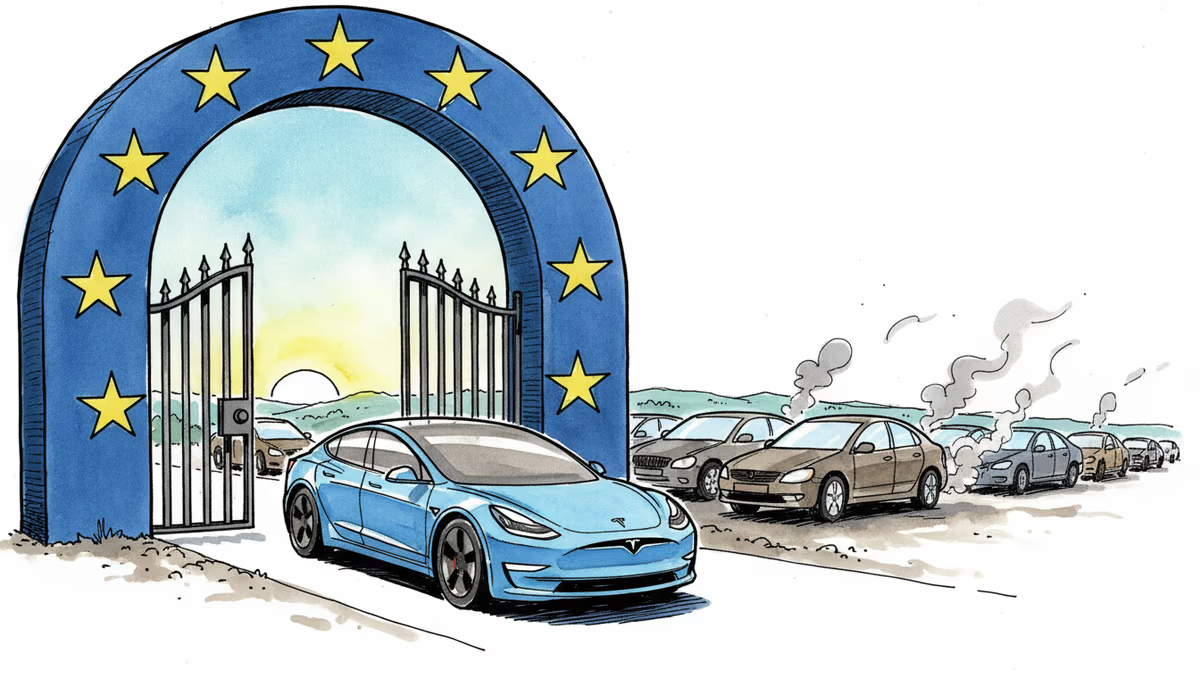
The Netherlands became the first European country to officially approve Tesla's FSD Supervised. With EU's type-approval framework, this could ripple across 27 member states fast.
Waymo's new Ojai robotaxi isn't just a vehicle upgrade. It's the company's most serious attempt yet at cracking the cost problem that has kept autonomous vehicles from scaling. Here's what's really at stake.
Elon Musk confirmed on Tesla's Q1 2026 earnings call that Hardware 3 vehicles will never receive unsupervised Full Self-Driving — locking out millions who paid for the feature.
Tesla expanded its driverless robotaxi to Dallas and Houston, even after reporting 14 crashes in Austin. What does this tell us about how autonomous vehicles actually get built?
The Netherlands became the first European country to officially approve Tesla's FSD Supervised. With EU's type-approval framework, this could ripple across 27 member states fast.
Thoughts
Share your thoughts on this article
Sign in to join the conversation