
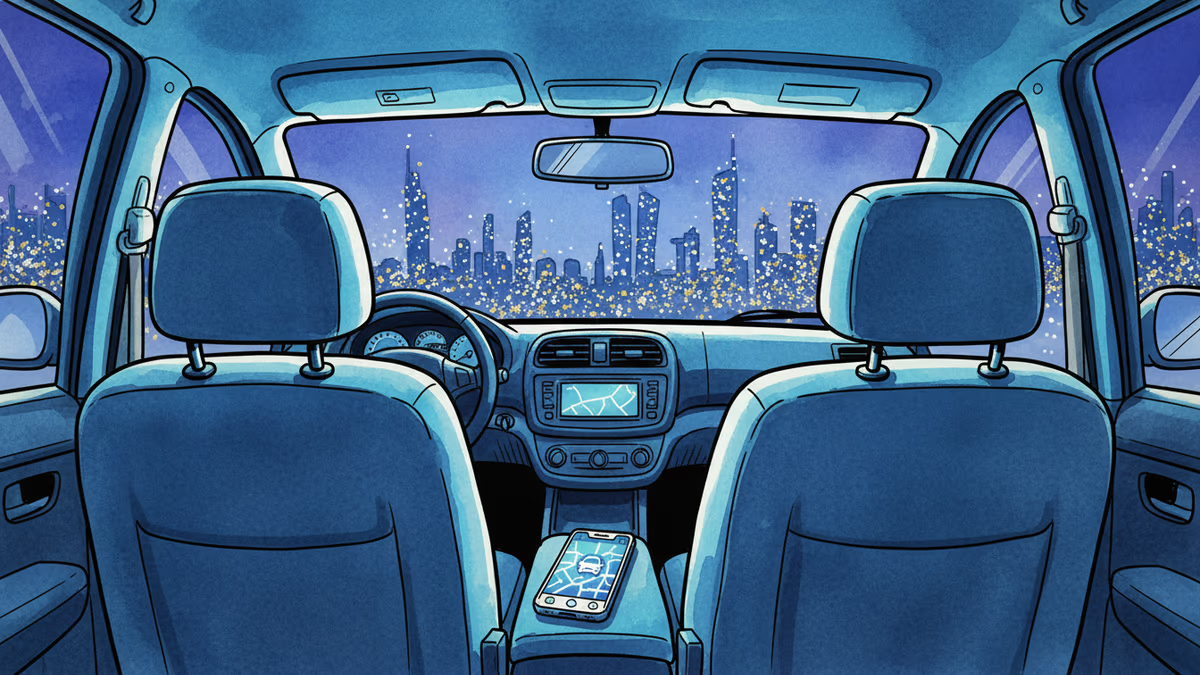
No Driver, No Problem? Dubai's Driverless Bet
Uber and WeRide have launched fully driverless robotaxi service in Dubai — no safety operator, real fares. Here's what it means for the global AV race and your next ride.
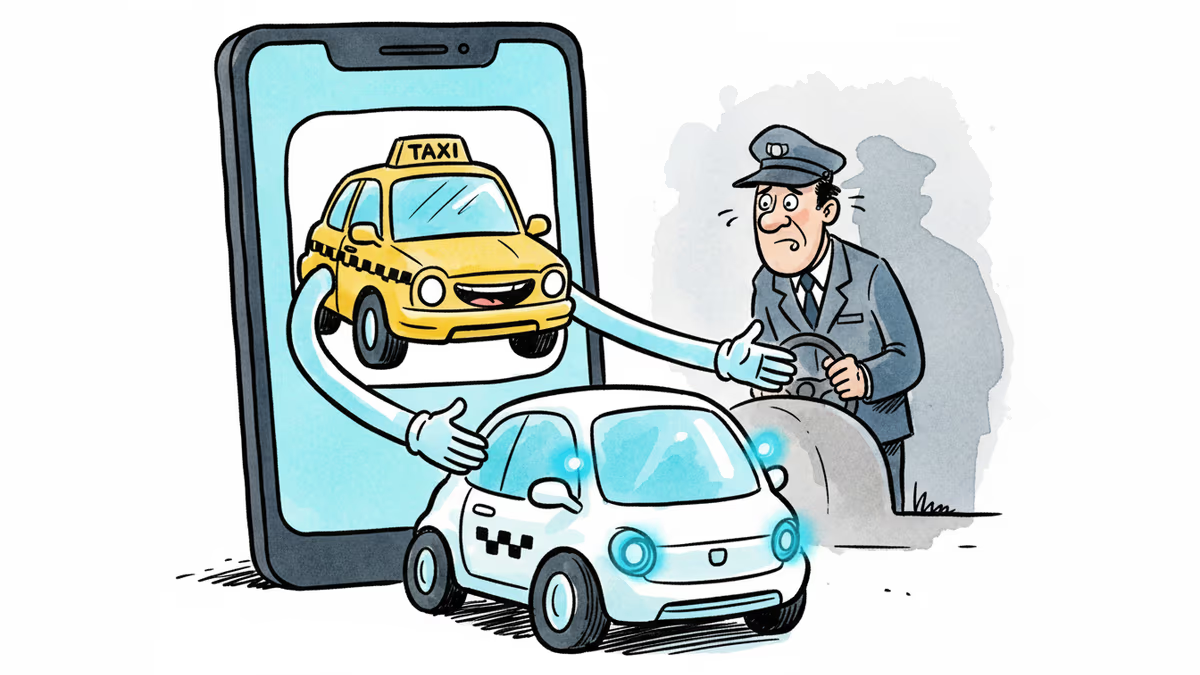
You open the app. The car arrives. The driver's seat is empty. You get in anyway.
That's not a thought experiment anymore. As of this month, it's Tuesday in Dubai.
Uber and Chinese autonomous vehicle company WeRide have launched a fully driverless robotaxi service in Dubai — no safety operator on board, real fares, real passengers. Riders book through the Uber app and get picked up in commercial zones including Dubai Silicon Oasis, Dubai Investment Park, Jabal Ali Industrial First, and the maritime hub Al Hamriya Port. Local fleet operations are handled by UAE mobility operator Tawasul.
From Pilot to Paid: What Changed
This didn't happen overnight. The two companies introduced robotaxis to Dubai in December under a pilot program — free rides, human safety operator on board. Then in February, Dubai's Roads and Transport Authority issued a driverless vehicle trial permit. Two months later: paid service, no human backup.
That's a fast regulatory clock. For context, Waymo spent years in San Francisco navigating permit battles before launching commercial driverless service. Dubai moved from pilot to permitted in roughly 60 days.
The financial architecture behind this move is worth understanding. Uber invested $100 million into WeRide in May 2025, forming a commercial robotaxi partnership targeting 15 cities over five years — including European cities. Documents filed Monday with the SEC show Uber now holds a 5.82% stake in WeRide, valued at approximately $400 million based on current share price. Uber's role mirrors its Waymo partnership: handle the network routing and demand side, let the AV company own the technology.
Why Dubai, Why Now
Dubai isn't a random choice. The emirate has positioned itself as a regulatory sandbox for emerging technology — from crypto to flying taxis to, now, driverless cars. The government has an explicit target of making 25% of all trips in Dubai autonomous by 2030. That political will creates a permitting environment that most Western cities simply don't have.

For WeRide, the strategic logic runs deeper than one market. The company, listed on Nasdaq, has been expanding aggressively beyond its home base in China. Abu Dhabi, Singapore, and now commercial Dubai service give WeRide a dataset that no purely domestic AV player can match: varied climates, road cultures, and regulatory frameworks. Dust, intense sunlight, and mixed-use industrial zones are edge cases that stress-test autonomous systems in ways that San Francisco's fog does not.
Sarfraz Maredia, Uber's global head of autonomous mobility and delivery, framed the launch in terms of resilience: "a hybrid world — where drivers and AVs operate side-by-side to create a more resilient network." That word, hybrid, is doing a lot of work. It's partly a message to Uber's existing driver base — this isn't a replacement, it's a complement. It's also an honest acknowledgment that full autonomy at scale is still years away in most cities.
Three Stakeholders, Three Very Different Reactions
For riders, the proposition is straightforward: cheaper fares over time as labor costs drop, potentially more consistent service. The catch is trust. Every driverless mile logged without incident builds the case; one serious accident can set back public acceptance by years. Uber and Waymo both know this. The choice to launch in lower-traffic industrial and port zones — rather than downtown tourist corridors — isn't accidental.
For Uber drivers, the hybrid framing only goes so far. Uber has approximately 7 million active drivers globally. The company's equity stake in WeRide is now worth $400 million. Every dollar Uber invests in autonomous vehicles is a dollar invested in reducing its dependence on human labor. Drivers in markets where AV expansion is fastest — Phoenix, San Francisco, now Dubai — are already feeling the competitive pressure on fares and ride volume.
For regulators and city planners, Dubai's model raises a harder question for Western democracies: speed versus process. The RTA moved fast because it could — there's no elected city council to answer to, no ballot initiative process, no class-action liability culture of the same scale as the US. That's a competitive advantage in technology deployment. It's also a governance model that doesn't simply transplant to London, Los Angeles, or Seoul.
The Waymo Comparison Nobody Wants to Ignore
Waymo is the benchmark. Its ridership in Phoenix and San Francisco has grown steeply — the company recently reported crossing 200,000 paid rides per week in the US. Its safety record, while not perfect, has been strong enough to sustain regulatory confidence.
WeRide is a different company in a different position. It's backed by Renault, Abu Dhabi's ADNOC, and now significantly by Uber. It operates in China, the Gulf, and is targeting Europe. But its public safety data is less transparent than Waymo's, and its US operational history is limited. The Dubai launch is a credibility-building exercise as much as a commercial one.
For investors, the comparison matters. Waymo remains private (Alphabet-owned). WeRide is the only major AV pure-play publicly traded on a US exchange. Uber's growing stake ties its own valuation increasingly to WeRide's success. If Dubai scales cleanly, that's a meaningful data point for anyone watching the AV investment thesis.
Authors
Related Articles
Waymo's new Ojai robotaxi isn't just a vehicle upgrade. It's the company's most serious attempt yet at cracking the cost problem that has kept autonomous vehicles from scaling. Here's what's really at stake.
Tesla expanded its driverless robotaxi to Dallas and Houston, even after reporting 14 crashes in Austin. What does this tell us about how autonomous vehicles actually get built?
A U.S. Senate investigation found that seven autonomous vehicle companies — including Waymo and Tesla — refused to disclose how often remote operators intervene in their vehicles. Here's why that silence matters.
Uber partners with China's Pony AI and Croatia's Verne to launch Europe's first commercial robotaxi service. Is this a survival strategy or a sign that the ride-hail giant is ceding its future to others?
Waymo's new Ojai robotaxi isn't just a vehicle upgrade. It's the company's most serious attempt yet at cracking the cost problem that has kept autonomous vehicles from scaling. Here's what's really at stake.
Tesla expanded its driverless robotaxi to Dallas and Houston, even after reporting 14 crashes in Austin. What does this tell us about how autonomous vehicles actually get built?
A U.S. Senate investigation found that seven autonomous vehicle companies — including Waymo and Tesla — refused to disclose how often remote operators intervene in their vehicles. Here's why that silence matters.
Uber partners with China's Pony AI and Croatia's Verne to launch Europe's first commercial robotaxi service. Is this a survival strategy or a sign that the ride-hail giant is ceding its future to others?
Thoughts
Share your thoughts on this article
Sign in to join the conversation