
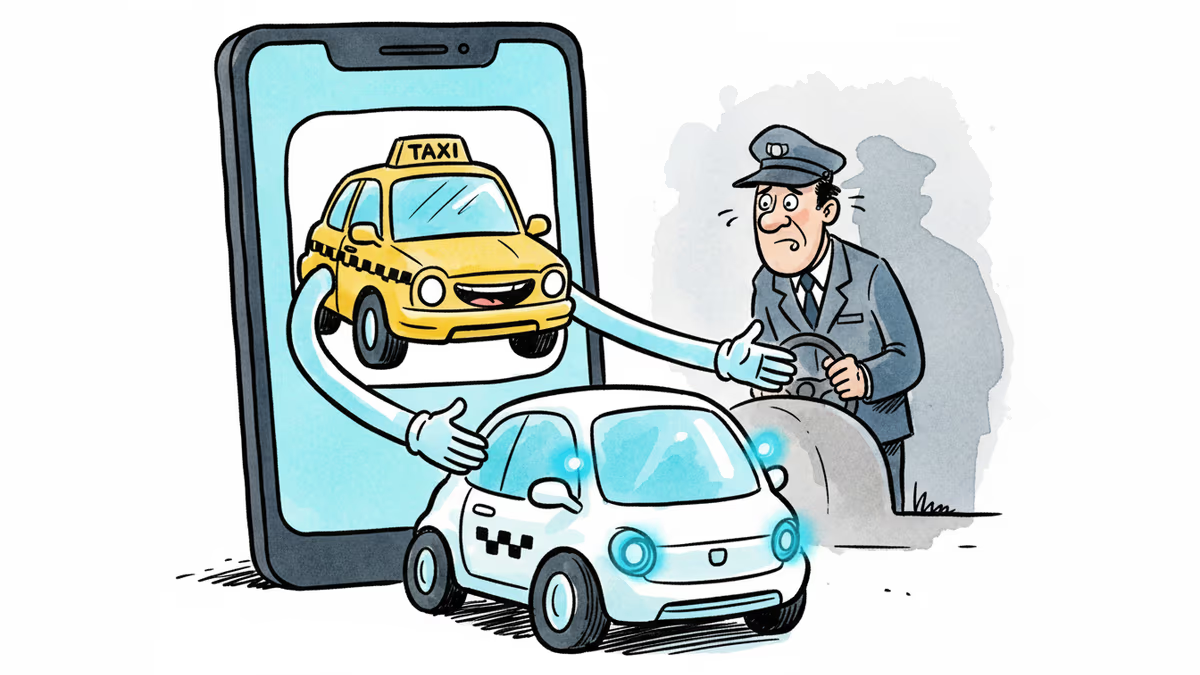
Uber's Robotaxi Bet: If You Can't Beat Them, Book Them
Uber partners with China's Pony AI and Croatia's Verne to launch Europe's first commercial robotaxi service. Is this a survival strategy or a sign that the ride-hail giant is ceding its future to others?
Every time Waymo expanded a city, every time Tesla teased a robotaxi reveal, Wall Street asked the same uncomfortable question: is Uber driving toward its own obsolescence?
Uber's answer, it turns out, isn't to out-engineer the competition. It's to become the road they all drive on.
Zagreb, Croatia: An Unlikely Ground Zero
Uber has announced a three-way partnership with Pony AI, a Chinese autonomous vehicle company listed on the Nasdaq, and Verne, a Croatian startup, to launch what it's billing as Europe's first commercially available robotaxi service. Test vehicles are already running in Zagreb, where Verne is headquartered, and the service will soon be accessible directly through the Uber app.
The structure of the deal reveals Uber's playbook. It won't build the cars. It won't write the self-driving code. Instead, it contributes what it already has: hundreds of millions of users, a trusted payment infrastructure, and a decade's worth of demand data across cities worldwide. Pony AI and Verne bring the hardware and the autonomy stack. The platform company stays a platform company — it just swaps out the human drivers.
Pony AI is no small bet. Operating robotaxis in Beijing, Guangzhou, and Shanghai, it's one of China's most advanced autonomous vehicle firms. Verne, lesser known internationally, has focused specifically on building vehicles suited to European regulatory frameworks — a non-trivial challenge given how fragmented mobility regulation remains across the EU.
The Math Behind the Partnership
Over the past year, Uber has signed autonomous vehicle partnerships with dozens of companies. This isn't a science project. It's an investor relations strategy with a clear financial logic.
If robotaxis displace human drivers, Uber loses its supply base. But if those robotaxis operate on Uber's platform, the company still collects its commission — and the portion previously paid to drivers becomes margin. The threat becomes a profit improvement story.

It's a compelling pitch. But not everyone's buying it.
The obvious counterargument: why would autonomous vehicle companies need Uber at all? Waymo already proved the point. After an early flirtation with Uber, it built its own app and expanded independently in San Francisco and Los Angeles. Tesla's robotaxi ambitions, if they materialize, come with their own direct-to-consumer model baked in. Chinese players like Baidu's Apollo Go are scaling fast domestically. Each of these companies has a long-term incentive to cut out the middleman.
Uber's counter is network density. Getting a robotaxi fleet profitable requires utilization — cars need to be moving, not parked. Uber can theoretically deliver demand faster than any newcomer can build it. Whether that advantage holds as competitors scale is the $80 billion question (roughly Uber's current market cap).
The Geopolitical Wrinkle Nobody's Talking About
There's a detail in this partnership worth sitting with: one of the two technology partners is a Chinese company.
Pony AI operates in a world where US and European regulators are increasingly scrutinizing Chinese technology in critical infrastructure. Connected vehicles — which collect real-time mapping data, passenger behavior, and urban movement patterns — are already under review in Washington. The Biden administration moved to restrict Chinese-made vehicle software last year; the current administration has shown no signs of reversing course.
Whether Pony AI's European expansion faces similar headwinds remains to be seen. Croatia is an EU member state. Zagreb is not Brussels or Berlin, but regulatory pressure has a way of traveling. If this service scales beyond its pilot city, the geopolitical dimension of this partnership could become as significant as the technical one.
What It Means for the Average Rider
For consumers, the near-term promise is straightforward: cheaper rides, available around the clock, with no awkward small talk. Robotaxis don't need tips, don't surge-price during rain, and don't cancel two minutes before pickup.
But the transition won't be frictionless. Trust is still being built. Robotaxi incidents — however rare — receive disproportionate media attention compared to the far higher rate of human-driver accidents. Regulators in most European cities are still writing the rulebooks. And for the millions of professional drivers whose livelihoods depend on platforms like Uber, the timeline of displacement matters enormously, even if the direction seems clear.
The Zagreb pilot is small. But pilots have a habit of becoming precedents.
Authors
Related Articles
Waymo's new Ojai robotaxi isn't just a vehicle upgrade. It's the company's most serious attempt yet at cracking the cost problem that has kept autonomous vehicles from scaling. Here's what's really at stake.
Auto China 2026 set records with 1,451 vehicles and 181 world premieres. But the real story isn't the size—it's how Chinese automakers stopped competing on price and started competing on brains.
Tesla expanded its driverless robotaxi to Dallas and Houston, even after reporting 14 crashes in Austin. What does this tell us about how autonomous vehicles actually get built?
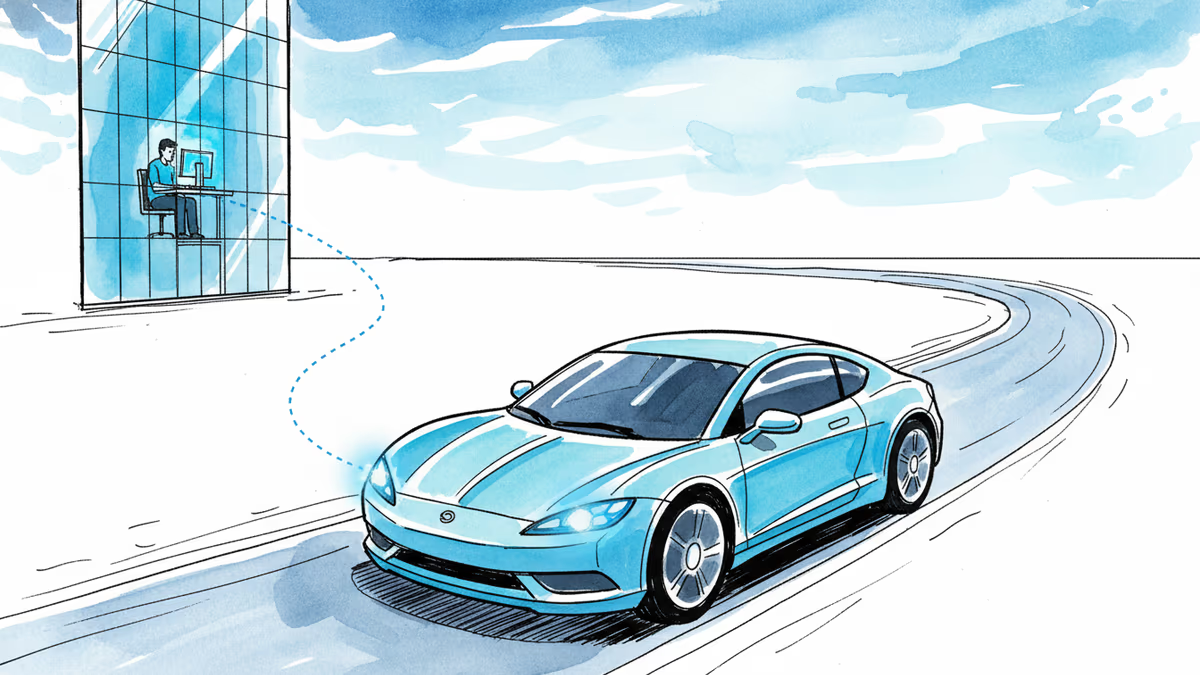
A U.S. Senate investigation found that seven autonomous vehicle companies — including Waymo and Tesla — refused to disclose how often remote operators intervene in their vehicles. Here's why that silence matters.
Waymo's new Ojai robotaxi isn't just a vehicle upgrade. It's the company's most serious attempt yet at cracking the cost problem that has kept autonomous vehicles from scaling. Here's what's really at stake.
Auto China 2026 set records with 1,451 vehicles and 181 world premieres. But the real story isn't the size—it's how Chinese automakers stopped competing on price and started competing on brains.
Tesla expanded its driverless robotaxi to Dallas and Houston, even after reporting 14 crashes in Austin. What does this tell us about how autonomous vehicles actually get built?
A U.S. Senate investigation found that seven autonomous vehicle companies — including Waymo and Tesla — refused to disclose how often remote operators intervene in their vehicles. Here's why that silence matters.
Thoughts
Share your thoughts on this article
Sign in to join the conversation