
Waymo's "Driverless" Cars Have 70 Human Helpers
Waymo reveals it employs 70 remote assistance agents, half based in the Philippines, to support its robotaxi operations when autonomous systems need help.
The 70 People Behind "Unmanned" Vehicles
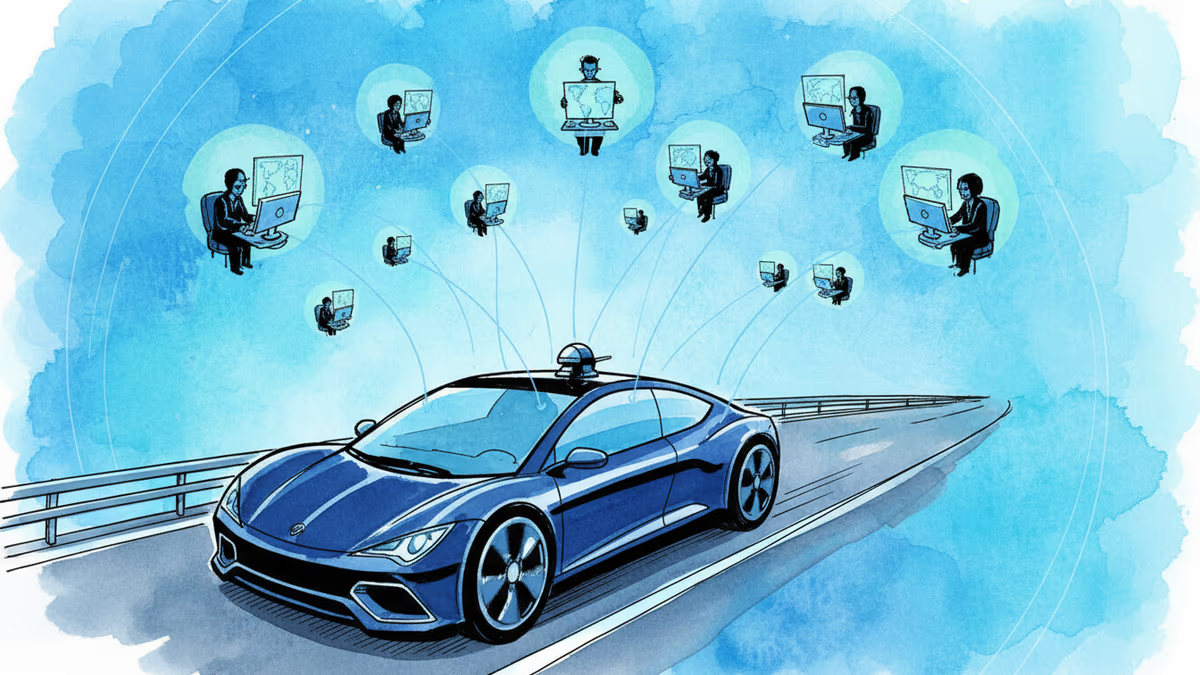
When a Waymo robotaxi navigates San Francisco streets, someone on the other side of the world might be watching. In a letter responding to Sen. Ed Markey's inquiry, Waymo disclosed it employs 70 "remote assistance agents" — with half based in the Philippines.
These agents provide "advice only when requested by the automated driving system," according to Waymo's head of global operations Ryan McNamara. But this revelation raises fundamental questions about what "fully autonomous" really means.
The Last Mile Problem
Waymo insists these agents only intervene on an "event-driven basis" — when vehicles encounter situations they can't handle alone. Construction zones, emergency vehicles, unexpected obstacles: the edge cases that represent autonomous driving's biggest challenge.
Industry experts call it the "last 5%" problem. While AI can handle routine driving with impressive reliability, those rare but critical moments still require human judgment. The question isn't whether this happens, but how often.
A Global Workforce for Local Streets

Waymo's decision to base half its remote agents in the Philippines reflects Silicon Valley's global labor arbitrage. With Bay Area engineer salaries exceeding $150,000, offshore operations offer significant cost savings.
But this creates a peculiar dynamic: Filipino workers making split-second decisions about American traffic situations they've never physically experienced. Cultural differences in driving norms, local traffic patterns, and emergency protocols could all factor into these remote interventions.
Safety vs. Economics
The Philippines deployment highlights a tension at the heart of autonomous vehicle operations. Companies need human oversight to ensure safety, but those humans don't necessarily need to be expensive Silicon Valley residents.
This model could reshape how we think about transportation jobs. Instead of eliminating human roles, autonomous vehicles might relocate them — from local drivers to global remote operators. The Uber driver displaced by a robotaxi might be replaced by a remote agent in Manila.
Regulatory Blind Spots
Sen. Markey's inquiry suggests growing regulatory scrutiny of autonomous vehicle operations. The revelation about overseas remote assistance raises questions about oversight, data privacy, and operational transparency that current regulations don't fully address.
Should companies be required to disclose their remote assistance operations? What standards should apply to overseas operators making safety-critical decisions about American roads? These questions will likely shape future AV regulations.
Authors
Related Articles
Waymo's new Ojai robotaxi isn't just a vehicle upgrade. It's the company's most serious attempt yet at cracking the cost problem that has kept autonomous vehicles from scaling. Here's what's really at stake.
Tesla expanded its driverless robotaxi to Dallas and Houston, even after reporting 14 crashes in Austin. What does this tell us about how autonomous vehicles actually get built?
A U.S. Senate investigation found that seven autonomous vehicle companies — including Waymo and Tesla — refused to disclose how often remote operators intervene in their vehicles. Here's why that silence matters.
Uber and WeRide have launched fully driverless robotaxi service in Dubai — no safety operator, real fares. Here's what it means for the global AV race and your next ride.
Waymo's new Ojai robotaxi isn't just a vehicle upgrade. It's the company's most serious attempt yet at cracking the cost problem that has kept autonomous vehicles from scaling. Here's what's really at stake.
Tesla expanded its driverless robotaxi to Dallas and Houston, even after reporting 14 crashes in Austin. What does this tell us about how autonomous vehicles actually get built?
A U.S. Senate investigation found that seven autonomous vehicle companies — including Waymo and Tesla — refused to disclose how often remote operators intervene in their vehicles. Here's why that silence matters.
Uber and WeRide have launched fully driverless robotaxi service in Dubai — no safety operator, real fares. Here's what it means for the global AV race and your next ride.
Thoughts
Share your thoughts on this article
Sign in to join the conversation