
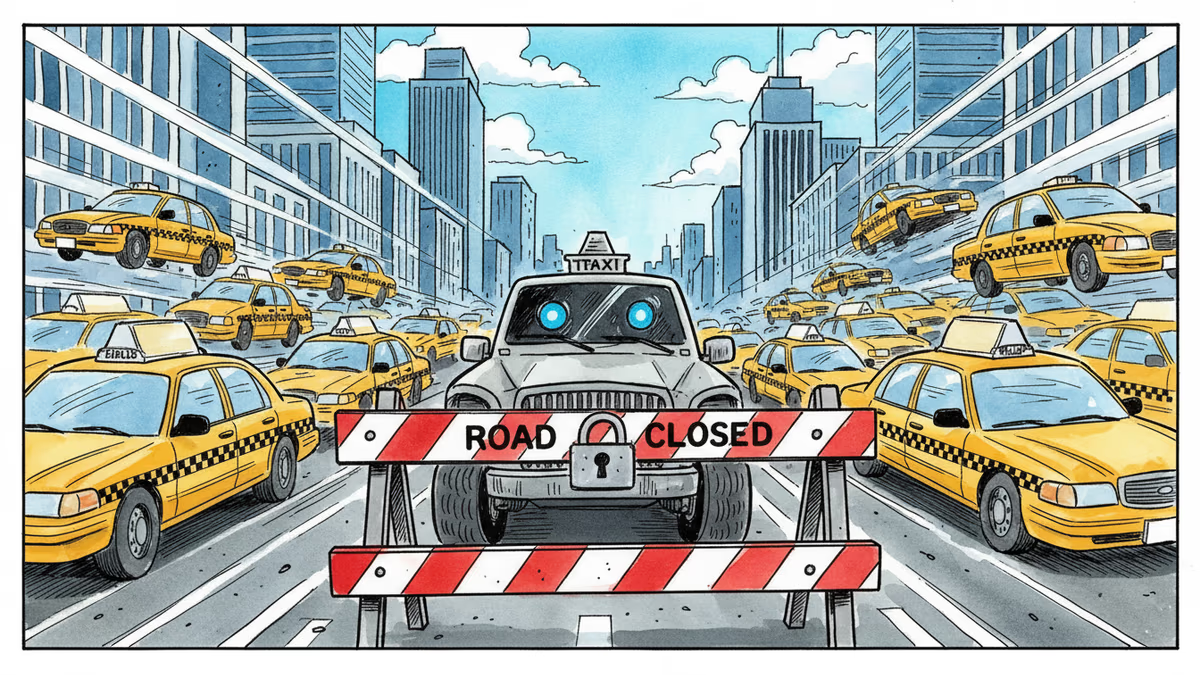
Why Waymo Can't Crack New York (Yet)
New York Governor Hochul withdrew a robotaxi legalization proposal, blocking Waymo's path to the nation's largest city. What this means for the autonomous vehicle industry's expansion strategy.
400,000 paid rides every week. That's Waymo's current scale across six U.S. cities. But America's largest city remains off-limits. New York Governor Kathy Hochul just pulled the plug on a proposal that would have legalized robotaxis statewide, leaving Waymo and other AV companies locked out of their biggest prize.
The $1 Million Entry Fee That Never Materialized
Hochul's original proposal would have amended New York's "one hand on the wheel" law that effectively bans driverless vehicles. Even if it had survived, the barriers were steep: a $1 million fee, $5 million in financial security, and a ban on operations in cities over one million people. That last clause would have excluded New York City anyway.
"Based on conversations with stakeholders, including in the legislature, it was clear that the support was not there," said Hochul's spokesperson. Translation: too much pushback, not enough political will.
Waymo currently operates under a much more restrictive pilot program, testing up to eight Jaguar I-Pace vehicles in Manhattan and downtown Brooklyn with safety drivers behind the wheel. The permit expires March 31.
A Tale of Two Regulatory Approaches
The contrast is stark. While New York maintains tight restrictions, Waymo operates commercial services in Atlanta, Austin, Miami, Phoenix, Los Angeles, and the San Francisco Bay Area. The company aims to hit one million weekly rides by year-end.

California has embraced fully driverless robotaxis. Texas and Arizona maintain lighter regulatory touches. But New York—along with most East Coast states—remains cautious. The result? A patchwork regulatory landscape that's shaping where AV companies can scale.
Why New York Matters Beyond Market Size
For Waymo, New York isn't just about revenue potential. It's about proving the technology works in America's most complex urban environment. "We hear from thousands of New Yorkers who have experienced Waymo in other cities and want access to it at home," the company said.
But New York's caution reflects legitimate concerns. The city's transportation ecosystem—subways, buses, taxis, ride-hailing, and aggressive pedestrians—presents unique challenges. Add job displacement fears for the city's 13,000 taxi drivers, and political resistance becomes understandable.
The Broader Stakes
This setback reveals a fundamental tension in AV deployment. Tech companies want rapid scaling to justify massive investments. Regulators want measured approaches to ensure public safety and minimize disruption.
Waymo has invested over $7 billion in autonomous driving technology. Every month of delayed expansion in major markets represents lost revenue and competitive positioning. Meanwhile, Chinese companies like Baidu are rapidly deploying robotaxis in dozens of cities.
Authors
Related Articles
Waymo's new Ojai robotaxi isn't just a vehicle upgrade. It's the company's most serious attempt yet at cracking the cost problem that has kept autonomous vehicles from scaling. Here's what's really at stake.
A U.S. Senate investigation found that seven autonomous vehicle companies — including Waymo and Tesla — refused to disclose how often remote operators intervene in their vehicles. Here's why that silence matters.
Alphabet's new pay deal for Sundar Pichai links his compensation to Waymo and Wing performance—signaling where Google is placing its biggest bets. Here's what investors should actually read into it.
Swedish startup Einride raises $113M ahead of NYSE debut, deploying 200 autonomous trucks for major brands. The logistics revolution accelerates.
Waymo's new Ojai robotaxi isn't just a vehicle upgrade. It's the company's most serious attempt yet at cracking the cost problem that has kept autonomous vehicles from scaling. Here's what's really at stake.
A U.S. Senate investigation found that seven autonomous vehicle companies — including Waymo and Tesla — refused to disclose how often remote operators intervene in their vehicles. Here's why that silence matters.
Alphabet's new pay deal for Sundar Pichai links his compensation to Waymo and Wing performance—signaling where Google is placing its biggest bets. Here's what investors should actually read into it.
Swedish startup Einride raises $113M ahead of NYSE debut, deploying 200 autonomous trucks for major brands. The logistics revolution accelerates.
Thoughts
Share your thoughts on this article
Sign in to join the conversation