
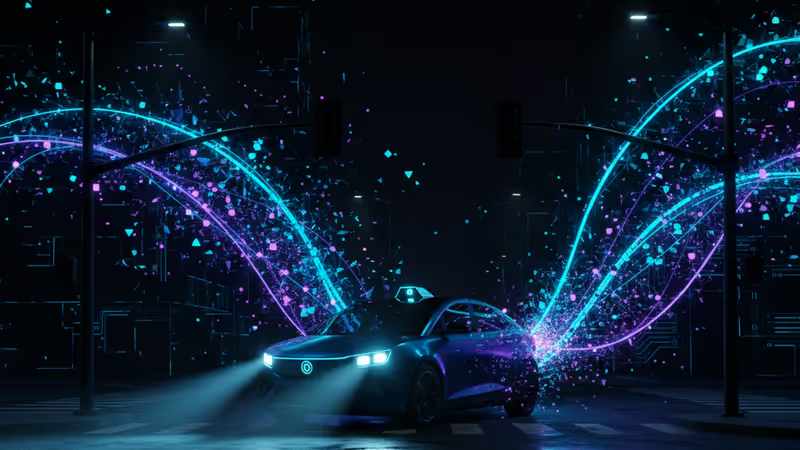
Waymo Halts Robotaxi Service in San Francisco Amid Massive Blackout, Cars Reportedly Block Traffic
Waymo suspended its robotaxi service in San Francisco during a city-wide blackout after vehicles were seen blocking traffic. The incident highlights the vulnerability of autonomous tech to infrastructure failures.
Waymo suspended its driverless robotaxi service in San Francisco on Saturday night after a major power outage plunged nearly a third of the city into darkness. According to The San Francisco Standard, the blackout was caused by a fire at a Pacific Gas and Electric (PG&E) substation, leaving residents without power for hours.
During the outage, San Franciscans began sharing photos and videos on social media showing Waymo vehicles that appeared to be stopped in intersections, causing traffic congestion. In response, Waymo announced that evening that it had suspended service due to the power failures, as reported by Mission Local.

“We have temporarily suspended our ride-hailing services in the San Francisco Bay Area due to the widespread power outage,” Waymo spokesperson Suzanne Philion told Mashable in an emailed statement. “Our teams are working diligently and in close coordination with city officials, and we are hopeful to bring our services back online soon.” However, the company didn't specify what percentage of its fleet was impacted or provide a technical reason for why the driverless vehicles stopped working during the blackout.
This is the latest in a recent series of incidents putting Waymo's reliability under scrutiny. Just this month, a viral video showed a driverless Waymo seemingly driving straight into oncoming traffic. In a separate event, a Los Angeles woman discovered a stranger hiding in the trunk of her Waymo. The company also issued a software recall following reports of its cars illegally passing school buses in Austin. This follows a wave of criticism back in November, when a Waymo vehicle struck and killed a beloved neighborhood cat in San Francisco.
Authors
Related Articles
Waymo's new Ojai robotaxi isn't just a vehicle upgrade. It's the company's most serious attempt yet at cracking the cost problem that has kept autonomous vehicles from scaling. Here's what's really at stake.
Tesla expanded its driverless robotaxi to Dallas and Houston, even after reporting 14 crashes in Austin. What does this tell us about how autonomous vehicles actually get built?
A U.S. Senate investigation found that seven autonomous vehicle companies — including Waymo and Tesla — refused to disclose how often remote operators intervene in their vehicles. Here's why that silence matters.
Uber and WeRide have launched fully driverless robotaxi service in Dubai — no safety operator, real fares. Here's what it means for the global AV race and your next ride.
Waymo's new Ojai robotaxi isn't just a vehicle upgrade. It's the company's most serious attempt yet at cracking the cost problem that has kept autonomous vehicles from scaling. Here's what's really at stake.
Tesla expanded its driverless robotaxi to Dallas and Houston, even after reporting 14 crashes in Austin. What does this tell us about how autonomous vehicles actually get built?
A U.S. Senate investigation found that seven autonomous vehicle companies — including Waymo and Tesla — refused to disclose how often remote operators intervene in their vehicles. Here's why that silence matters.
Uber and WeRide have launched fully driverless robotaxi service in Dubai — no safety operator, real fares. Here's what it means for the global AV race and your next ride.
Thoughts
Share your thoughts on this article
Sign in to join the conversation