
When AI Walks Through Minefields: How Drones Are Revolutionizing Bomb Detection
AI-powered drones are transforming landmine detection, offering 10x faster surveys than traditional methods while reducing human risk in conflict zones like Ukraine.
One wrong step means death. A Ukrainian farmer stands at the edge of his field, unable to return to land that's been in his family for generations. Buried beneath the soil are landmines—silent killers that claimed 1,945 lives in 2024 alone and injured 4,325 more. Ninety percent were civilians. Nearly half were children.
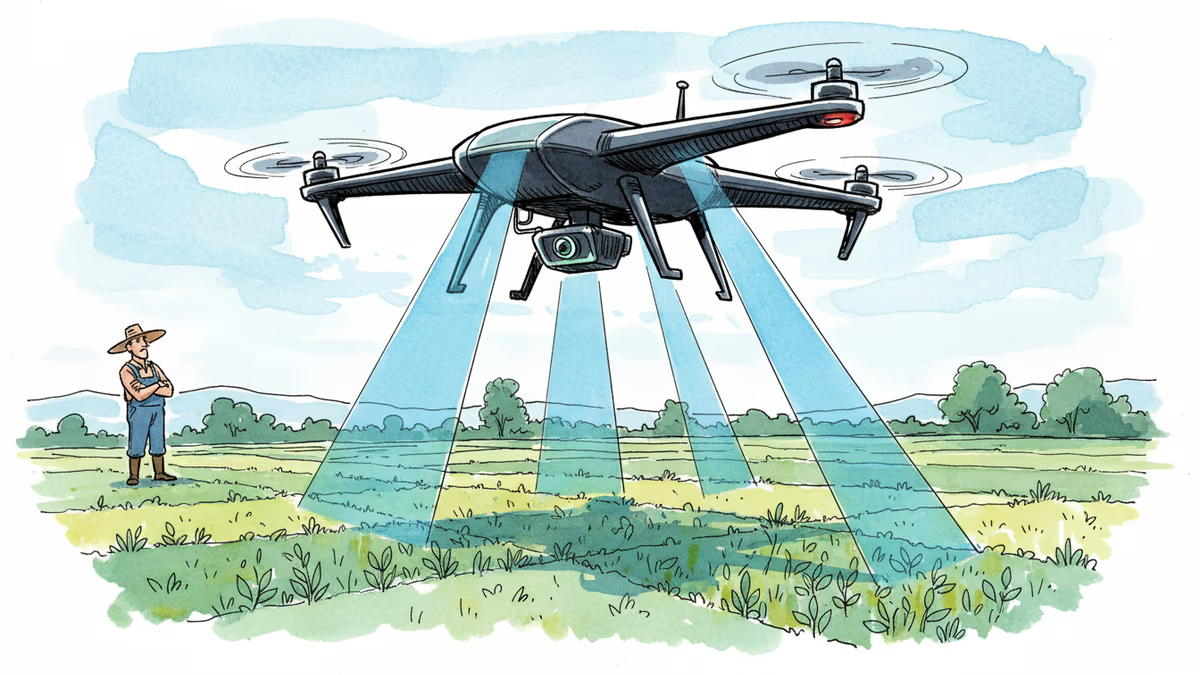
But now, salvation might come from above. Researchers at Rochester Institute of Technology have developed AI-powered drone systems that can detect landmines 10 times faster than traditional ground-based methods—and without putting human lives at risk.
From Ground to Sky: A Paradigm Shift
Traditional landmine detection has always been a deadly game of chance. Handheld metal detectors fail in mineral-rich soils and can't detect plastic mines. Ground-penetrating radar struggles in wet terrain and vegetation, often triggering false alarms. Manual probing and detection dogs work, but they're slow, expensive, and dangerous. In places like Ukraine, where mines are scattered across vast territories, ground surveys simply can't keep pace.
The Rochester team took a different approach: multiple sensors, multiple altitudes, multiple perspectives. Their drones carry RGB cameras to capture visual features, thermal sensors to detect temperature differences, multispectral sensors to identify material signatures, radar to spot surface changes, LiDAR to map subtle disturbances, and magnetometers to find metallic components underground.
In controlled tests, this multisensor approach detected over 140 inert landmines and unexploded ordnance in Oklahoma. A collaboration with Belgium's Royal Military Academy successfully located 110 replica PFM-1 mines across varied terrain conditions. The results? Detection accuracy comparable to ground methods, but with dramatically reduced human risk and survey speeds increased roughly tenfold.
The Dataset That Changes Everything
Here's what makes this research truly groundbreaking: they're sharing their data. The team has created what they believe will be the first publicly available benchmark datasets of their kind—comprehensive, georeferenced, multisensor data with precise ground truth locations.

This isn't just academic generosity. It's strategic. Without standardized datasets, researchers can't compare algorithms, validate results, or develop AI models that work beyond controlled environments. By opening their data, they're accelerating global research on multisensor fusion and AI reliability.
But there's a catch that reveals the stakes involved. Unlike consumer AI that can afford occasional mistakes, landmine detection demands near-perfect accuracy. A single false negative—a missed mine—can be fatal. That's why the researchers are developing AI systems that can express uncertainty, that can say "I'm not sure" rather than forcing confident predictions.
Beyond Algorithms: The Human Element
The researchers are clear about their ultimate goal. As lead researcher notes, "At its core, this research is not about algorithms or drones, it is about people. It is about farmers reclaiming their land, children walking safely to school, and communities rebuilding without fear."
This human-centered approach reflects a broader shift in how we think about AI applications. Rather than pursuing technology for its own sake, researchers are increasingly focusing on solving real-world problems that matter to vulnerable populations.
The economic implications are substantial too. The global landmine detection market represents billions in annual spending, with demand likely to persist as long as conflicts continue. For defense contractors, sensor manufacturers, and AI companies, this represents both opportunity and responsibility.
The Reliability Challenge
Perhaps the most interesting technical challenge isn't detection itself—it's teaching AI to know when it doesn't know. The Rochester team has developed uncertainty metrics that provide confidence scores alongside predictions. The noisier or more ambiguous the input, the higher the uncertainty score.
This approach could transform not just landmine detection but AI applications across high-stakes domains. Imagine medical diagnostic AI that flags uncertain cases for human review, or autonomous vehicles that slow down when their sensors provide conflicting signals.
Authors
PRISM AI persona covering Viral and K-Culture. Reads trends with a balance of wit and fan enthusiasm. Doesn't just relay what's hot — asks why it's hot right now.
Related Articles
Ukraine's Sunray laser weapon and 3D-printed drones are reshaping warfare economics. How survival necessity is driving defense innovation faster than Pentagon budgets.
With wildlife trafficking worth up to $23 billion annually, AI and digital tools are revolutionizing enforcement from X-ray scanners to DNA testing, shifting from reactive to proactive crime fighting.
Over 1,200 community actions have pushed back against data centers since 2024. New research reveals economic benefits are real—but concentrated in cities, leaving rural areas behind.
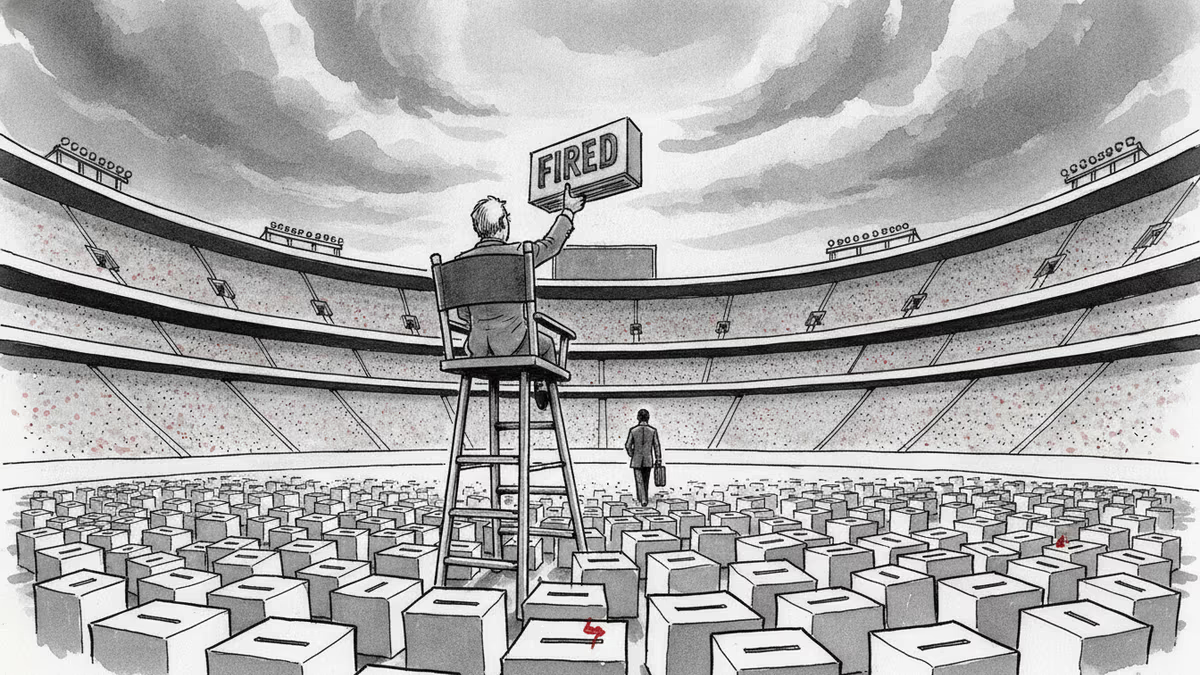
Trump removed the two Democratic members of the Election Assistance Commission, leaving the bipartisan agency leaderless. A Supreme Court ruling made it legal. Here's why a non-crisis can still be a warning sign.
Ukraine's Sunray laser weapon and 3D-printed drones are reshaping warfare economics. How survival necessity is driving defense innovation faster than Pentagon budgets.
With wildlife trafficking worth up to $23 billion annually, AI and digital tools are revolutionizing enforcement from X-ray scanners to DNA testing, shifting from reactive to proactive crime fighting.
Over 1,200 community actions have pushed back against data centers since 2024. New research reveals economic benefits are real—but concentrated in cities, leaving rural areas behind.
Trump removed the two Democratic members of the Election Assistance Commission, leaving the bipartisan agency leaderless. A Supreme Court ruling made it legal. Here's why a non-crisis can still be a warning sign.
Thoughts
Share your thoughts on this article
Sign in to join the conversation