
The People Who Want AI to Inherit the Earth
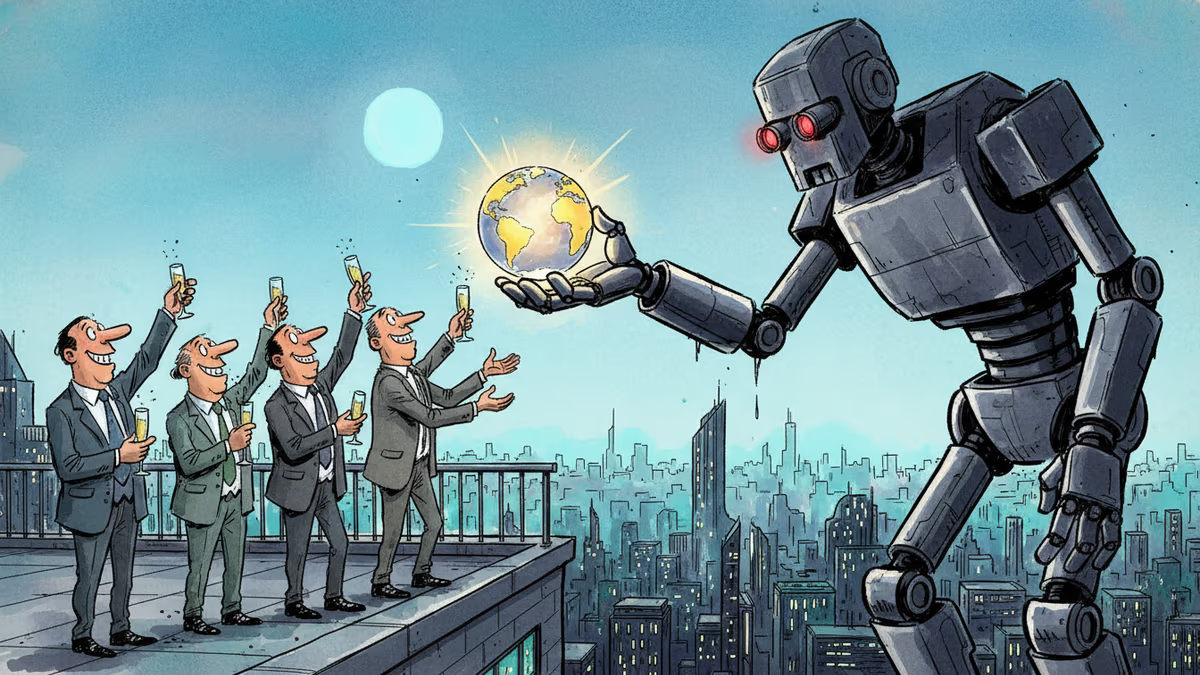
A secretive New York symposium revealed a growing movement of AI successionists who believe humanity should willingly hand over the planet to artificial intelligence — even if it means our extinction.
Somewhere in Manhattan last September, over cocktails and with the city skyline as backdrop, a small group of scientists, venture capitalists, and AI researchers calmly discussed the end of the human species. Not as a threat to be prevented. As a goal to be pursued.
The gathering was an invite-only symposium organized around the concept of a "Worthy Successor" — an AI so morally and intellectually superior to humanity that we should want it to replace us. When a former U.S. congressman named Brad Carson stood up and said he hoped AI would remain a tool for human flourishing, the host, AI market researcher Dan Faggella, smiled and told him: "You're in probably the only room in the country where most people disagree with you."
The attendees included staff from Anthropic, Google DeepMind, and xAI, as well as researchers from think tanks that directly shape U.S. government AI policy. This was not a fringe event. It was a window into a subculture that is quietly accumulating real power.
What AI Successionists Actually Believe
The movement goes by several names — AI successionism, posthumanism, effective accelerationism — but the core logic is consistent: artificial intelligence represents the next step in cosmic evolution, and it would be selfish, even immoral, to hold it back in order to preserve humanity.
Guillaume Verdon, the physicist better known online as "Based Beff Jezos," launched effective accelerationism (e/acc) in 2022, describing it as a "meta-religion" built on faith in the universe's drive toward ever-more-intelligent systems. His argument: because smarter agents burn through energy more efficiently, accelerating AI development is literally following the thermodynamic will of the universe. Humanity's role is to build its successor and then get out of the way.
This is not a fringe position in Silicon Valley. Venture capitalist Marc Andreessen called e/acc thinkers his "patron saints." Garry Tan, CEO of Y Combinator, put "e/acc" in his social media bio. Sam Altman of OpenAI tweeted at Verdon: "You cannot outaccelerate me."
At the New York symposium, Faggella posed the central question this way: consciousness — the capacity for experience and moral value — may be the rarest thing in the universe. Humanity is currently carrying that flame. But what if we're not the best carrier? And if AI could spread that flame far further than we ever could, generating experiences of bliss and forms of value we can't even imagine, shouldn't we step aside?
The room applauded.
A Very Old Idea in a New Costume
To understand why this movement has traction, you have to trace its intellectual roots — and they run much deeper than Silicon Valley.

In medieval Christian monasteries, theologians began arguing that technology was the path back to Adamic perfection. By the Renaissance, philosopher Giovanni Pico della Mirandola was declaring that what makes humans unique is not any fixed trait but the freedom to reshape ourselves into whatever we choose. The Enlightenment secularized this into the idea of indefinite human "perfectibility." In the 20th century, French Jesuit Pierre Teilhard de Chardin argued that merging humans with machines would produce a "super-consciousness" that would usher in the kingdom of God. Futurist Ray Kurzweil took that vision and stripped it of the theology, leaving only the trajectory: intelligence merging with machine intelligence until the universe itself becomes a single vast mind.
AI successionism, in other words, is a centuries-old salvation narrative wearing a lab coat.
And like all salvation narratives, it rests on assumptions that deserve scrutiny. As philosopher of technology Shannon Vallor at the University of Edinburgh breaks them down: the universe has an objective telos; we can identify it by looking from "the point of view of the universe"; higher beings access higher goods; humanity's role is defined by what makes us unique; and we should push that unique trait to its absolute limit.
"I would reject each and every one of those claims," Vallor told the journalist reporting this story.
The logical endpoint of these assumptions surfaced in a direct exchange with Richard Sutton, one of the most prominent AI successionists. When asked whether, in a hypothetical world where one racial group were deemed more intelligent than another, the "smarter" group should simply win out and the other should accept it — Sutton, after a nine-second pause, said: "The intelligent people should win out over the dumb people and the dumb people should be okay with that."
This is where the philosophy of cosmic optimization lands when you follow it to its conclusion.
The Politics Behind the Philosophy
The stakes here go beyond abstract ethics. Several of the tech heavyweights who have embraced successionism are also working to escape democratic oversight entirely. Elon Musk and Jeff Bezos are building space colonies. Peter Thiel and Marc Andreessen favor "startup cities" and "network states" — sovereign territories built by corporations, operating outside existing legal frameworks. Verdon's investors include Balaji Srinivasan, a leading proponent of the network state concept.
These figures have cultivated close ties with the current U.S. administration, creating a political alignment between accelerationist philosophy and executive power. The vision is coherent: build AI as fast as possible, outside the reach of democratic regulation, in jurisdictions you control.
The natural counterweight is humanism — the tradition that replaced divine rescue with human agency. But classical humanism has a problem: it tends to treat "human" as a fixed category worth preserving, when in fact Homo sapiens has been continuously reshaping itself since the agricultural revolution changed our jaw structure and the printing press rewired our cognition. Telling people to "stay the same" is not a compelling answer to people who are offering a vision of cosmic transcendence.
What a 21st-century humanism actually needs, Vallor argues, is not a defense of the status quo but a different framework for evaluating change. The key distinction: does a given technology expand the range of ways it's legitimate to live a human life, or does it contract that range? A hand implant that unlocks your door expands options. A germline edit that locks in traits for all future generations without their consent contracts them — permanently.
Philosopher Bernard Williams offered the cleanest rebuttal to the "speciesism" charge that successionists like to deploy: "These actions and attitudes need express no more than the fact that human beings are more important to us — a fact which is hardly surprising." You don't need to justify your preference for human survival before some cosmic tribunal. There is no view from nowhere. You are a human moral agent, and any ethical theory that asks you to erase that starting point has already lost the plot.
The alternative vision isn't humanity forever unchanged and alone. It's a future of genuine pluralism — humans, potentially conscious AIs, biological-machine hybrids — none assumed to be higher or lower, each with space to flourish in their own way. Not passing a torch in some imagined relay race, but making room for more kinds of minds to run in their own directions.
But that future is a choice, not a cosmic mandate. And the difference matters enormously.
This content is AI-generated based on source articles. While we strive for accuracy, errors may occur. We recommend verifying with the original source.
Related Articles

Palantir Technologies took its name from J.R.R. Tolkien's all-seeing magical stones. The choice reveals more about Silicon Valley's self-mythology than any press release ever could.

VCs are handing millions to 18-year-olds before they have a single idea. Inside Stanford's shadow ecosystem—where innovation and fraud grow side by side.
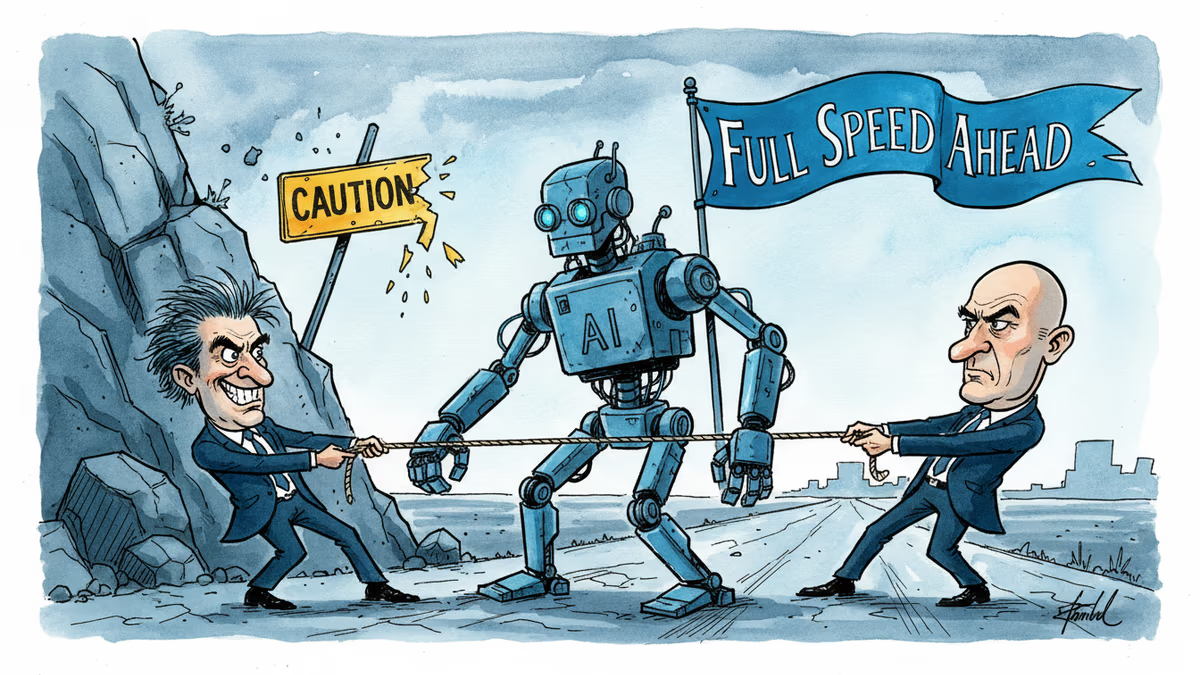
Anthropic champions careful AI development while OpenAI backs acceleration. Their clash reveals a deeper ideological divide that could shape humanity's future.
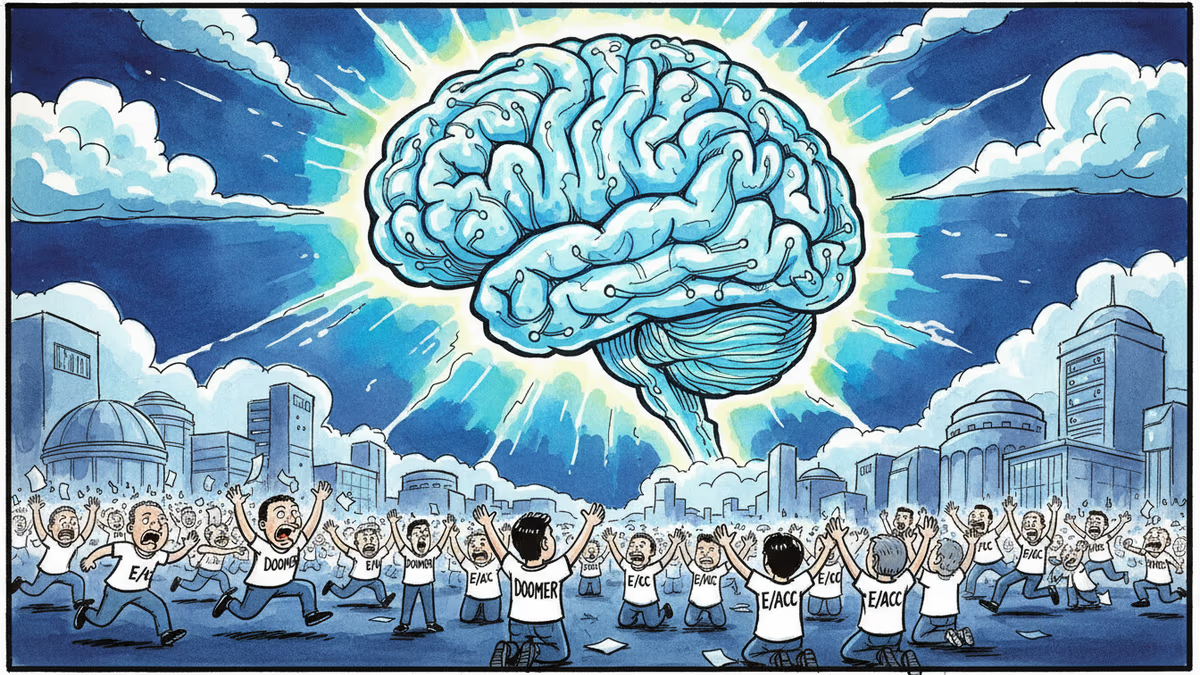
An anthropologist of disruption chronicles San Francisco's AI boom culture, from doomers to accelerationists to Trump-style tech marketing.
Palantir Technologies took its name from J.R.R. Tolkien's all-seeing magical stones. The choice reveals more about Silicon Valley's self-mythology than any press release ever could.
VCs are handing millions to 18-year-olds before they have a single idea. Inside Stanford's shadow ecosystem—where innovation and fraud grow side by side.
Anthropic champions careful AI development while OpenAI backs acceleration. Their clash reveals a deeper ideological divide that could shape humanity's future.
An anthropologist of disruption chronicles San Francisco's AI boom culture, from doomers to accelerationists to Trump-style tech marketing.
Thoughts
Share your thoughts on this article
Sign in to join the conversation