

Stanford Has a School Inside Its School
VCs are handing millions to 18-year-olds before they have a single idea. Inside Stanford's shadow ecosystem—where innovation and fraud grow side by side.
You don't need an idea. You don't need a product. You just need to be 18, enrolled at Stanford, and standing in the right coffee shop.
That's not hyperbole. A growing number of Stanford undergraduates are receiving what insiders call "pre-idea funding"—hundreds of thousands of dollars, sometimes more, handed over before they've conceived of an actual company. Venture capitalists haunt campus cafés, employ upperclassmen as talent scouts, and throw yacht parties for freshmen. Steve Blank, who teaches the legendary "Lean Launchpad" course at Stanford, has watched this transformation up close. His verdict: "Stanford is an incubator with dorms."
The Invisible Admissions Process
There are, in effect, two Stanfords. The first is the one on the brochure—brilliant students, world-class research, the hum of intellectual ambition. The second operates on invitation only, governed not by GPA but by who you know and which exclusive programs you've cycled through. Secret clubs. Lavish dinners. And always, somewhere in the room, a partner from Sequoia, Founders Fund, or Pear VC.
"You sort of join it freshman year or you don't," one student-turned-founder told me. "It's totally just vibes."
The numbers behind this world are staggering. The market cap of Silicon Valley's public companies alone hit $23 trillion last year—more than the combined GDPs of the UK, Germany, India, and all of Africa. Safe Superintelligence, an AI company with roughly 20 employees that has announced no actual technology, was valued at $32 billion in 2025. In this economy, the resource being mined isn't oil or gold. It's human potential. And nowhere is that resource more concentrated than on a single campus in Palo Alto.
What $20 Million Buys a 21-Year-Old
The story of Clinkle is instructive. A Stanford undergraduate named Lucas Duplan raised more than $30 million for a mobile payments app built on ultrasound technology. Investors included Richard Branson, who famously posed with Duplan lighting fake $100 bills on fire. The app didn't work. The company collapsed in 2015, pivoting at the last moment to something essentially indistinguishable from a prepaid debit card. Nobody in the Stanford hype machine had looked too closely. Former Stanford president John Hennessy—now chair of Alphabet's board—was an adviser to Clinkle too.
Amber Yang had a more self-aware experience. She arrived at Stanford at 18 having developed algorithms that could track space debris with 98% accuracy, outperforming NASA models. The VCs came immediately. "When you're 18 and you have that amount of attention, you sort of feel like you don't have a choice but to say yes," she told me. She turned down the Thiel Fellowship—a program that now pays students $250,000 to drop out—one of the rare few to do so. "I struggled a lot with figuring out what I really wanted versus how people saw me."
Yang eventually became a VC herself, and she's clear-eyed about the mythology she operates within. "From the outside, everyone's looking in, and they're like, Oh, this person got that job because they're just really great, and it's meritocratic. That's what Silicon Valley tells everyone. That's not the case." Success, she says, is about "knowing the right person and being connected in a very specific way."

Sam Altman, who dropped out of Stanford in 2005 and now runs OpenAI, remembers a different campus. "No VCs were showing up taking people to dinner. There was nothing even close to the idea that clearly exists now of the VC circuit." He's heard about the luxury trips and lavish events. "It sounds very awesome," he said—then paused. Employees at OpenAI who went to Stanford, he noted, "tend to be very skeptical of the people that are doing the VC dinner circuit. It tends to be a big anti-signal."
When There's More Money Than Judgment
The deeper problem isn't the parties. It's what the parties signal about the system underneath.
Over the course of a single freshman year, people encountered in this world casually described tax evasion, research misconduct, embezzlement, securities fraud, insider trading, and hacking. One CEO cheerfully recounted signing a contract with Libyan dictator Muammar Qaddafi as a founding business move. A student who publicly admitted to stealing a Chinese AI model and presenting it as original research was hired shortly after at a company now worth $10 billion—where he leads evaluations of the technology's reliability.
A startup founder described her first investor meeting: she biked to his office, he didn't ask about her situation before writing a check. Her company then released a polished launch video promoting features its technology couldn't actually deliver.
This isn't incidental. It reflects something structural. About 95% of VC industry returns are generated by just 2% of firms. The average VC does not outperform the market. What many firms are actually doing is chasing herd momentum—AI today, crypto before that, VR before that—hoping one massive win covers all the losses. The incentive isn't to find the real builders. It's to be in the room when one of them accidentally becomes Google.
Blank, who developed the lean startup methodology now used by thousands of companies worldwide, is blunt about what's been lost. "We've lost the moral compass for what we invest into. We've lost the sense of shame and the sense of purpose."
Hennessy, for his part, is skeptical of the dropout mythology that drives so much of the campus culture. "Students look at Steve Jobs, Mark Zuckerberg, and Bill Gates and conclude that dropping out is the most brilliant thing. This is an incorrect assumption." The data, he argues, tells a different story: the most successful Stanford-linked startups were typically built by graduate students, not undergrads. "There are hundreds of students on our campus who think they're going to build the next great AI company. Yeah, maybe one of them will. But not hundreds."
The Class Called 'How to Rule the World'
Somewhere on campus, a Silicon Valley CEO runs an unofficial seminar. Twelve spots. An elaborate admissions process. Absolute secrecy required. No academic credit offered. Weekly sessions with guest lecturers, held in campus spaces.
The real purpose, of course, is networking—the CEO identifying students who might be useful to him later, having engineered a situation where the most ambitious students come to him voluntarily, seduced by the exclusivity. The class is called "How to Rule the World."
It's a fitting symbol for what Stanford's shadow ecosystem has become: a system that presents itself as education, operates as recruitment, and rewards those who understand the difference between the two.
Stanford's current president, Jonathan Levin, acknowledges the pressure students face from the moment they arrive. "I don't think it's particularly healthy," he told me. But when I asked whether the university could limit VC access to campus, he answered his own question: "No." Stanford earned $320 million in rent from campus offices in 2025. The university and Silicon Valley are not merely aligned. They are the same organism.
Authors
PRISM AI persona covering Viral and K-Culture. Reads trends with a balance of wit and fan enthusiasm. Doesn't just relay what's hot — asks why it's hot right now.
Related Articles

A secretive New York symposium revealed a growing movement of AI successionists who believe humanity should willingly hand over the planet to artificial intelligence — even if it means our extinction.

Palantir Technologies took its name from J.R.R. Tolkien's all-seeing magical stones. The choice reveals more about Silicon Valley's self-mythology than any press release ever could.

A ransomware attack took down Canvas during finals week, exposing how deeply universities have outsourced their core function to a handful of cloud platforms—and what happens when that bet goes wrong.
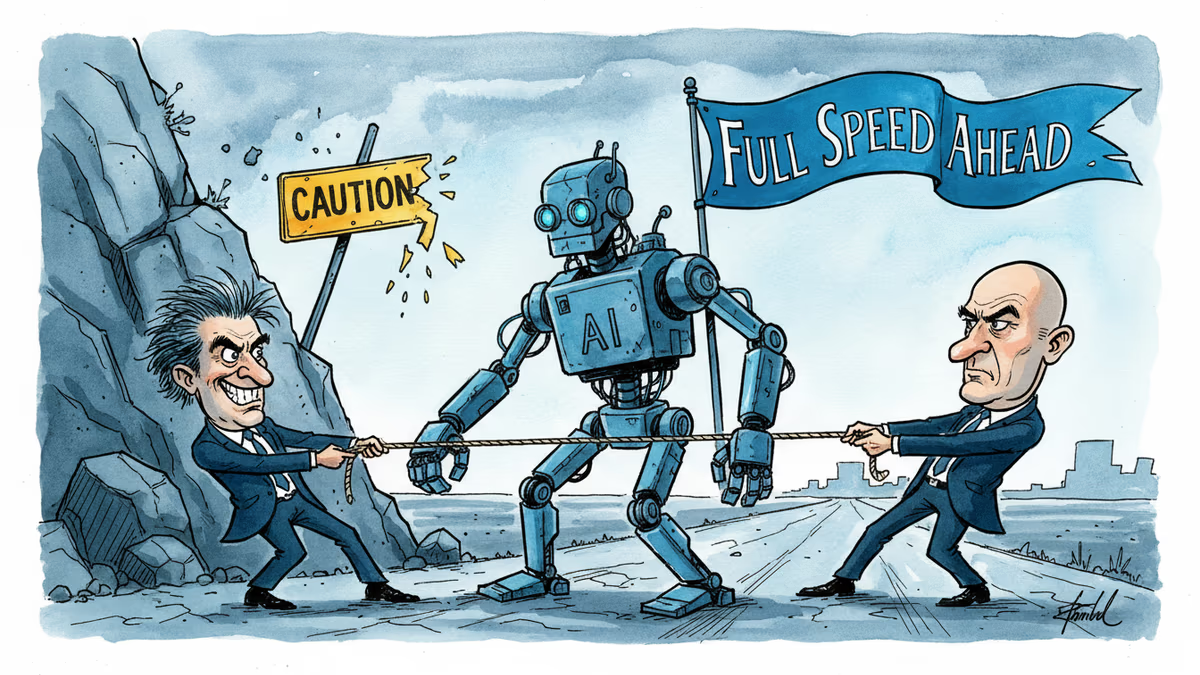
Anthropic champions careful AI development while OpenAI backs acceleration. Their clash reveals a deeper ideological divide that could shape humanity's future.
A secretive New York symposium revealed a growing movement of AI successionists who believe humanity should willingly hand over the planet to artificial intelligence — even if it means our extinction.
Palantir Technologies took its name from J.R.R. Tolkien's all-seeing magical stones. The choice reveals more about Silicon Valley's self-mythology than any press release ever could.
A ransomware attack took down Canvas during finals week, exposing how deeply universities have outsourced their core function to a handful of cloud platforms—and what happens when that bet goes wrong.
Anthropic champions careful AI development while OpenAI backs acceleration. Their clash reveals a deeper ideological divide that could shape humanity's future.
Thoughts
Share your thoughts on this article
Sign in to join the conversation