
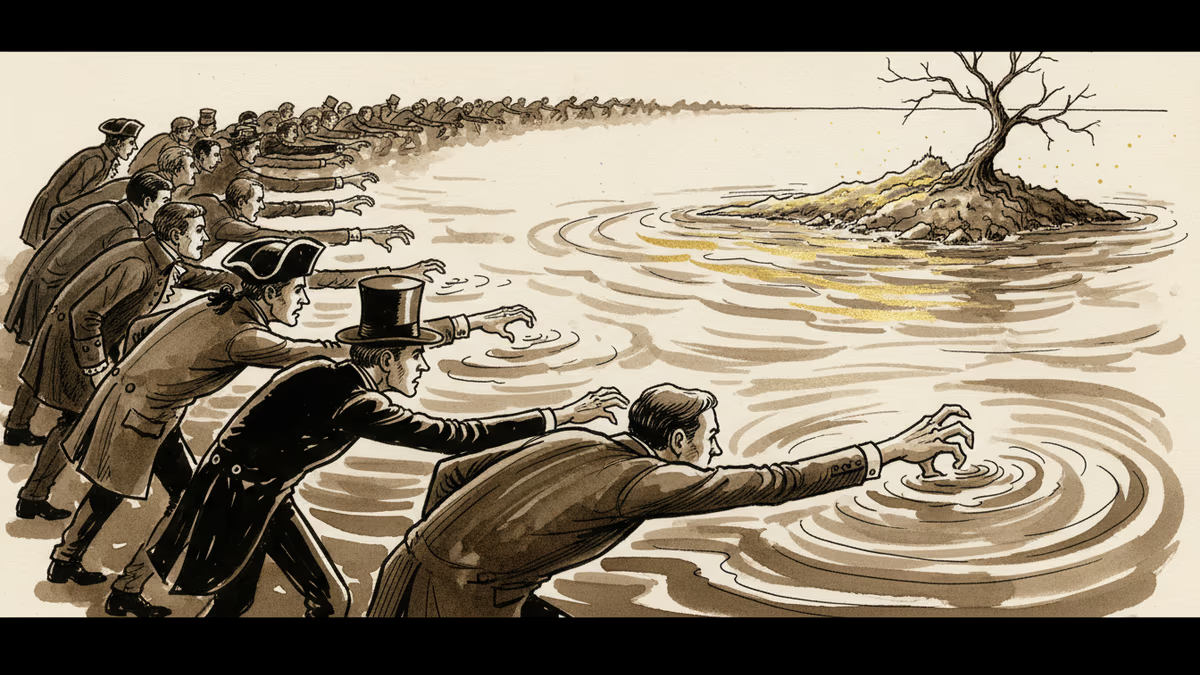
America Has Wanted Cuba for 200 Years
Trump says he wants to 'take' Cuba. But this desire isn't new—it stretches back to Thomas Jefferson. Why this centuries-old obsession is coming to a head right now.
"I do believe I'll be having the honor of taking Cuba." Donald Trump said that in the Oval Office in March 2025—then added, for good measure, "Whether I free it, take it—I think I could do anything I want with it." Crude words. But the desire behind them? That's been sitting in the American psyche for over 200 years.
What's Happening on the Ground
Cuba is in a slow-motion collapse. Residents of Havana are enduring up to 22 to 23 hours of blackouts per day. In rural areas, power disappears for days at a stretch. Food prices have soared beyond reach. Garbage rots uncollected in the streets. Hospital generators have gone silent. At night, people bang pots and pans in protest, burning trash because no one is coming to take it away.
The pressure behind this crisis is, in large part, American. The Trump administration cut off oil supplies flowing from Venezuela and Mexico to Cuba, strangling the island's energy supply. More recently, Washington imposed sanctions on Cuba's nickel and cobalt mines—one of the last remaining sources of hard currency for the regime. Most of that mineral revenue had been flowing to China, which is why the move carries a dual logic: squeeze the Castro government and deny Beijing access to critical minerals in the Western Hemisphere.
The legal machinery has also been set in motion. The Justice Department recently indicted 95-year-old Raúl Castro—Fidel's brother and the man who ran Cuba for over a decade—on murder charges tied to the shooting down of two civilian aircraft 30 years ago that killed four U.S. nationals. Around the same time, the USS Nimitz, the oldest active aircraft carrier in the U.S. Navy, was repositioned to the Caribbean. In January, Venezuelan President Nicolás Maduro was extracted by U.S. commandos and flown to the United States. Administration officials barely waited before turning their gaze south.
Two Men, Two Motivations
To understand the current moment, it helps to separate the two most powerful voices shaping U.S. Cuba policy—because they want different things.
Marco Rubio, the Secretary of State, is an idealist with a personal score. His parents left Cuba shortly before Fidel Castro took power in 1959. He grew up in Florida's Cuban exile community, steeped in the stories of what the revolution took from families like his. For Rubio, dismantling the Castro regime isn't just foreign policy—it's a lifelong political identity. On May 20th, Cuban Independence Day, he delivered an address in Spanish directly to the Cuban people. Notably, he barely mentioned freedom or democracy. Instead, he focused on GAESA, the military conglomerate that controls much of Cuba's economy—a signal that his vision is less about liberation rhetoric and more about structural dismantlement.
Trump operates from a different playbook entirely. He wants a deal. Hotels on the coast. Minerals flowing north. American companies back in business. In Venezuela, the regime didn't actually change—just the face at the top. Acting President Delcy Rodríguez opened the door to U.S. oil companies, and Trump praised her publicly. The same transactional arithmetic could, in theory, apply to Cuba. The idealist and the dealmaker are, for now, pulling in roughly the same direction—but toward very different end states.

A 200-Year Pattern
Ada Ferrer, a Cuban-American historian at Princeton and Pulitzer Prize-winning author of Cuba: An American History, describes this moment as "unprecedented in living memory"—and yet entirely familiar.
The desire to control Cuba runs through American history like a fault line. In the early 1800s, Thomas Jefferson argued that the security of the young republic depended on acquiring Cuba. Havana sat at the mouth of the Gulf of Mexico; whoever held it could choke American commerce through New Orleans. By the mid-19th century, pro-slavery interests saw Cuba—then the world's largest sugar producer and one of the Atlantic world's major slave societies—as a potential addition to the Union as multiple slave states.
The most consequential chapter came in 1898. After three decades of Cuban wars of independence against Spain, the U.S. intervened, framing it as humanitarian support for a sister nation seeking freedom. When the fighting ended, the Americans didn't leave. They eventually departed in 1902—but only after forcing Cubans to embed the Platt Amendment into their own constitution. That amendment gave the United States the legal right to intervene militarily in Cuba whenever it deemed American lives or business interests at risk. It also handed Washington the land that became Guantánamo Naval Base.
Then came 1959. Castro's revolution is widely misread, Ferrer argues. Its unifying cry wasn't communism or anti-Americanism—it was the restoration of the 1940 constitution and the removal of the corrupt Batista dictatorship. The radicalization came later, driven in significant part by escalating U.S. pressure. When the new government nationalized American-owned land five months after taking power, Washington responded with increasing hostility. Each side escalated; each escalation pushed Castro further left. "The U.S. did things that pushed Castro further left," Ferrer says plainly. America, in a real sense, helped build the adversary it spent the next six decades trying to dismantle.
Why This Time Is Different—and Why It Might Not Be
The administration is confident. Officials describe extensive planning and point to Cuba's deepening crisis as proof that the regime is ripe for change. But foreign policy analysts and Cuba experts are considerably more cautious.
The core problem is the opposition—or rather, its absence. Seven decades of one-party rule have fragmented, exiled, and surveilled Cuba's dissident community into incoherence. In Venezuela, the U.S. could lean on an opposition with elected representatives and a recognized popular base. In Cuba, there is no equivalent. Whoever Washington might try to install would lack domestic legitimacy from day one. History offers no encouraging precedents for externally imposed leadership in Cuba.
Ferrer's deepest worry isn't failure—it's violence. If a military or law enforcement operation goes sideways, the consequences could include Cuban-on-Cuban conflict, mass migration flows toward Florida, and a humanitarian disaster that would land squarely on the United States' doorstep. She also flags a subtler danger: the rhetoric itself. When both sides escalate their language—Trump promising to "take" Cuba, Cuban officials vowing a "bloodbath" in response—the words can generate their own momentum. "Combative rhetoric can create its own reality," she warns. "It mounts. It creates its own sense of inevitability."
For now, the Trump administration remains consumed by the Iran situation, raising real questions about bandwidth. But the USS Nimitz is in the Caribbean. The indictment is filed. And the pattern is in motion.
This content is AI-generated based on source articles. While we strive for accuracy, errors may occur. We recommend verifying with the original source.
Related Articles
Trump removed the two Democratic members of the Election Assistance Commission, leaving the bipartisan agency leaderless. A Supreme Court ruling made it legal. Here's why a non-crisis can still be a warning sign.
Lebanon and Israel signed a framework agreement in June 2026. Hezbollah rejected it. Israel kept fighting. History suggests this moment is real—and fragile.
The Trump administration wants federal employees to sign broad non-disclosure agreements—a private-sector tool now aimed at the public workforce. What happens when government runs like a corporation?
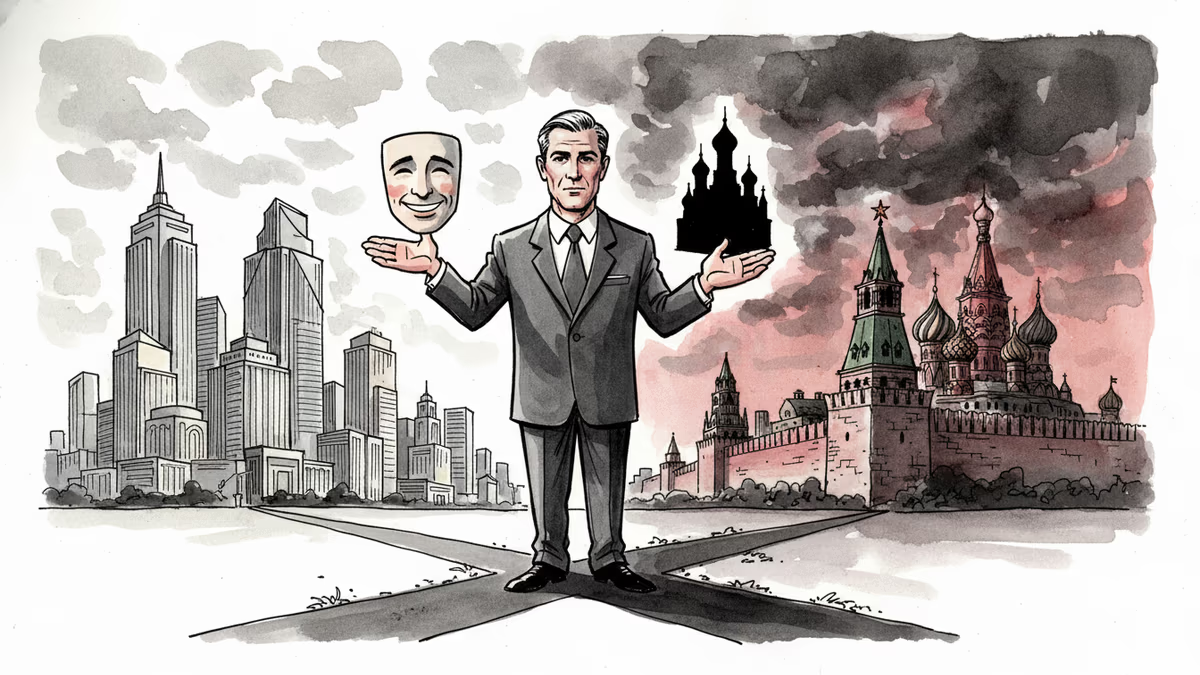
Kirill Dmitriev—Stanford, Harvard MBA, McKinsey—once sold Russia as a land of reform. Now he's selling out Ukraine's sovereignty in Mar-a-Lago backrooms. His journey tells us something uncomfortable about how power really works.
Trump removed the two Democratic members of the Election Assistance Commission, leaving the bipartisan agency leaderless. A Supreme Court ruling made it legal. Here's why a non-crisis can still be a warning sign.
Lebanon and Israel signed a framework agreement in June 2026. Hezbollah rejected it. Israel kept fighting. History suggests this moment is real—and fragile.
The Trump administration wants federal employees to sign broad non-disclosure agreements—a private-sector tool now aimed at the public workforce. What happens when government runs like a corporation?
Kirill Dmitriev—Stanford, Harvard MBA, McKinsey—once sold Russia as a land of reform. Now he's selling out Ukraine's sovereignty in Mar-a-Lago backrooms. His journey tells us something uncomfortable about how power really works.
Thoughts
Share your thoughts on this article
Sign in to join the conversation