
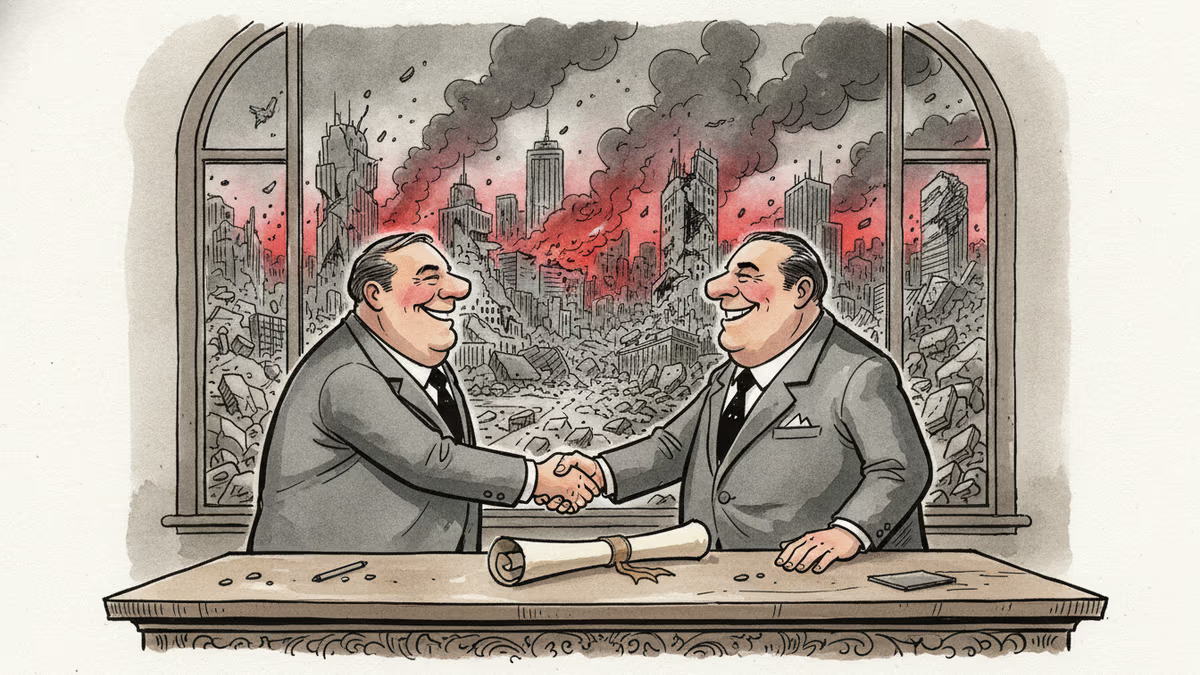
A Peace Deal Signed. A War Still Running.
Lebanon and Israel signed a framework agreement in June 2026. Hezbollah rejected it. Israel kept fighting. History suggests this moment is real—and fragile.
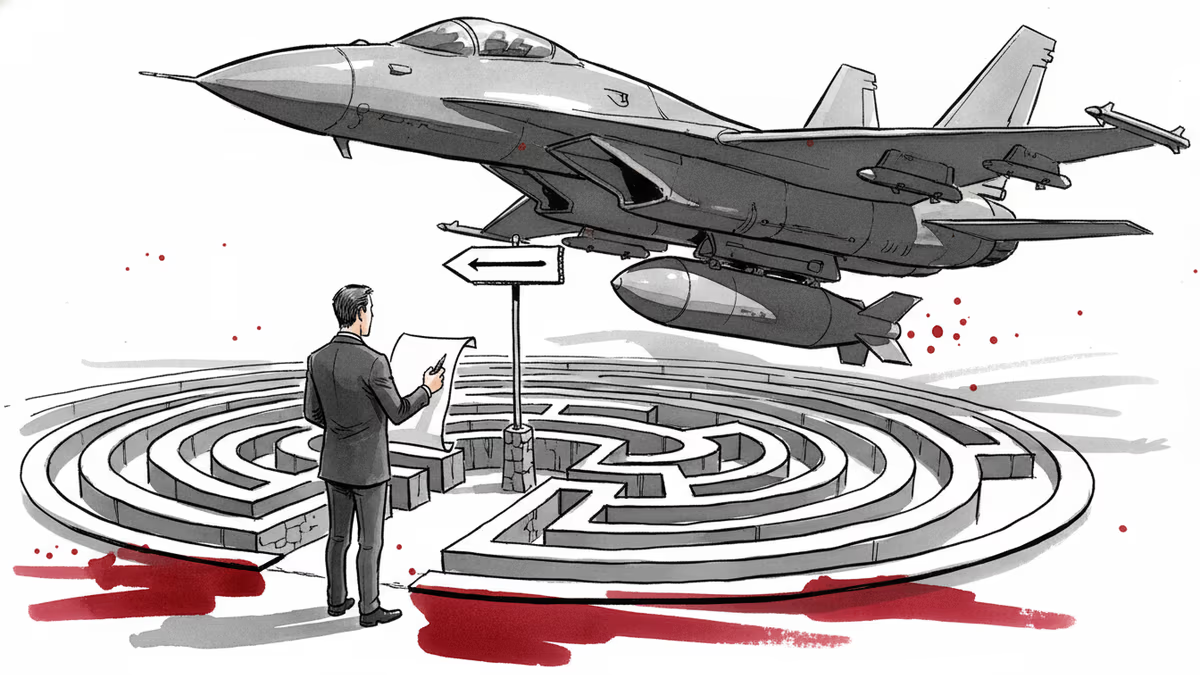
The cameras captured the handshake. Lebanon's ambassador and Israel's ambassador sat side by side, signed the papers, and made history—at least on paper. At that same moment, Israeli military operations were still running inside Lebanese territory.
The Most Consequential Deal in 80 Years—If It Holds
In June 2026, Lebanon and Israel formalized a framework agreement that experts are calling the most significant accord between the two countries since the 1949 U.N.-brokered armistice that ended the first Arab-Israeli war. The deal is ambitious by any measure: peaceful relations between the two states, a road map to disarm Hezbollah, full Israeli withdrawal from Lebanese soil, and the restoration of Lebanese sovereignty over its entire territory.
The problem is that every single one of those provisions is, right now, a fiction. Hezbollah has flatly rejected the agreement. Israel has not stopped its military operations. And the Lebanese government—the party that would actually have to implement the deal—is watching its domestic credibility erode with every Israeli airstrike that lands on Lebanese soil. You cannot enforce an agreement when the government signing it is being undermined in real time.
A Pattern Written in Failed Ceasefires
Researchers who have studied armed conflict and peace processes in the Middle East point to an uncomfortable pattern. The ceasefires of 1993, 1996, 2006, 2024, and April 2026 between Israel and Hezbollah all share the same trajectory: a pause in fighting, followed by a resumption. Each lull, it turns out, was used by both sides to rebuild capabilities, consolidate gains, and wait for the next opening.
The most instructive precedent is the 1983 agreement. Israel and Lebanon signed a deal promising peace and normalization in exchange for Israeli withdrawal. It collapsed within a year. Anti-government forces launched a coordinated offensive against Lebanese army positions in West Beirut, shattering the government's authority and splitting the military along sectarian and ideological lines. The agreement didn't fail because of bad faith at the negotiating table. It failed because the Lebanese state lost the capacity to implement it.
The vacuum that followed gave Hezbollah the conditions it needed to grow. Born from a network of Shiite Islamist militants, the group announced itself to the world by attacking an Israeli military base in 1982, then carried out the 1983 bombings of the U.S. Embassy in Beirut and the barracks housing American Marines and French peacekeepers. Backed by sustained Iranian support and a powerful narrative of resistance to Israeli occupation, Hezbollah spent the next four decades becoming one of the most capable non-state armed groups in the world.
The disarmament question was either left off the table entirely—as in the 1993 and 1996 ceasefires—or folded into a 2006 U.N. Security Council resolution that contained no credible enforcement mechanism. The result was the same each time: Hezbollah used the calm to rearm, regroup, and retain the initiative over when the next round of conflict would begin.

Why This Moment Is Different—and Why It Might Not Be Enough
For all of that history, the current situation contains elements that genuinely distinguish it from previous cycles.
Israel's military campaigns have significantly degraded Hezbollah's capabilities. Lebanese public opinion has shifted—many Lebanese, including within the Shiite community, are blaming Hezbollah for dragging the country into repeated, devastating conflicts. Anger toward Iran, Hezbollah's main patron, is growing. These are not marginal shifts. They represent a meaningful change in the political landscape that Hezbollah has operated in for decades.
Lebanon's President Joseph Aoun and Prime Minister Nawaf Salam, who came to power in 2025, are trying to convert this shift into policy. They are pursuing Hezbollah's disarmament in line with the 2006 U.N. resolution—provisions that for years existed only on paper. For the first time in a long time, those provisions look like a concrete possibility rather than a diplomatic aspiration.
But the window is narrow, and it is being squeezed from both sides. Prime Minister Benjamin Netanyahu faces elections with few of the stated objectives of Israel's war with Iran achieved. Continuing military operations in Lebanon offers domestic political advantages: it delays proceedings in his ongoing criminal trial and lets him campaign as a wartime leader. Hezbollah, meanwhile, is doing the opposite calculation—Israel's continued military presence on Lebanese soil is the single most effective tool for reclaiming the resistance narrative that gives the group its legitimacy. Every Israeli airstrike is a recruitment poster.
The paradox, as researchers put it, borders on tragic: Israel's continued operations risk repeating the very strategic mistake that created Hezbollah in the first place, breathing new life into an adversary it has brought to the brink.
What Would Actually Make This Work
History does offer examples of agreements that held. The 1949 armistice worked for roughly two decades, sustained by genuine international backing and U.N. monitoring. The 1973 Arab-Israeli war produced something unexpected: Egyptian and Israeli commanders met face to face along the Suez–Cairo road, under U.N. auspices, because both sides had an interest in stopping the fighting. That direct contact eventually produced the 1979 Egyptian-Israeli peace treaty—the most durable peace agreement in the modern Middle East.
More recently, U.S. envoy Amos Hochstein demonstrated that even entrenched Israel-Lebanon disputes are not beyond negotiation, brokering the 2022 maritime boundary agreement and beginning work on the land border. Those efforts were overtaken by the October 7, 2023 Hamas attacks and the regional wars that followed—but they showed that sustained American engagement can produce real results.
What experts argue is needed now is not just diplomacy, but professionalized diplomacy: the kind that designs implementation mechanisms, maintains pressure on both parties, and doesn't end when the cameras leave the signing ceremony. That means American pressure on Israel to curtail military operations on Lebanese territory. It means security assistance and financial support to enable the Lebanese military to actually extend government authority into the south. And it means sustained international backing for a Lebanese government that is trying to do something no Lebanese government has successfully done in forty years.
Moments like this, researchers note, don't arrive by design. They emerge from the unintended convergence of military outcomes, political shifts, and diplomatic initiative. They are also fleeting. The history of the Israel–Lebanon conflict is full of openings that closed before anyone could consolidate them.
This one has the contours of a real opportunity. It also has the fragility of a mirage.
This content is AI-generated based on source articles. While we strive for accuracy, errors may occur. We recommend verifying with the original source.
Related Articles
Trump says he wants to 'take' Cuba. But this desire isn't new—it stretches back to Thomas Jefferson. Why this centuries-old obsession is coming to a head right now.
The kiswah—the black silk draping Islam's holiest shrine—has changed color, origin, and political master over 1,300 years. Its history is a map of Islamic power itself.
Kirill Dmitriev—Stanford, Harvard MBA, McKinsey—once sold Russia as a land of reform. Now he's selling out Ukraine's sovereignty in Mar-a-Lago backrooms. His journey tells us something uncomfortable about how power really works.
Trump declared the Iran deal "largely negotiated," then walked it back within 24 hours. Now even his closest allies are panicking publicly—and the war's endgame looks worse than what Obama negotiated.
Trump says he wants to 'take' Cuba. But this desire isn't new—it stretches back to Thomas Jefferson. Why this centuries-old obsession is coming to a head right now.
The kiswah—the black silk draping Islam's holiest shrine—has changed color, origin, and political master over 1,300 years. Its history is a map of Islamic power itself.
Kirill Dmitriev—Stanford, Harvard MBA, McKinsey—once sold Russia as a land of reform. Now he's selling out Ukraine's sovereignty in Mar-a-Lago backrooms. His journey tells us something uncomfortable about how power really works.
Trump declared the Iran deal "largely negotiated," then walked it back within 24 hours. Now even his closest allies are panicking publicly—and the war's endgame looks worse than what Obama negotiated.
Thoughts
Share your thoughts on this article
Sign in to join the conversation