
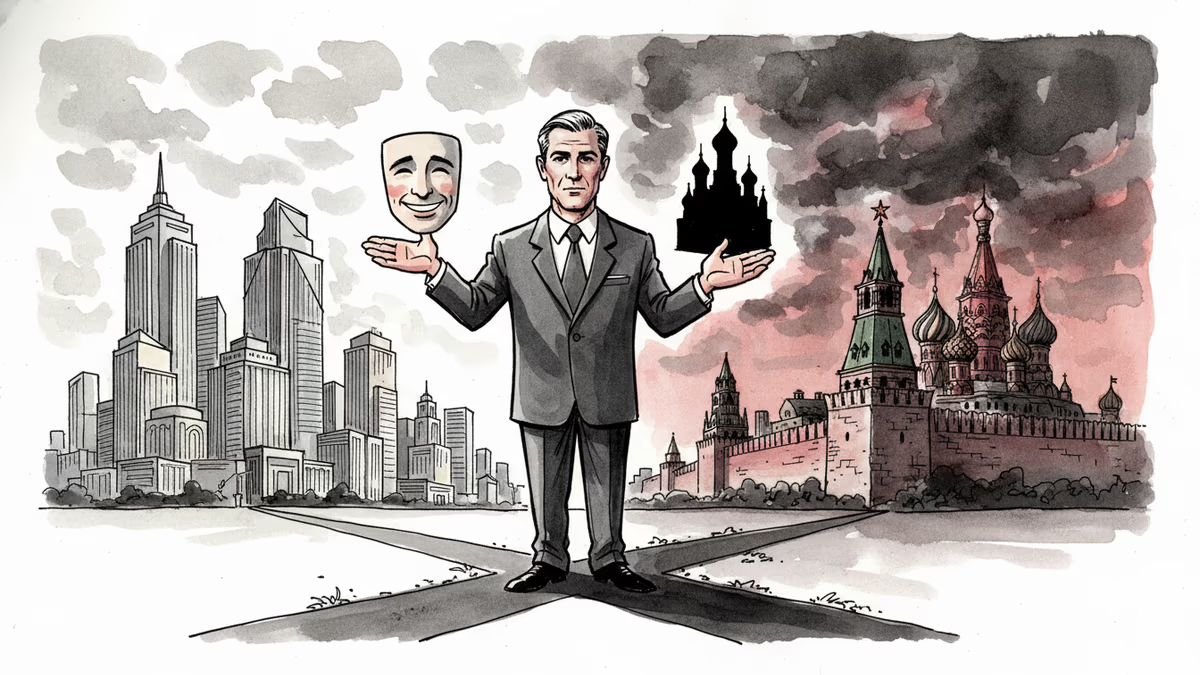
The Oligarch Who Learned to Forget Ukraine
Kirill Dmitriev—Stanford, Harvard MBA, McKinsey—once sold Russia as a land of reform. Now he's selling out Ukraine's sovereignty in Mar-a-Lago backrooms. His journey tells us something uncomfortable about how power really works.
One of Kirill Dmitriev's childhood friends was badly wounded fighting on the front lines in Ukraine. When a journalist asked to speak with him about his old classmate, the friend declined. "I don't want to talk about Kirill," he said. "I just want to shoot him in the knees."
That friend grew up in Kyiv, the same city where Dmitriev was born and raised before earning degrees from Stanford and Harvard Business School, building a career at McKinsey and Goldman Sachs, and eventually becoming one of Vladimir Putin's most trusted operatives. Today, Dmitriev shuttles between Moscow and Florida, meeting with Steve Witkoff and Jared Kushner on a private island known as Billionaire Bunker, pitching joint Arctic mineral ventures and shared Mars missions as sweeteners for a deal that would hand Russia permanent control over large swaths of Ukraine.
His biography reads like a case study in how authoritarian systems find their most effective ambassadors not among ideologues, but among the perfectly adaptable.
From Reform Apostle to Kremlin Fixer
In 2011, at the St. Petersburg International Economic Forum, Dmitriev approached Matthew Murray, an American lawyer running a nonprofit focused on business ethics in Russia. He had just been appointed to lead the newly created Russian Direct Investment Fund (RDIF) and wanted Murray's help drafting a model ethics code. He spoke about transparency, modernization, diversifying Russia away from oil and gas dependence. He got some of America's biggest private equity names—Stephen Schwarzman of Blackstone, David Bonderman of TPG, Leon Black of Apollo—to sign on as advisers. One early investment was a well-regarded chain of maternity hospitals.
This wasn't performance art. The context was real: Russia was on the cusp of joining the World Trade Organization after nearly two decades of negotiations. President Dmitry Medvedev was in the Kremlin, striking notes about rule of law. The country might, plausibly, have moved in a more liberal direction. Dmitriev was surfing that wave.
"He was so invisible," one former business partner recalled. "Bland charm. Completely adaptable to the moment."
Then came the Maidan. When protests erupted in Kyiv in late 2013, demanding democracy and a European future, Putin saw an existential threat—not just to Ukraine, but to the entire system of Moscow-friendly oligarchs that kept former Soviet states in line. He annexed Crimea. Western sanctions followed. The illustrious advisers quietly departed from the RDIF. Dmitriev's reform chapter closed.
What happened next was swift and instructive. Dmitriev retooled the RDIF into a political vehicle: part slush fund for domestic oligarchs, part charm offensive for Gulf autocrats. He flew to Riyadh and Abu Dhabi, persuading Mohammed bin Salman and Mohamed bin Zayed to pledge billions. In 2015, the RDIF moved $1.75 billion in Russian pension money into Sibur, a petrochemical giant with ties to Putin's son-in-law at the time. Leaked documents published by the Latvian investigative platform iStories show Dmitriev shared information about upcoming fund deals with that same son-in-law.
His personal wealth tracked the ascent. According to an investigation by Navalny's Anti-Corruption Foundation, Dmitriev's real estate holdings grew from roughly $5 million to $100 million over the past decade—far exceeding what his salary and board positions could explain. His wife, TV presenter Natalia Popova, is both a close friend and a business associate of Putin's daughter Katerina Tikhonova. Dmitriev had become, in effect, a virtual member of the Putin family.
The Man Who Knew the Invasion Was Coming

Dmtriev was born in Kyiv. His father, a cell biologist and senior Communist Party official, still lived there in early 2022, as Russian troops massed on Ukraine's borders. Most observers—including President Zelensky—believed Putin was bluffing. Dmitriev apparently did not. A few days before the invasion, his father abruptly left the country. Neighbors later told Ukrainian television channel TSN that the departure was almost certainly at his son's urging.
His former classmates at Kyiv's elite Natural-Scientific Lyceum No. 145 were not surprised. Volodymyr Ariev, now a member of Ukraine's Parliament, reached for a word that predates modern diplomacy: yanichar. The term originated centuries ago, when Ottoman rulers controlling parts of present-day Ukraine would kidnap young boys, indoctrinate them in the imperial capital, and send them back as soldiers to crush rebellions among their own people. "Traitor" is probably too weak a translation, Ariev said.
The arc of Dmitriev's career since 2016 maps cleanly onto the role. On the day after Trump's first election victory, he flew to New York and texted George Nader, a Lebanese American political fixer later convicted of sex offenses, that if there was "a chance to see anyone key from Trump camp," he "would love to start building for the future." Another text read: "My boss sends you his warmest regards." The boss was Putin. Two months later, Dmitriev sat at a hotel bar in the Seychelles with Erik Prince, the Blackwater founder, discussing how Washington and Moscow might drop their differences and make money together. All of this emerged in the 2019 Mueller report.
When Trump returned to the White House in 2024, Dmitriev had prepared carefully. He had cultivated an online persona that was pure MAGA—snarky posts mocking "globalists," effusive praise of Trump and Elon Musk. His pinned post on X links to a Fox News interview in which he declares that the Trump team "stopped World War Three from happening."
What He's Actually Selling
The peace framework Dmitriev has been advancing—he appears to have had a hand in the 28-point plan Trump urged Zelensky to sign last November—would require Ukraine to cede large territories, dramatically shrink its military, and accept terms that would leave it strategically indefensible. The sweetener is Dmitriev's specialty: a menu of "mutually beneficial corporate opportunities" for American and Russian companies, from Arctic mineral extraction to joint space missions.
The pitch has a fundamental problem, one that Dmitriev's own career illustrates perfectly. What rational investor puts long-term capital into a country where the law is a facade, where the security services can expropriate a profitable business on a whim, and where another imperial war might rewrite the rules overnight?
The Gulf states learned this the hard way. The UAE invested heavily in RDIF, partly hoping that financial entanglement with Russia and China might lead them to restrain Iran. Instead, Russia provided Iran with targeting information on U.S. military assets in the Middle East during the recent conflict—assets located largely in those same Gulf countries.
The Sputnik vaccine saga adds another data point. In 2020, Putin assigned Dmitriev—a financier with zero public health experience—to lead Russia's COVID vaccine export campaign. The rollout was plagued by accusations of profiteering: in multiple countries across Africa, Asia, and South America, Dmitriev granted exclusive distribution rights to a newly registered UAE company linked to Dubai's ruling family, which doubled the price per dose. Ghana canceled its contract over corruption allegations. Kenya blocked the vaccine entirely.
The pattern is consistent: Dmitriev is extraordinarily skilled at generating the appearance of institutional credibility while systematically hollowing out the institution itself.
The Deeper Discomfort
There's a temptation to read Dmitriev as a villain in a straightforward morality play. The more unsettling reading is different.
He is not an outlier. He is what the system produces when it encounters someone sufficiently talented, sufficiently ambitious, and sufficiently willing to blur the line between adaptation and complicity. His Stanford degree and Goldman Sachs pedigree are not incidental to his effectiveness—they are the point. They allow him to sit across from Witkoff and Kushner and speak their language, to appear on Fox News and seem reasonable, to make the expropriation of a sovereign nation sound like a business opportunity.
If Alexei Navalny represents what it costs to resist power in contemporary Russia, Dmitriev may represent something equally important: what it looks like to fully surrender to it, and how that surrender can be made to look, from certain angles, like pragmatism.
His former classmates in Kyiv have a word for it. The Americans negotiating with him, apparently, do not.
This content is AI-generated based on source articles. While we strive for accuracy, errors may occur. We recommend verifying with the original source.
Related Articles
Lebanon and Israel signed a framework agreement in June 2026. Hezbollah rejected it. Israel kept fighting. History suggests this moment is real—and fragile.
Trump says he wants to 'take' Cuba. But this desire isn't new—it stretches back to Thomas Jefferson. Why this centuries-old obsession is coming to a head right now.
The Wizard of the Kremlin isn't really about Putin's evil. It's about the clever people who thought they could manage him—and what that says about how power actually works.
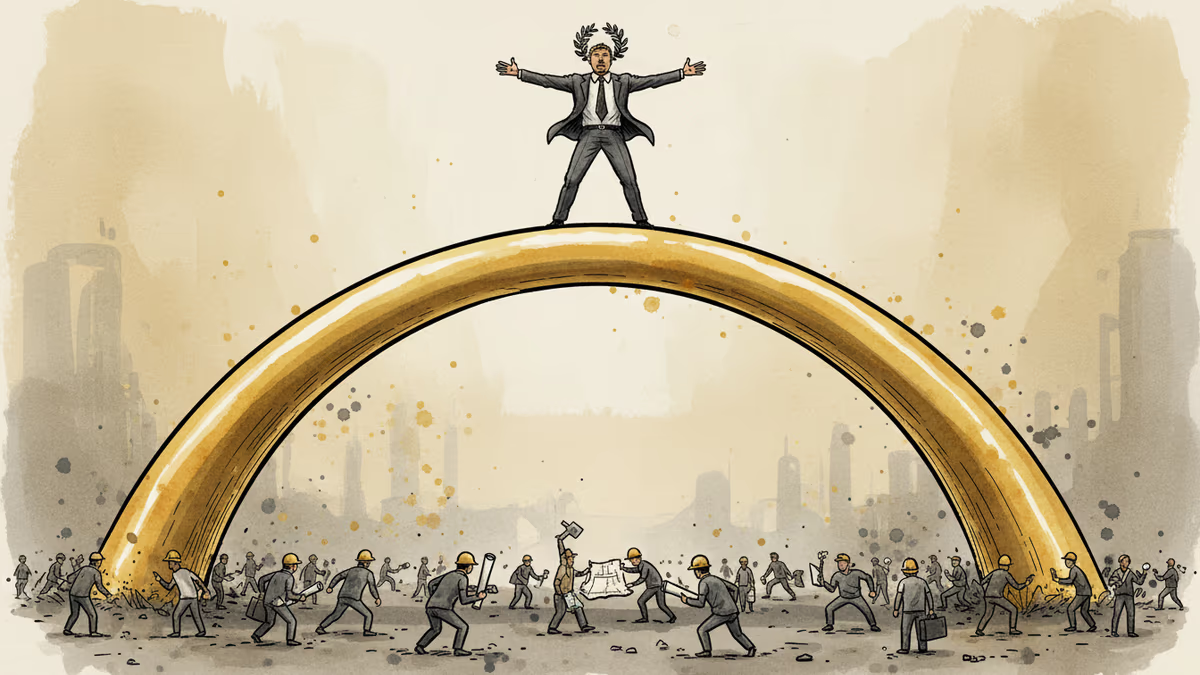
Trump's inner circle reveals he now sees himself not as Washington or Lincoln, but as a peer of Alexander, Caesar, and Napoleon. This psychological shift is reshaping his second term—and the world.
Lebanon and Israel signed a framework agreement in June 2026. Hezbollah rejected it. Israel kept fighting. History suggests this moment is real—and fragile.
Trump says he wants to 'take' Cuba. But this desire isn't new—it stretches back to Thomas Jefferson. Why this centuries-old obsession is coming to a head right now.
The Wizard of the Kremlin isn't really about Putin's evil. It's about the clever people who thought they could manage him—and what that says about how power actually works.
Trump's inner circle reveals he now sees himself not as Washington or Lincoln, but as a peer of Alexander, Caesar, and Napoleon. This psychological shift is reshaping his second term—and the world.
Thoughts
Share your thoughts on this article
Sign in to join the conversation