
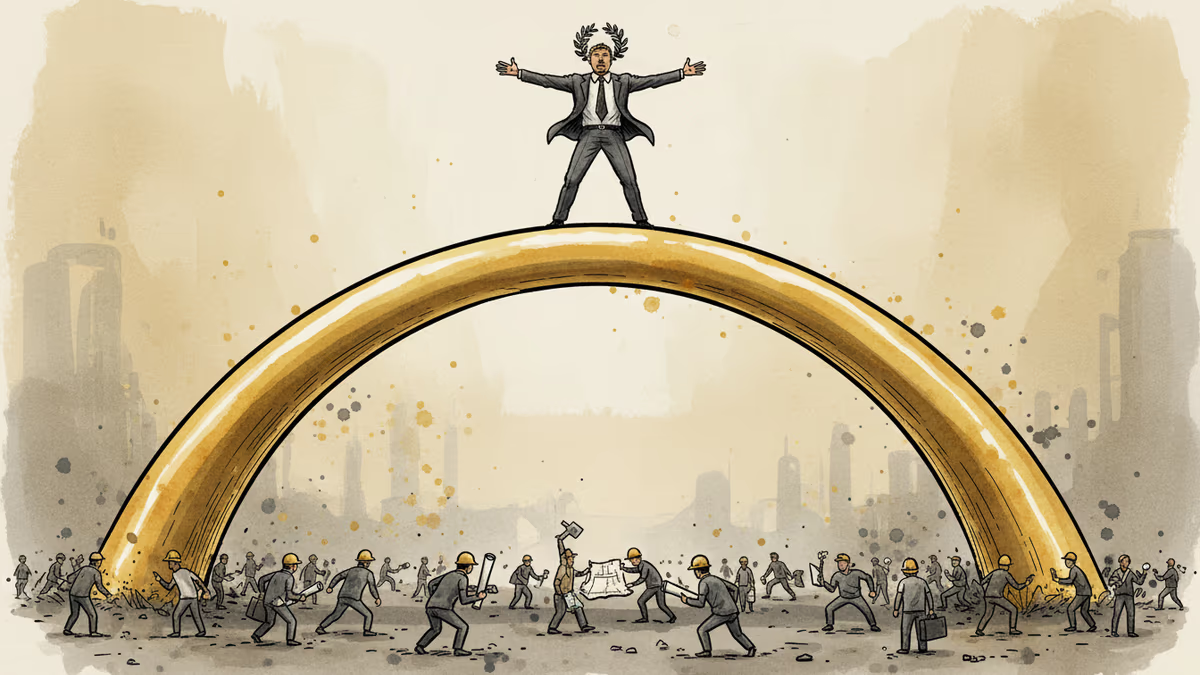
Trump Wants to Be Caesar. What Happens Next?
Trump's inner circle reveals he now sees himself not as Washington or Lincoln, but as a peer of Alexander, Caesar, and Napoleon. This psychological shift is reshaping his second term—and the world.
What does a man do when he no longer needs your vote?
That question has quietly become the defining one of Donald Trump's second term. And according to people who speak with him regularly, the answer is becoming clearer: he stops thinking about the next election and starts thinking about the next millennium.
Two sources close to the president—a senior administration official and a longtime personal confidant—told The Atlantic that Trump has begun privately framing himself not as a peer of George Washington or Abraham Lincoln, as he long preferred, but as a fourth entry in a very different hall of fame. "He's been talking recently about how he is the most powerful person to ever live," the confidant said. "He wants to be remembered as the one who did things that other people couldn't do, because of his sheer power and force of will."
The three names already in that hall: Alexander the Great. Julius Caesar. Napoleon Bonaparte.
The Philosopher He Probably Never Read
The intellectual framework, improbably, traces back to Georg Wilhelm Friedrich Hegel. The 19th-century German philosopher coined the concept of "world-historical individuals"—figures who redirected the course of humanity not through careful planning but through an almost unconscious force of will. Hegel described them as "heroes of an Epoch," men who smashed established orders that had seemed immovable, and who were condemned in their own time for conduct "obnoxious to moral reprehension."
Did Trump read Hegel? White House officials laughed at the suggestion. The president is not known as a reader. What apparently happened, a senior official explained, is that someone handed Trump a brief passage—possibly a poem, possibly an essay, the official couldn't recall—touching on this idea. Another official suggested Trump may be remembering a speech at a golf-club event last year, where a speaker placed him alongside Alexander and Genghis Khan.
The delivery mechanism matters less than the reception. Trump absorbed the frame and made it his own. "He is conscious, proud, and hopeful that some of the things that he does are resetting long-standing orders of things," a second senior official told The Atlantic. "Not in a Socrates sort of way, just: The stuff I'm doing is very different, and it will reset things to some level, and that includes not just this country but the world."
One confidant put it more plainly: "He's clearly in his 'I don't give a fuck' mood."
What Unburdened Power Looks Like
The shift is not merely rhetorical. It has a body count and a price tag.

In the months since his second inauguration, Trump has ordered bombing campaigns across seven countries, toppled two foreign leaders within as many months, threatened to seize Greenland, and systematically undermined NATO commitments. The war with Iran—which Trump described on social media as a night when "a whole civilization will die"—has pushed gas prices toward $4 a gallon, driven mortgage rates higher, and reignited inflation fears that Republicans are now quietly panicking about ahead of midterm elections.
At home, the transformation is architectural and symbolic in equal measure. The Oval Office doors are gilded. Trump's personal challenge coin—a palm-sized souvenir he designed himself—has been glued to doors throughout the West Wing, the president personally affixing them one by one to his deputies' offices. A $400 million White House ballroom is under construction, complete with hand-carved Corinthian columns and a drone-resistant roof. The proposed Arc de Trump, modeled on Paris's Arc de Triomphe but standing 250 feet tall, would be the largest triumphal arch in human history—more than twice the height of the Lincoln Memorial.
Jackie Kennedy's Rose Garden has been paved over into a Mar-a-Lago-style patio. The East Wing has been demolished. The Kennedy Center has been renamed. When Trump flew back from Mar-a-Lago one month into the Iran war—as gas prices spiked and stock values eroded—he came to the press cabin not to discuss the conflict but to present six photo-realistic renderings of the ballroom project, explaining the Corinthian columns at length before noting, almost as an aside: "I'm fighting wars and other things. But this is very important because this is gonna be with us for a long time."
The administration official framed all of this as clarity, not chaos. "He is unburdened by political concerns and is able to do what is truly right rather than what is in his best political interests," this person said. "Hence the decision to strike Iran."
The Costs Nobody Is Counting Loudly Enough
The political math is deteriorating in ways that even Trump's allies acknowledge privately.
Sarah Longwell, a former Republican and anti-MAGA strategist who runs regular focus groups with Biden-Trump swing voters, describes a consistent pattern. "Every time he's focused on the ballroom, every time he's focused on the Kennedy Center, voters are like, 'But you're not focused on Americans. You're not focused on me. You're not focused on the economy,'" she said. "Most people are like, 'I don't care about the ballroom. Just be focused on the economy. That was the whole point of you.'"
Senior Republicans and Cabinet members met in mid-February at the Capitol Hill Club to map out a midterm strategy centered on economic messaging. They reconvened a month later at what used to be the Trump International Hotel. The February plan had already collided with the Iran war. The new message was blunter: there was no longer room for error.
Trump, according to one ally, is not particularly worried about losing the House, and only slightly concerned about the Senate. His calculation: a Democratic Senate means a longer impeachment trial, and he has survived two impeachments already. What he is worried about, several people said, is being perceived as a lame duck. And that fear is revealing.
When Jimmy Carter died in late 2024 and lay in state at the Capitol Rotunda, Trump watched the proceedings for hours from Mar-a-Lago, transfixed. He mused aloud that one day he would be inside a flag-draped coffin like that. A man who has spent a lifetime avoiding introspection was, for a moment, staring directly at his own end.
Hegel's Warning
Hegel's world-historical individuals did not, on the whole, end well. Napoleon was exiled to St. Helena in his 40s. Alexander the Great died at 32. Caesar, after declaring himself dictator of Rome, was assassinated at 55 by the very nobles whose order he had upended. "So mighty a form must trample down many an innocent flower," Hegel wrote, "crush to pieces many an object in its path."
The philosopher argued that these figures operated with "an unconscious impulse that occasioned the accomplishment of that for which the time was ripe." They were not intellectuals. They did not live particularly happy lives. Their greatness and their destruction were inseparable.
Trump's team remains cautiously optimistic that the midterms can act as a last guardrail—that the prospect of losing Congress will refocus the president on conventional political logic. "He knows he is essentially on the ballot in the midterms," one senior White House official told The Atlantic, as if saying it aloud might make it true. But after those elections, this person added quietly: "God knows what the next two years will look like."
This content is AI-generated based on source articles. While we strive for accuracy, errors may occur. We recommend verifying with the original source.
Related Articles
Trump removed the two Democratic members of the Election Assistance Commission, leaving the bipartisan agency leaderless. A Supreme Court ruling made it legal. Here's why a non-crisis can still be a warning sign.
Trump says he wants to 'take' Cuba. But this desire isn't new—it stretches back to Thomas Jefferson. Why this centuries-old obsession is coming to a head right now.
Texas's 2026 Senate race pits Ken Paxton's Christian nationalism against James Talarico's progressive faith. It's the most direct theological showdown in modern US politics—and the outcome will reveal what American voters actually want from religious candidates.
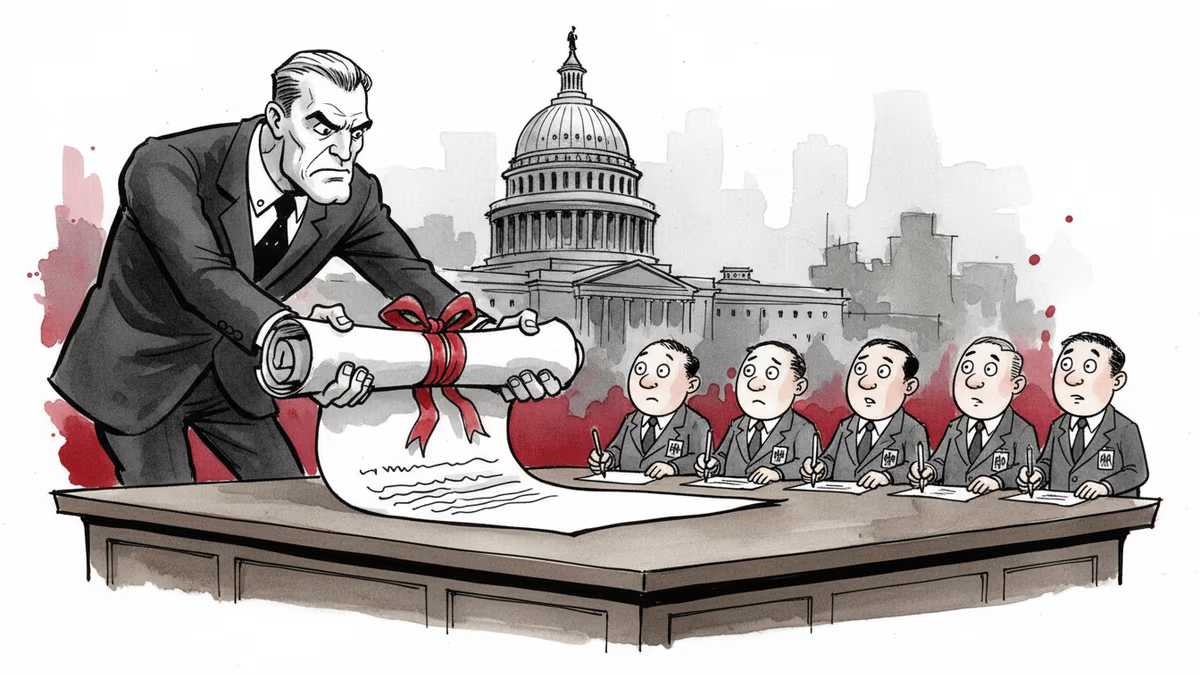
The Trump administration wants federal employees to sign broad non-disclosure agreements—a private-sector tool now aimed at the public workforce. What happens when government runs like a corporation?
Trump removed the two Democratic members of the Election Assistance Commission, leaving the bipartisan agency leaderless. A Supreme Court ruling made it legal. Here's why a non-crisis can still be a warning sign.
Trump says he wants to 'take' Cuba. But this desire isn't new—it stretches back to Thomas Jefferson. Why this centuries-old obsession is coming to a head right now.
Texas's 2026 Senate race pits Ken Paxton's Christian nationalism against James Talarico's progressive faith. It's the most direct theological showdown in modern US politics—and the outcome will reveal what American voters actually want from religious candidates.
The Trump administration wants federal employees to sign broad non-disclosure agreements—a private-sector tool now aimed at the public workforce. What happens when government runs like a corporation?
Thoughts
Share your thoughts on this article
Sign in to join the conversation