
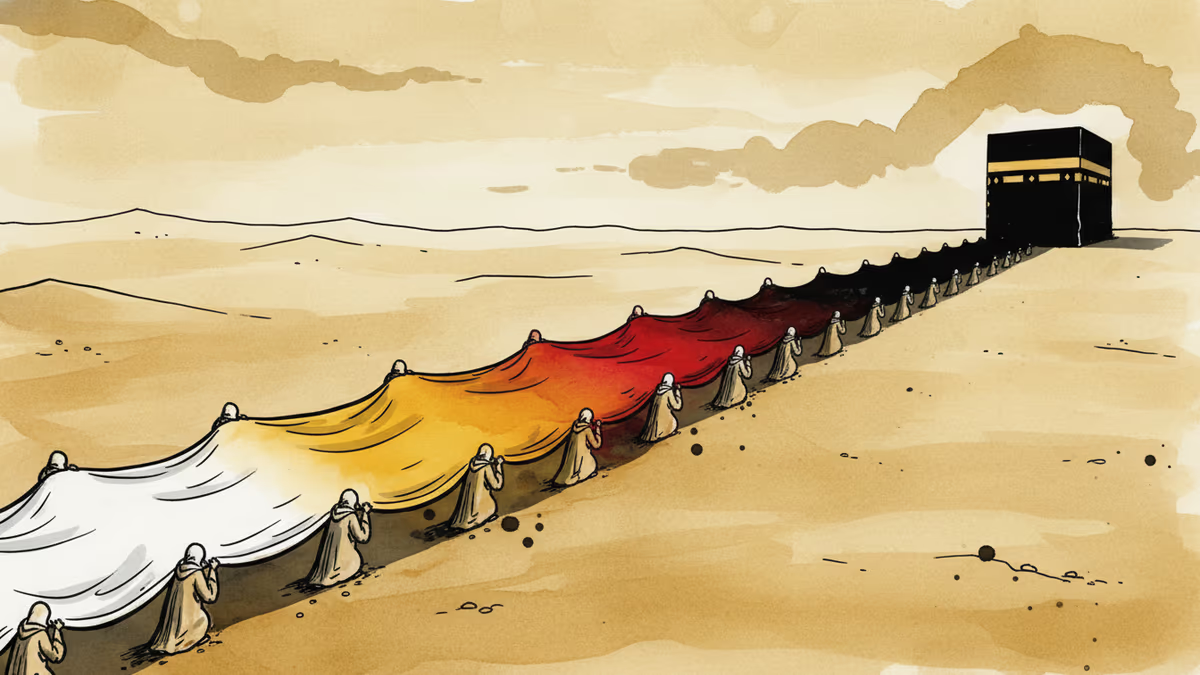
The Cloth That Crowned Caliphs: Inside the Kaaba's Sacred Covering
The kiswah—the black silk draping Islam's holiest shrine—has changed color, origin, and political master over 1,300 years. Its history is a map of Islamic power itself.
Every year, roughly 1.8 million Muslim pilgrims arrive in Mecca and walk seven circles around a black cube. Most of them believe that cube has always been black. It hasn't.
The cloth covering Islam's holiest shrine—the Kaaba—has been white, red, green, yellow, and striped. It has been woven by Coptic Christian craftsmen in Egypt, shipped by Ottoman sultans from Cairo, and fought over in a confrontation that left dozens dead. Today it is manufactured in a Saudi state factory at an annual cost of over $5 million. The story of how it got there is, in many ways, the story of who has controlled Islam.
A Structure That Is Empty by Design
The Kaaba itself is a roughly cubic granite structure standing about 43 feet tall in the center of Mecca's Grand Mosque. Islamic tradition holds that the Prophet Abraham—Ibrahim in Arabic—and his son Ishmael built it as a site of monotheistic worship in antiquity. Inside, there is nothing: no altar, no idol, no relic. The emptiness is the point.
Yet it is the geographic and spiritual axis of the Muslim world. Five times a day, more than 1.8 billion Muslims worldwide orient their prayers toward this structure. What they actually see when they arrive for the Hajj pilgrimage is not the granite beneath—it's the kiswah, the ceremonial textile that has draped the Kaaba for over a millennium.
Today's kiswah is made from roughly 1,500 pounds of high-grade black silk, embroidered with nearly 260 pounds of gold-plated and pure silver thread spelling out Quranic verses along a wide belt running two-thirds of the way up the cube. A separate, more ornate curtain covers the door. The whole assembly is replaced once a year on the first day of the Islamic calendar, funded entirely by the Saudi treasury.
But the cloth was not always black—and it was not always Saudi.
Thirteen Centuries of Changing Hands
The earliest documented covering dates to around 400 C.E., when a Yemeni king named As'ad Abū Karib reportedly draped the shrine in striped red wool. For centuries, successive rulers added new coverings on top of old ones. By the eighth century, the accumulated weight was threatening to collapse the structure itself.
It was the Abbasid caliph al-Mahdi—whose dynasty governed a stretch of territory from Persia to Spain—who intervened during his pilgrimage in 777 C.E. He ordered the layers stripped away and established the rule of a single annual replacement. That cycle has governed the practice for nearly 1,300 years.

The color shifted constantly. White linen came from Coptic Christian weavers in the Nile Delta. The Mamluk sultans of Egypt, who ruled from 1250 to 1517, favored saffron-yellow silk. Black only became the standard around 1224 C.E., under an Islamic ruler in Baghdad. The transformation has since become so total that most Muslims today would be surprised to learn it was ever otherwise—a striking example of how recently established traditions can feel ancient within a few generations.
The material history matters less, though, than the political one.
The Caravan Was Never Just a Caravan
For roughly a thousand years, the right to manufacture the kiswah and send it from Cairo to Mecca was one of the most potent symbols of legitimate authority in the Muslim world. The Mamluk sultans held this role; after the Ottoman conquest of Egypt in 1517, Ottoman sultans dispatched the cloth from Cairo for four centuries.
The cloth never traveled alone. Accompanying it was a richly decorated empty palanquin called the maḥmal—essentially a mobile throne. The sultan didn't need to be present; the maḥmal announced his protection of Islam's holiest cities. It was a statement of sovereignty rendered in silk and ceremony.
That system collapsed violently in 1926. Ibn Saud, the founder of modern Saudi Arabia, had just seized Mecca with the help of a fiercely austere religious militia. When Egyptian pilgrims arrived with their customary caravan—accompanied by music and public celebration—the militia declared the festivities contrary to true Islam and attacked. Dozens of Egyptians were killed in what became known as the Maḥmal Incident.
The episode was more than a clash over ritual propriety. It marked a decisive shift in where Islamic religious authority was centered. For centuries, that center had been cosmopolitan Cairo. After 1926, it moved to the Arabian heartland, where the Saudi state was remaking Mecca according to a far more austere theological vision. The kiswah factory followed: Saudi Arabia has manufactured the cloth itself ever since, at the King Abdulaziz Complex in Mecca's Umm al-Joud neighborhood.
What a Fragment Carries
When the old kiswah comes down each year, it is cut into pieces by the Banū Shayba—a family that has held this hereditary duty for generations. Fragments are distributed to heads of state, museums, and ordinary pilgrims who happen to be present at the right moment.
In Muslim belief, holding a piece of the kiswah is holding something that bridges the earthly and the divine. Many believe miraculous healing can occur simply through contact with the cloth. The fragments circulate across the world, carried home by pilgrims to places as far apart as Indonesia, Nigeria, and Bosnia.
This raises a question that the cloth's layered history makes harder to ignore: if the kiswah has been white, yellow, and red; woven by Christian craftsmen and shipped by Turkish sultans; replaced annually on the orders of a Persian-based caliph—what exactly is the sacred object? Is the sanctity in the material, or in the unbroken human act of covering and venerating?
The question isn't unique to Islam. Flags, crowns, constitutional originals, sacred relics—every civilization has objects whose power depends less on physical continuity than on the community's collective decision to treat them as continuous. The kiswah is simply one of the most visible examples of how that process works, and how it can be contested.
This content is AI-generated based on source articles. While we strive for accuracy, errors may occur. We recommend verifying with the original source.
Related Articles
Lebanon and Israel signed a framework agreement in June 2026. Hezbollah rejected it. Israel kept fighting. History suggests this moment is real—and fragile.
Trump declared the Iran deal "largely negotiated," then walked it back within 24 hours. Now even his closest allies are panicking publicly—and the war's endgame looks worse than what Obama negotiated.
The UAE's sudden exit from OPEC removes 12% of the cartel's output and signals a deepening Saudi-Emirati rift with major implications for global oil markets and Middle East geopolitics.
The US-Iran ceasefire announced April 7, 2026, halted a costly war neither side was winning. But with deep mistrust on all sides, can two weeks build a lasting peace?
Lebanon and Israel signed a framework agreement in June 2026. Hezbollah rejected it. Israel kept fighting. History suggests this moment is real—and fragile.
Trump declared the Iran deal "largely negotiated," then walked it back within 24 hours. Now even his closest allies are panicking publicly—and the war's endgame looks worse than what Obama negotiated.
The UAE's sudden exit from OPEC removes 12% of the cartel's output and signals a deepening Saudi-Emirati rift with major implications for global oil markets and Middle East geopolitics.
The US-Iran ceasefire announced April 7, 2026, halted a costly war neither side was winning. But with deep mistrust on all sides, can two weeks build a lasting peace?
Thoughts
Share your thoughts on this article
Sign in to join the conversation