
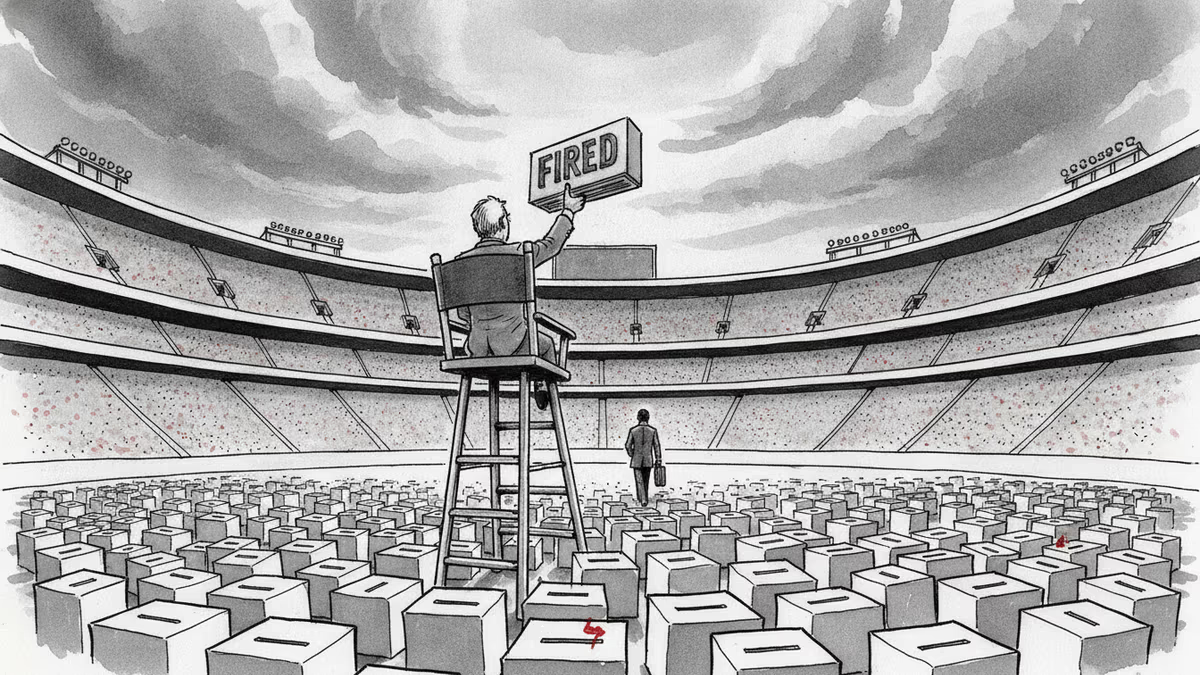
The Quiet Gutting of America's Election Referee
Trump removed the two Democratic members of the Election Assistance Commission, leaving the bipartisan agency leaderless. A Supreme Court ruling made it legal. Here's why a non-crisis can still be a warning sign.
Nothing exploded. No emergency was declared. A small federal agency simply ran out of people — and that's exactly what makes it worth paying attention to.
On July 10, 2026, President Donald Trump removed the two Democratic members of the Election Assistance Commission (EAC), the bipartisan federal body responsible for helping states run their elections. The lone remaining Republican member resigned the same day. A four-person commission became a zero-person commission before the weekend.
What the EAC Actually Does — and Doesn't Do
The EAC was created in 2002, partly in response to the chaos of the 2000 Florida recount. Its mandate, in its own words, is to "help election officials improve the administration of elections and help Americans participate in the voting process." In practice, that means certifying voting systems, providing guidance to state election administrators, and distributing federal election security grants.
Here's the crucial nuance: the EAC doesn't run elections. The United States has no national election authority. All 50 states manage their own voting systems, and the EAC's role is closer to that of a technical advisor and standards body than a regulator. According to legal outlet Just Security, the agency can still carry out most of its existing functions without Senate-confirmed commissioners in place. What it cannot do is adopt new policies or update existing ones to respond to emerging challenges.
So no, the midterms are not in immediate jeopardy. But the distinction between "no crisis now" and "no problem" is doing a lot of work here.
The Supreme Court Opened This Door

Trump didn't act in a legal vacuum. The removals came directly on the heels of the Supreme Court's ruling in Trump v. Slaughter, which held that the president has the authority to fire appointees at ostensibly independent federal agencies at will. The Federal Reserve was carved out as a notable exception — a nod to the financial markets' sensitivity — but the ruling effectively brought dozens of other independent bodies under direct presidential control.
Vox journalists Zack Beauchamp and Ian Millhiser described the decision as "a big boost to Trump's power" that created "a serious threat of politicization of government." The EAC purge is among the first concrete demonstrations of what that looks like in practice: an agency designed to be insulated from partisan pressure, stripped of leadership by a president who found that leadership inconvenient.
The word "independent" in "independent federal agency" now carries significantly less legal weight than it did a year ago.
The Slow Erosion Nobody Notices Until It's Too Late
Trump's broader ambitions on elections have hit real obstacles. The SAVE America Act — which would have imposed new voter ID requirements at the federal level — stalled in Congress. And because elections are state-administered, there's a hard ceiling on how much the federal executive can directly manipulate the process ahead of the 2026 midterms.
But the removal of EAC leadership doesn't need to cause an immediate crisis to matter. The people most immediately affected are the state and local election workers who already operate under extraordinary strain — facing burnout, threats, and harassment at rates that have driven experienced administrators out of the profession in significant numbers since 2020. The EAC has been one of the few federal lifelines providing technical support and security funding to those workers.
Remove the leadership, freeze the policy-making capacity, and the gap between well-resourced states and under-resourced ones quietly widens. The machinery doesn't break down dramatically. It just gets harder to maintain.
There's a broader pattern here that scholars of democratic backsliding — in Hungary, Poland, Turkey — have documented carefully: institutions rarely collapse in a single dramatic moment. They are hollowed out through accumulated small decisions: budget cuts, vacant appointments, replaced personnel. Each individual step looks manageable. The cumulative effect is not.
This content is AI-generated based on source articles. While we strive for accuracy, errors may occur. We recommend verifying with the original source.
Related Articles
Trump says he wants to 'take' Cuba. But this desire isn't new—it stretches back to Thomas Jefferson. Why this centuries-old obsession is coming to a head right now.
Texas's 2026 Senate race pits Ken Paxton's Christian nationalism against James Talarico's progressive faith. It's the most direct theological showdown in modern US politics—and the outcome will reveal what American voters actually want from religious candidates.
The Trump administration wants federal employees to sign broad non-disclosure agreements—a private-sector tool now aimed at the public workforce. What happens when government runs like a corporation?
Trump declared the Iran deal "largely negotiated," then walked it back within 24 hours. Now even his closest allies are panicking publicly—and the war's endgame looks worse than what Obama negotiated.
Trump says he wants to 'take' Cuba. But this desire isn't new—it stretches back to Thomas Jefferson. Why this centuries-old obsession is coming to a head right now.
Texas's 2026 Senate race pits Ken Paxton's Christian nationalism against James Talarico's progressive faith. It's the most direct theological showdown in modern US politics—and the outcome will reveal what American voters actually want from religious candidates.
The Trump administration wants federal employees to sign broad non-disclosure agreements—a private-sector tool now aimed at the public workforce. What happens when government runs like a corporation?
Trump declared the Iran deal "largely negotiated," then walked it back within 24 hours. Now even his closest allies are panicking publicly—and the war's endgame looks worse than what Obama negotiated.
Thoughts
Share your thoughts on this article
Sign in to join the conversation