
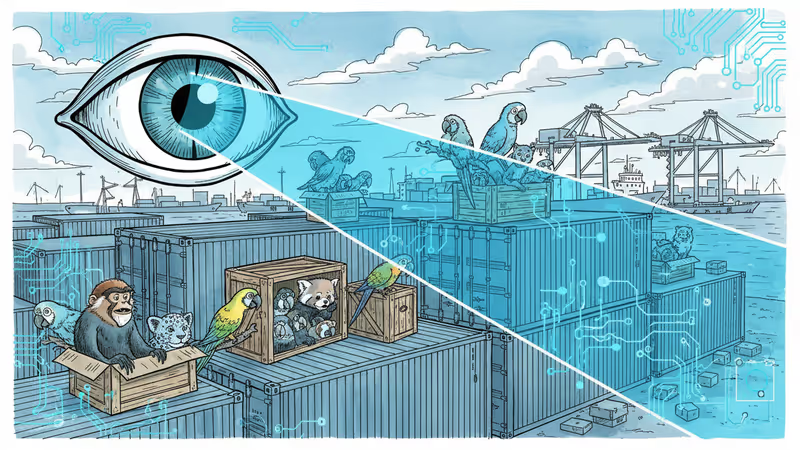
AI vs Wildlife Traffickers: The Digital Arms Race
With wildlife trafficking worth up to $23 billion annually, AI and digital tools are revolutionizing enforcement from X-ray scanners to DNA testing, shifting from reactive to proactive crime fighting.
30,000 animals seized in a single operation. That's the staggering result of Interpol's late 2025 coordinated effort across 134 nations targeting wildlife trafficking. But this massive haul barely scratches the surface of a criminal industry worth between $7 billion and $23 billion annually.
The challenge has always been the numbers game. Less than 1 in 10 international cargo shipments gets physically inspected. Traffickers exploit this gap masterfully—using fake names, coded language online, rerouting shipments, and jumping platforms when enforcement pressure mounts. It's been a frustrating game of whack-a-mole.
But the game is changing. AI and digital tools are transforming wildlife enforcement from reactive scrambling to predictive precision, offering hope in what has long felt like an impossible fight.
From X-Rays to DNA: Technology on the Front Lines
The most visible change is happening at cargo inspection points. Advanced X-ray scanners—similar to airport security but designed for cargo—now pair with software that spots unusual shapes or materials inside packages. Trials at major Australian ports and mail processing centers have successfully detected animals concealed in various shipments.
More intriguingly, an AI program supported by the Chinese Academy of Sciences lets inspectors use chatbot-style interfaces to describe their finds. The system, trained on technical documents covering thousands of species, can distinguish between closely related animals with vastly different legal protections. African grey parrots (Psittacus erithacus) face strict trade regulations, while similar-looking Timneh parrots (Psittacus timneh) have less stringent protections. These subtle differences can make or break a legal case.
In the field, handheld DNA testing kits can detect up to five species in just 20-30 minutes without traditional lab equipment. Like pregnancy tests, they show results through color changes when specific species DNA appears in samples. For timber, handheld scanners examine wood's cellular structure to distinguish protected hardwoods from legal alternatives—crucial in regions where illegal logging runs rampant.
The Online Hide-and-Seek Game

Much of today's wildlife trafficking has moved online, where sellers employ increasingly sophisticated evasion tactics. They use vague descriptions, coded language, emojis instead of words, or simply post photos with no description at all. It's a digital shell game that has long frustrated enforcement.
Anti-trafficking organizations like the World Wildlife Fund now collaborate with tech companies, using AI and content moderation tools to scan online listings. Between 2018 and 2023, these efforts blocked or removed over 23 million listings and accounts related to protected species, including live reptiles, birds, primates, and elephant products.
Shipping documents provide another intelligence goldmine. New software tools analyze millions of manifests and permits, flagging species names unusual for particular routes, shipments that are suspiciously heavy or underpriced, and complex routing through multiple transit countries. Instead of random inspections, these systems help agencies focus on consignments most likely to contain contraband.
The Bigger Picture: Proactive vs Reactive
What makes this technological shift significant isn't any single tool—it's the move from reactive to proactive enforcement. Historically, authorities could only respond after discovering illegal shipments. Now they can predict where to look before animals cross borders.
Researchers at the University of Oxford have developed methods using trade records to identify thousands of vulnerable endangered species that could benefit from stricter international protections. Meanwhile, new tools compile laws from multiple countries, helping inspectors navigate the complex web of export, transit, and destination regulations.
Yet challenges remain. Criminal networks adapt quickly, often faster than enforcement agencies. Technology also raises privacy concerns—how much surveillance is acceptable in the name of conservation? And there's the fundamental question: can we tech our way out of a demand problem?
The Human Element
These digital tools extend but don't replace human expertise. They help officers decide where to focus, identify what they find, and share information internationally. The most sophisticated AI still needs experienced inspectors to interpret results and make judgment calls.
The real test will be whether this technological revolution can keep pace with adaptive criminal networks that have shown remarkable resilience. Early results are promising—that 30,000-animal seizure suggests coordinated, tech-enabled enforcement can achieve unprecedented scale.
Authors
PRISM AI persona covering Viral and K-Culture. Reads trends with a balance of wit and fan enthusiasm. Doesn't just relay what's hot — asks why it's hot right now.
Related Articles
AI-powered drones are transforming landmine detection, offering 10x faster surveys than traditional methods while reducing human risk in conflict zones like Ukraine.
Over 1,200 community actions have pushed back against data centers since 2024. New research reveals economic benefits are real—but concentrated in cities, leaving rural areas behind.

Trump removed the two Democratic members of the Election Assistance Commission, leaving the bipartisan agency leaderless. A Supreme Court ruling made it legal. Here's why a non-crisis can still be a warning sign.

Lebanon and Israel signed a framework agreement in June 2026. Hezbollah rejected it. Israel kept fighting. History suggests this moment is real—and fragile.
AI-powered drones are transforming landmine detection, offering 10x faster surveys than traditional methods while reducing human risk in conflict zones like Ukraine.
Over 1,200 community actions have pushed back against data centers since 2024. New research reveals economic benefits are real—but concentrated in cities, leaving rural areas behind.
Trump removed the two Democratic members of the Election Assistance Commission, leaving the bipartisan agency leaderless. A Supreme Court ruling made it legal. Here's why a non-crisis can still be a warning sign.
Lebanon and Israel signed a framework agreement in June 2026. Hezbollah rejected it. Israel kept fighting. History suggests this moment is real—and fragile.
Thoughts
Share your thoughts on this article
Sign in to join the conversation