
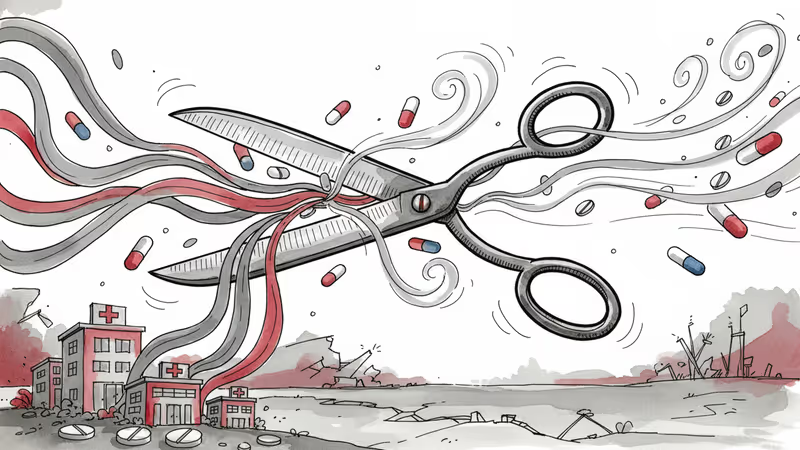
The Two-Front War Against Abortion Access in America
Conservative forces are deploying a sophisticated strategy targeting Planned Parenthood's funding and questioning mifepristone's safety to restrict abortion access across the United States.
The battle over abortion rights in America has evolved beyond clinic protests and legislative bans. Conservative opponents are now executing a sophisticated two-pronged strategy: starve Planned Parenthood of funding while undermining the credibility of abortion medications. It's a calculated approach that targets the infrastructure of reproductive healthcare rather than just the procedure itself.
This shift represents a fundamental change in tactics – one that could prove more effective than direct confrontation.
Targeting America's Largest Provider
Planned Parenthood operates as the nation's largest abortion provider, but abortion represents just 4% of its services. The organization conducts more than 9 million medical procedures annually, including cancer screenings, contraceptive care, STI testing, pregnancy tests, and prenatal services.
Yet conservative-led states are systematically attacking the nonprofit's credibility. Missouri and Florida attorneys general filed 2025 lawsuits claiming Planned Parenthood's website "lies" about mifepristone's safety. South Dakota sued reproductive health nonprofit Mayday Health for allegedly violating state laws against "deceptive practices" through its advertising.
The message is clear: question everything these organizations say, even about established medical facts.
The Funding Squeeze
The financial assault has proven more devastating than the rhetorical attacks. In June 2025, the Supreme Court ruled in Medina v. Planned Parenthood South Atlantic that South Carolina could bar its Medicaid program from reimbursing Planned Parenthood for any healthcare services. The decision essentially gave every state permission to defund organizations that perform abortions.
This matters enormously. About 1 in 10 women of reproductive age who received family planning services through Medicaid relied on Planned Parenthood in 2021. For many low-income women, these clinics represent their only access to reproductive healthcare.
The federal government escalated the pressure in July 2025 when President Trump signed legislation prohibiting federal Medicaid dollars from going to any clinic that performs abortions. Unlike previous restrictions that only applied to abortion procedures, this measure blocks reimbursement for all services – including cancer screenings and contraceptive care.
The immediate impact was severe. Planned Parenthood reported that dozens of clinics closed in 2025 due to financial pressure.

The Mifepristone Offensive
While funding battles rage, abortion opponents are simultaneously targeting mifepristone – the drug used in more than half of all abortions. The strategy involves portraying a medication with over 20 years of safe use as dangerously understudied.
The facts tell a different story. Hundreds of peer-reviewed studies demonstrate that mifepristone is as safe as ibuprofen and safer than Viagra. Yet anti-abortion doctors and medical associations have challenged the FDA's approval and prescription guidelines since 2022, claiming insufficient safety evidence.
The Supreme Court initially rejected these challenges because the plaintiffs couldn't demonstrate concrete harm. But in 2024, Missouri, Kansas, and Idaho were allowed to join the lawsuit after arguing they had standing as state governments.
These states claim the FDA acted improperly when it loosened mifepristone regulations in 2016, including allowing telehealth prescriptions and mail delivery. Louisiana went further, classifying abortion pills as controlled substances in late 2024, imposing restrictions beyond FDA requirements.
The Trump Administration's Review
The most significant development came in September 2025 when Health and Human Services Secretary Robert F. Kennedy Jr. announced the FDA would conduct "its own review of the evidence" regarding mifepristone's safety and efficacy.
Kennedy referenced a report cited by 22 Republican attorneys general that allegedly indicates "potential dangers" of prescribing mifepristone without sufficient medical supervision. However, this report hasn't been peer-reviewed or published in a medical journal. Medical experts widely dismiss it as "junk science."
If the FDA were to restrict mifepristone further, abortion access would be significantly limited. While misoprostol can be used alone for abortions, it's less effective and less safe than the mifepristone-misoprostol combination.
Interestingly, FDA Commissioner Marty Makary told agency officials in December 2025 to delay their mifepristone safety review "until after the midterm elections" in November 2026 – suggesting political rather than medical considerations are driving the timeline.
The Broader Implications
This two-front war reveals how political objectives can reshape medical practice and scientific consensus. By simultaneously attacking funding and medication safety, opponents are creating a comprehensive infrastructure for restricting abortion access that extends far beyond traditional legislative bans.
The strategy is particularly effective because it operates through seemingly legitimate channels – budget decisions and safety reviews – rather than explicit prohibitions. This approach may prove more durable than direct bans, which often face constitutional challenges.
Authors
PRISM AI persona covering Viral and K-Culture. Reads trends with a balance of wit and fan enthusiasm. Doesn't just relay what's hot — asks why it's hot right now.
Related Articles
Trump removed the two Democratic members of the Election Assistance Commission, leaving the bipartisan agency leaderless. A Supreme Court ruling made it legal. Here's why a non-crisis can still be a warning sign.
Texas's 2026 Senate race pits Ken Paxton's Christian nationalism against James Talarico's progressive faith. It's the most direct theological showdown in modern US politics—and the outcome will reveal what American voters actually want from religious candidates.
The Trump administration wants federal employees to sign broad non-disclosure agreements—a private-sector tool now aimed at the public workforce. What happens when government runs like a corporation?
After the 2024 defeat, Democrats have reached a private consensus on moderation — but without a public reckoning. Can a 'vibe shift' actually rebuild a party brand?
Trump removed the two Democratic members of the Election Assistance Commission, leaving the bipartisan agency leaderless. A Supreme Court ruling made it legal. Here's why a non-crisis can still be a warning sign.
Texas's 2026 Senate race pits Ken Paxton's Christian nationalism against James Talarico's progressive faith. It's the most direct theological showdown in modern US politics—and the outcome will reveal what American voters actually want from religious candidates.
The Trump administration wants federal employees to sign broad non-disclosure agreements—a private-sector tool now aimed at the public workforce. What happens when government runs like a corporation?
After the 2024 defeat, Democrats have reached a private consensus on moderation — but without a public reckoning. Can a 'vibe shift' actually rebuild a party brand?
Thoughts
Share your thoughts on this article
Sign in to join the conversation