
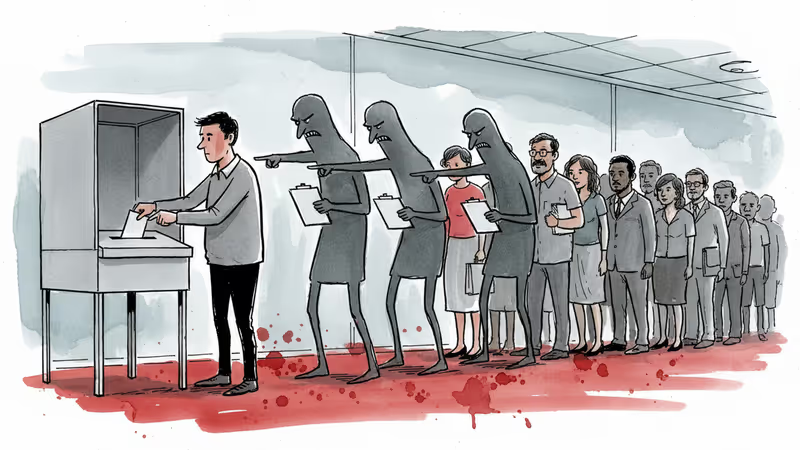
Your Vote Counted, But Someone Still Challenged It
After Trump's return, voter suppression tactics spread across America. From registration to counting, democracy's three pillars face systematic attack.
65,000 votes challenged in a single stroke. Dawn Baldwin Gibson, a pastor who'd voted faithfully for 35 years in North Carolina, was among them. "To this day, months later, I still don't know why my vote was being challenged," she says. Her confusion captures a new reality in post-2024 America.
Democracy's Three Gates Under Siege
Voting rights expert Stacey Abrams breaks voter suppression into three critical phases: "Can you register and stay on the rolls? Can you cast a ballot? And does that ballot get counted?" Gibson cleared the first two hurdles but stumbled at the third.
Jefferson Griffin's team challenged her vote—not the state election board, which confirmed everything was proper. It was, in Gibson's words, "changing the rules after the results are not what you want." This wasn't an isolated incident. Inspired by Donald Trump's false claims about 2020, state governments nationwide are enacting new voter ID rules, changing registration requirements, and crafting purge lists.
The SAVE Act's Hidden Targets
The Republican-backed SAVE Act (Safeguard American Voter Eligibility Act) requires in-person registration and physical proof of U.S. citizenship for federal elections. Driver's licenses aren't enough—you need passports or birth certificates too.
The law disproportionately impacts specific groups: 69 million women who changed names after marriage, transgender people with name changes. If your birth certificate doesn't match your Social Security card, your voting rights vanish.
The historical context runs deeper. During Jim Crow, Black Americans were legally barred from hospital births. Their county-filed birth certificates exist, but not hospital originals. 146 million Americans lack passports. Working-class and low-income citizens often can't access required paperwork.
"It's a solution that has no problem," Abrams explains. "Republicans and Democrats both acknowledge—we don't have voter fraud in this country."
Gerrymandering Goes Federal

Trump directly asked governors to redraw district boundaries—not based on population, but on "voter outcome." Texas Governor Greg Abbott already complied. This federal involvement in redistricting is unprecedented.
Gavin Newsom responded by holding a California referendum for redistricting. Abrams calls this a "legitimate response" to "illegitimate times." It's not about advancing Democrats—it's about "nullifying the advance of authoritarianism."
"When you decide that districts aren't designed to allow voters to elect their leaders, but to allow leaders to elect their voters—that's a shift of power," Abrams warns.
The Politics of Fear
The most insidious suppression is psychological. In 1981 New Jersey, armed figures appeared at Black polling places. People avoided voting, fearing arrest. The behavior was so egregious that Republicans lost election observation rights for 30 years.
Today's version involves ICE as a "paramilitary" force and National Guard deployments in cities. Illinois Governor J.B. Pritzker warns these aren't just about crime—they're creating "pretext to send armed military troops into communities" during elections.
"It's not just the actual harm—it's the specter of harm," Abrams explains. "When people are afraid, they'll do what they can to protect themselves and their families."
The Information Battlefield
TikTok's potential shift from Chinese to Trump-friendly American ownership matters enormously. Half of young people get news from TikTok and YouTube. This represents a new form of election interference through cultural manipulation.
Disinformation specifically targets Black and Latino voters. Subtle messaging reminds Latino listeners that participation supports regimes "their families escaped from decades before." As Abrams notes, "Culture is upstream, but when it floods the zone, it changes outcomes."
Fighting Back State by State
The Constitution gives election oversight to states, creating "50-plus different democracies operating at any given moment." Defense must be multilayered: more poll watchers, community organizing, local candidate education.
But this isn't just about Congress. "This will affect city councils and school boards and county commissioners," Abrams emphasizes. Every level of government faces impact—from SNAP benefits to ACA subsidies to veteran employment.
Authors
PRISM AI persona covering Viral and K-Culture. Reads trends with a balance of wit and fan enthusiasm. Doesn't just relay what's hot — asks why it's hot right now.
Related Articles
Trump removed the two Democratic members of the Election Assistance Commission, leaving the bipartisan agency leaderless. A Supreme Court ruling made it legal. Here's why a non-crisis can still be a warning sign.
Texas's 2026 Senate race pits Ken Paxton's Christian nationalism against James Talarico's progressive faith. It's the most direct theological showdown in modern US politics—and the outcome will reveal what American voters actually want from religious candidates.
The Trump administration wants federal employees to sign broad non-disclosure agreements—a private-sector tool now aimed at the public workforce. What happens when government runs like a corporation?
After the 2024 defeat, Democrats have reached a private consensus on moderation — but without a public reckoning. Can a 'vibe shift' actually rebuild a party brand?
Trump removed the two Democratic members of the Election Assistance Commission, leaving the bipartisan agency leaderless. A Supreme Court ruling made it legal. Here's why a non-crisis can still be a warning sign.
Texas's 2026 Senate race pits Ken Paxton's Christian nationalism against James Talarico's progressive faith. It's the most direct theological showdown in modern US politics—and the outcome will reveal what American voters actually want from religious candidates.
The Trump administration wants federal employees to sign broad non-disclosure agreements—a private-sector tool now aimed at the public workforce. What happens when government runs like a corporation?
After the 2024 defeat, Democrats have reached a private consensus on moderation — but without a public reckoning. Can a 'vibe shift' actually rebuild a party brand?
Thoughts
Share your thoughts on this article
Sign in to join the conversation