
Venice Biennale 2026: When Art Can't Escape Politics
From Pussy Riot's smoke flares outside the Russian Pavilion to a cursed palazzo on the Grand Canal—the 2026 Venice Biennale asks whether art can still operate outside geopolitics.
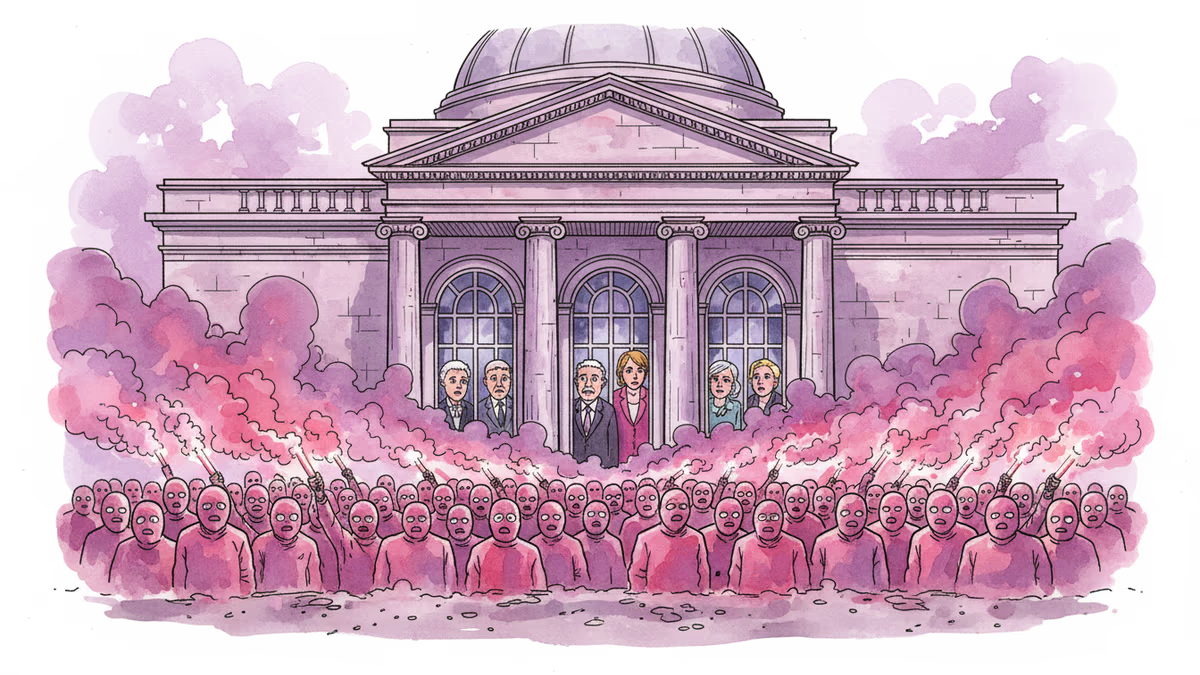
The Russian ambassador was cowering inside his pavilion. Outside, pink smoke filled the rain-soaked air.
That image—diplomacy retreating from art, or art refusing to let diplomacy breathe—captures something essential about the 2026 Venice Biennale, which opened last week and runs through November. For five days, a reporter moved through dozens of venues, saw thousands of works, and still missed much of what was on offer. The whole thing, as the piece puts it, is "frankly preposterous." But preposterous in ways that matter.
The Fight Before the Paintings
The buildup to this year's Biennale was dominated by a single decision: Pietrangelo Buttafuoco, the Biennale's president, allowed both the Russian and Israeli Pavilions to mount exhibitions. Accusations of complicity with pariah states collided with countercharges of censorship. The debate was loud before anyone had seen a single artwork.
On opening day, it became physical. Dozens of women in black clothes and pink balaclavas gathered outside the Russian Pavilion. They set off smoke flares—pink, blue, yellow. They chanted ("Blood is Russia's art!"; "Disobey! Disobey! Disobey!"), climbed the building's external structures, and bared their chests to reveal more slogans. This was Pussy Riot, the performance artists and anti-Putin activists who have disrupted a World Cup final, a Winter Olympics, and—most famously, at great personal cost—a Russian Orthodox cathedral in Moscow in 2012. For 20 minutes, they held the space entirely.
What made the moment more than spectacle was what lay behind it. Look past the pink balaclavas, the reporter writes, and into their eyes: "their hearts are broken in ways that they'll never truly communicate to us in the crowd, clutching our cellphones." The most powerful art, the observation goes, is sometimes less a dialogue than a soliloquy. Pussy Riot's performance was that.
The pavilion's commissioner, Anastasia Karneeva, was later identified as the daughter of a deputy chief executive at Rostec, Russia's state-owned defense corporation. That detail sits quietly alongside the smoke and the chanting—a reminder that cultural diplomacy is rarely just cultural.

The Main Show Stumbles; the City Delivers
The official thematic exhibition, "In Minor Keys," was to have been organized by Koyo Kouoh, a Cameroonian-born, Swiss-educated curator widely admired in the field. She died a year ago, days after a liver cancer diagnosis. A five-person committee carried out her outline. The result, by most accounts, is a disappointment: an avalanche of slapdash assemblages, clumsy painting, and wall labels that cycle through identity politics, ecological crisis, colonialism, and wellness without pause. The word "practice" appears on nearly every label—curatorial shorthand that, critics argue, substitutes process for the harder question of whether the object itself has resonance.
A few works cut through. Thania Petersen, a South African artist of Afro Asian Creole descent, contributed a giant embroidery—a fantastical map tracing the migration of Sufi music across Africa, overlaid on a 17th-century coastal landscape, populated by whirling dervishes riding flying fish. Cauleen Smith, a Los Angeles–based artist, offered a four-channel video meditation on that city: ocean waves, the Watts Towers, freeways, protests, night streets, all set to commissioned music keyed to the poetry of Wanda Coleman. Both pieces earned their space.
The national pavilions fared little better overall. The Austrian Pavilion, by performance artist Florentina Holzinger, converted the space into what she calls "Seaworld Venice"—multiple naked women performing continuous actions in and around water, framed as a critique of mass tourism and ecological devastation. The ambition is legible; the execution reads as provocation for its own sake. The U.S. Pavilion, showing abstract sculptures by Alma Allen, a Utah-born artist living in Mexico, swung to the opposite extreme: so polished and inoffensive that visitors reportedly left with blank expressions. Allen's selection was itself last-minute, after another artist was chosen and then dropped.
Where the Biennale delivered was in its satellite exhibitions scattered across Venice's churches, palazzi, and warehouses. Michael Armitage, a British painter born in Kenya, updated history painting with journalistic urgency—migrants on rafts, COVID curfews, chicken thieves—in compositions that feel "strangely dreamlike," underpinned by extraordinary color. Nalini Malani, an Indian artist in her 80s, layered her imagery over Goya's Disasters of War etchings in large-scale animations that turned a narrow salt warehouse into a colonnade of colored light. And Matthew Wong—who died by suicide at 35 in 2019—showed intimate, luminous figurative works inspired by van Gogh and Matisse, installed in rooms painted tomato red and pale green, with light filtering through pale curtains. For the reporter, it was the week's finest experience: "everything seemed to rhyme, both within and beyond the paintings."
Soft Power, Hard Questions
The Saudi Arabian Pavilion offered the Biennale's most uncomfortable tension. Created by Dana Awartani, a Saudi Palestinian artist, it re-creates floor mosaics from sites in Syria, Palestine, and Lebanon destroyed over the past 15 years. The tiles are designed to crack over time. The work is genuinely moving. It is also presented by a government whose record in the region is, to put it carefully, complicated. As the reporter notes, "soft power is no joke: It can help you get away with murder, as the Saudis have demonstrated."
That sentence applies beyond Saudi Arabia. The Biennale has been staging national pavilions for more than a century. The format assumes that art and statecraft can coexist—that a country's cultural output can be separated from its political behavior. That assumption has always been strained. In 2026, with wars active in Ukraine and Gaza, it is close to breaking.
Meanwhile, on the Grand Canal, Christie's International Real Estate was marketing Ca' Dario—a 15th-century palazzo painted by Monet, praised by Ruskin, linked to at least seven deaths across its history—at an asking price of more than $20 million. During opening week, invited guests could view the interior, which included a Titian portrait, a rare Manet of Venice, and works by Turner, Sargent, Twombly, and Warhol, ranging from $500,000 to $50 million. Great art attached to significant sums, in a city that is itself slowly sinking.
This content is AI-generated based on source articles. While we strive for accuracy, errors may occur. We recommend verifying with the original source.
Related Articles
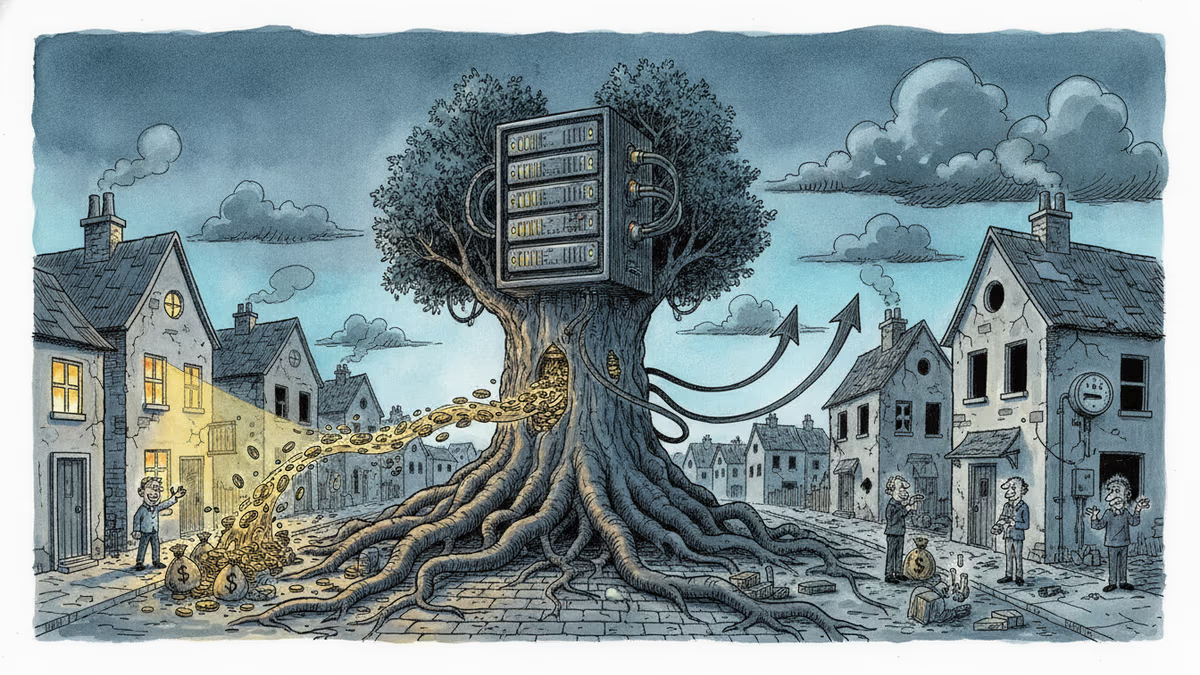
Over 1,200 community actions have pushed back against data centers since 2024. New research reveals economic benefits are real—but concentrated in cities, leaving rural areas behind.
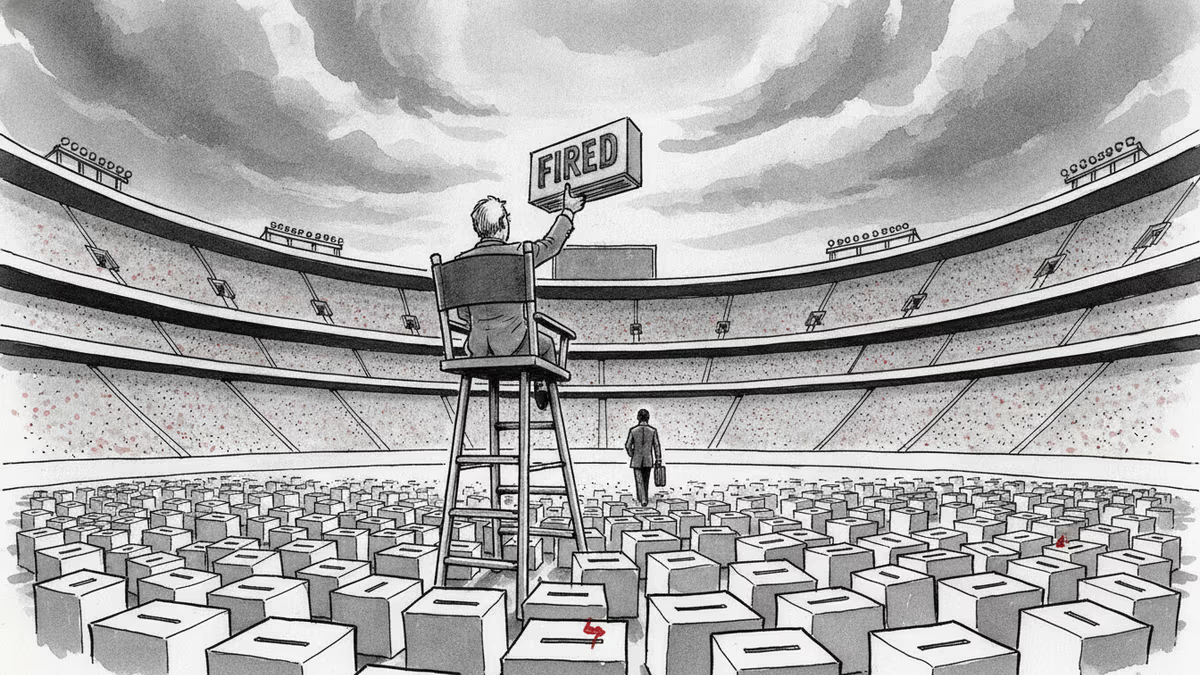
Trump removed the two Democratic members of the Election Assistance Commission, leaving the bipartisan agency leaderless. A Supreme Court ruling made it legal. Here's why a non-crisis can still be a warning sign.
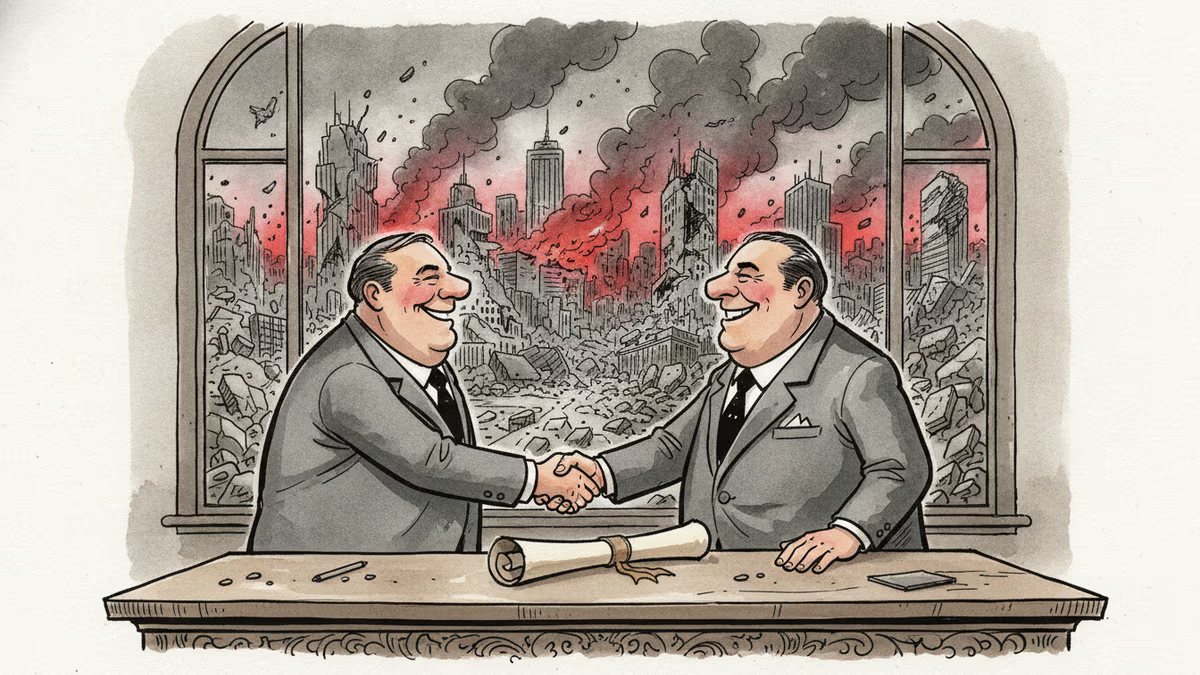
Lebanon and Israel signed a framework agreement in June 2026. Hezbollah rejected it. Israel kept fighting. History suggests this moment is real—and fragile.
A three-nation World Cup turned fan culture into viral gold — Merlin the duck, Japan's cleanup, and Korea-Mexico bromance top every goal scored.
Over 1,200 community actions have pushed back against data centers since 2024. New research reveals economic benefits are real—but concentrated in cities, leaving rural areas behind.
Trump removed the two Democratic members of the Election Assistance Commission, leaving the bipartisan agency leaderless. A Supreme Court ruling made it legal. Here's why a non-crisis can still be a warning sign.
Lebanon and Israel signed a framework agreement in June 2026. Hezbollah rejected it. Israel kept fighting. History suggests this moment is real—and fragile.
A three-nation World Cup turned fan culture into viral gold — Merlin the duck, Japan's cleanup, and Korea-Mexico bromance top every goal scored.
Thoughts
Share your thoughts on this article
Sign in to join the conversation