
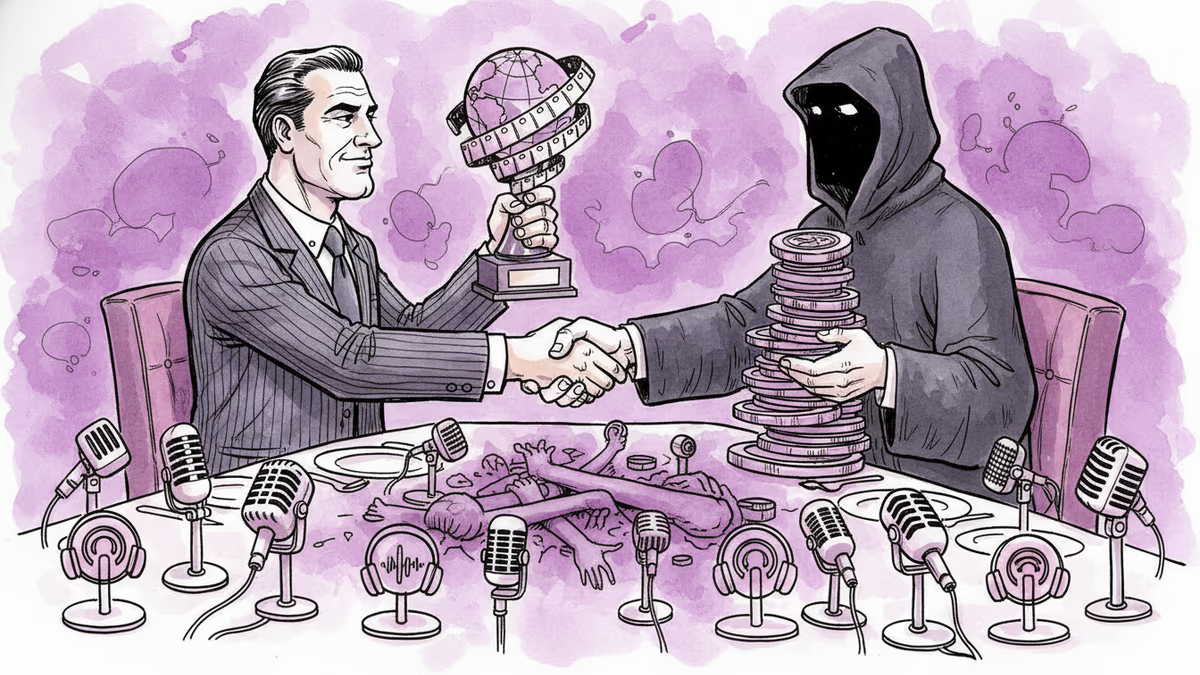
The Podcast, the Merger, and the Dinner Table
Paramount CEO David Ellison hosted a dinner honoring the Trump White House while seeking federal merger approval. His company is also in talks to acquire a podcast run by a top Trump adviser's wife.
The acting Attorney General reviewing your company's merger was in the room. The dinner was in your honor. And the person who helped fill the guest list was the woman your company is quietly negotiating to acquire.
That was the situation Paramount Global CEO David Ellison found himself in on April 25, at a private gathering held at the U.S. Institute of Peace in Washington, D.C. Billed on its invitation—which bore the CBS News logo—as a celebration of the CBS White House press team, the evening functioned as something more: a high-profile display of corporate proximity to political power. Ellison sat at the same table as President Trump. Acting Attorney General Todd Blanche, whose Justice Department is currently reviewing Paramount's proposed takeover of Warner Bros. Discovery, was in attendance. So was Stephen Miller, Trump's deputy chief of staff and one of the most powerful figures in the administration.
The person who helped make it happen was Stephen Miller's wife.
A Podcast in the Middle of It All
Katie Miller—former Trump White House staffer, onetime adviser to Elon Musk, and host of The Katie Miller Podcast—sent follow-up invitations to senior Trump officials to encourage attendance at what she called the "intimate gathering." Her involvement wasn't incidental. For months, she had been in serious discussions with Paramount's leadership about selling her podcast to the media company, according to two people familiar with the matter who spoke on condition of anonymity.
Those talks, first reported by Axios, have not yet produced a finalized deal. But they were substantive enough that Stephen Miller formally recused himself from all matters related to Paramount's pursuit of Warner Bros. Discovery—a deal he had not previously worked on. The White House confirmed the recusal through spokesperson Abigail Jackson, who said Miller "fully complies with all ethics recommendations and rules and regularly consults with White House ethics officials to address any potential conflicts of interest."
This is not the first time the Millers have navigated this kind of terrain. Stephen recused himself last year from AI-related matters because Katie maintained a part-time consulting contract with xAI, Musk's AI company. When SpaceX acquired xAI in February, he recused himself from space issues as well. What he has not recused himself from are matters touching on his wife's podcast sponsors—because the White House counsel concluded that sponsorship arrangements are legally distinct from consulting contracts.
What the Podcast Is Selling
Katie Miller launched her podcast in August 2025, and the guest list reads like a who's-who of the Trump inner circle: Vice President JD Vance was the debut interview. Former Attorney General Pam Bondi, then-Deputy AG Todd Blanche, FBI Director Kash Patel, House Speaker Mike Johnson, and Defense Secretary Pete Hegseth have all appeared—many alongside their spouses, in a format that emphasizes personal intimacy over political adversarialism.

The show's sponsors include the Southern Company, one of the largest utility conglomerates in the U.S.; the American Beverage Association, which lobbies against sugar taxes; Polymarket, the online prediction market; and the Merchants Payments Coalition, which is pushing legislation to cap credit-card swipe fees. All of them have active interests before the Trump administration.
Several people familiar with the podcast's operations told us, speaking anonymously, that Katie Miller's pitch to guests and advertisers is inseparable from her marriage to one of Trump's most senior advisers. "She was explicitly selling access," one person said. Allies of Katie Miller dispute this framing. A person involved in some of the sponsorship arrangements said the deals reflected standard industry terms and included no services outside the norm. No evidence has emerged that Stephen Miller took any action on behalf of a podcast sponsor.
The Bigger Architecture
Zooming out, what's happening here is bigger than one podcast or one dinner party.
Paramount is in the middle of one of the most consequential media consolidation plays in years. It has already merged with Ellison's Skydance. Now it's seeking regulatory approval to absorb Warner Bros. Discovery—which would bring CNN, HBO, and a vast content library under the same roof as CBS, MTV, and Paramount Pictures. The combined entity would rival Disney and Netflix in scale.
Ellison has been methodical in his courtship of the administration. He settled a lawsuit brought by Trump over a 60 Minutes segment for $16 million, much of it directed to the president's future library—a payment widely interpreted as a goodwill gesture toward regulators. He has met repeatedly with Trump, as has his father, Oracle founder and major Republican donor Larry Ellison. Inside CBS News, employees told The New York Times that they were unsettled by the existence of an event "honoring the Trump White House" bearing the CBS logo.
Hegseth, for his part, has been explicit about what he wants. "The sooner David Ellison takes over that network," he said at a Pentagon briefing, referring to CNN, "the better."
None of this is technically illegal. Recusals were filed. Disclosures were made. The White House counsel signed off. But the architecture of relationships—a CEO seeking regulatory approval, a podcast potentially being acquired by that CEO's company, the podcast host's husband overseeing White House policy, and the couple co-inhabiting the social world of senior administration officials—raises questions that legal compliance alone cannot fully resolve.
The Line That's Being Tested
The traditional norm in American media held that editorial independence required structural distance from political power. That norm has been eroding for years, accelerated by the partisan media ecosystem that emerged after Fox News rewrote the playbook in the 1990s. What's different now is the directionality: it's not just that media companies are ideologically aligned with a political faction, it's that the approval machinery for corporate consolidation runs through the same people whose spouses are on the payroll—or close to it.
Katie Miller's defenders are right that she is a credentialed professional with genuine relationships built over years in government. The podcast, on its own terms, is a legitimate media product. The question isn't whether any individual act crossed a line. The question is whether the sum of these arrangements constitutes a structure where access to power is quietly monetized—through sponsorships, through acquisition talks, through dinner party guest lists—in ways that existing ethics rules weren't designed to catch.
This content is AI-generated based on source articles. While we strive for accuracy, errors may occur. We recommend verifying with the original source.
Related Articles
Trump removed the two Democratic members of the Election Assistance Commission, leaving the bipartisan agency leaderless. A Supreme Court ruling made it legal. Here's why a non-crisis can still be a warning sign.
Trump says he wants to 'take' Cuba. But this desire isn't new—it stretches back to Thomas Jefferson. Why this centuries-old obsession is coming to a head right now.
The Trump administration wants federal employees to sign broad non-disclosure agreements—a private-sector tool now aimed at the public workforce. What happens when government runs like a corporation?

Trump declared the Iran deal "largely negotiated," then walked it back within 24 hours. Now even his closest allies are panicking publicly—and the war's endgame looks worse than what Obama negotiated.
Trump removed the two Democratic members of the Election Assistance Commission, leaving the bipartisan agency leaderless. A Supreme Court ruling made it legal. Here's why a non-crisis can still be a warning sign.
Trump says he wants to 'take' Cuba. But this desire isn't new—it stretches back to Thomas Jefferson. Why this centuries-old obsession is coming to a head right now.
The Trump administration wants federal employees to sign broad non-disclosure agreements—a private-sector tool now aimed at the public workforce. What happens when government runs like a corporation?
Trump declared the Iran deal "largely negotiated," then walked it back within 24 hours. Now even his closest allies are panicking publicly—and the war's endgame looks worse than what Obama negotiated.
Thoughts
Share your thoughts on this article
Sign in to join the conversation