
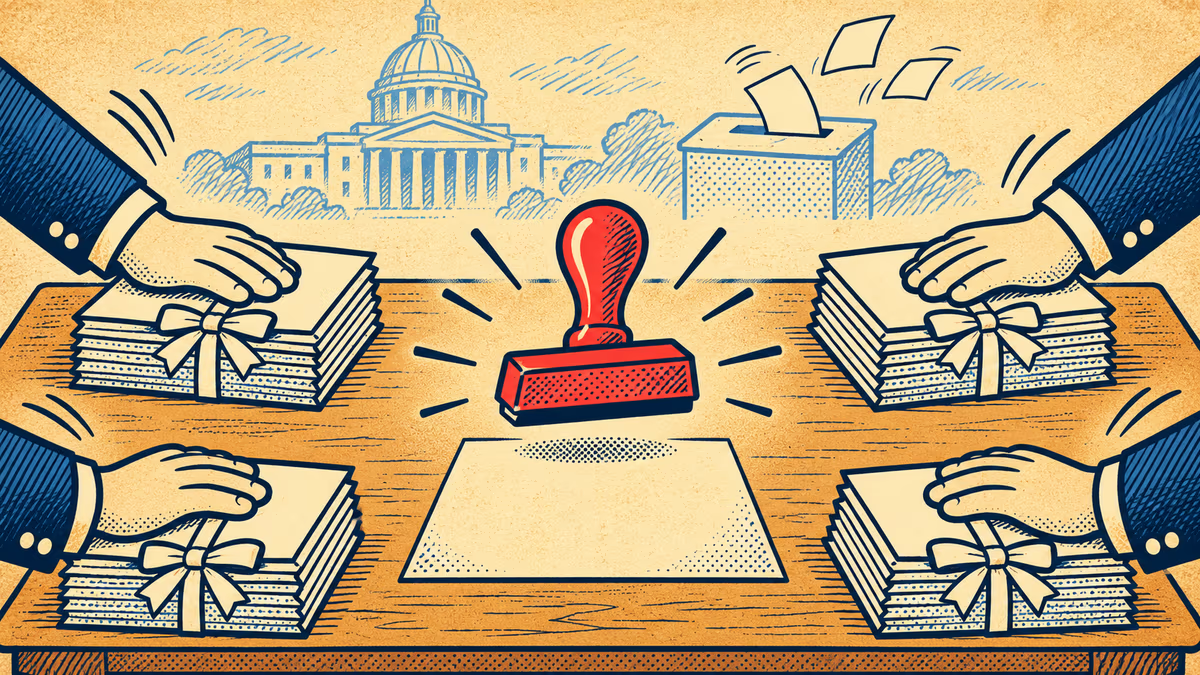
Democrats Win House: What Changes for Asia Tariffs
US midterms set the next Congress. PRISM read the original tariff and chip documents on Korea, Japan, Taiwan and China for where Congress appears.
As of 4:52 p.m. KST on Nov. 4 (Nov. 4, 2:52 a.m. ET), the Associated Press (AP) had declared Democrats the majority party in both the US House and the Senate. AP had called 135 House seats for Republicans, 224 for Democrats and 0 (PRISM calculation) for others, with 76 uncalled. Of the 35 Senate seats up for election this year, AP had called 11 (PRISM calculation) for Republicans, 20 (PRISM calculation) for Democrats and 0 (PRISM calculation) for others, with 4 uncalled.
The current 119th House stands at 218 Republicans, 214 Democrats, 1 independent and 2 vacancies, according to the Clerk of the House (viewed Nov. 4). Under the 20th Amendment, new members' regular terms begin at noon on Jan. 3, 2027. A US tariff that applies to all four countries here (South Korea, Japan, Taiwan and China), at country-specific rates, rests on a presidential memorandum (Federal Register 2026-15274) that follows forced-labor investigations under Section 301 of the Trade Act. The memo contains no congressional approval procedure and no expiration-date language, and the word "Congress" doesn't appear in it (PRISM check, Nov. 4).
Table 1. AP race calls as of 4:52 p.m. KST on Nov. 4 (Nov. 4, 2:52 a.m. ET)
| Chamber | Called Republican | Called Democratic | Other | Uncalled | Majority call |
|---|---|---|---|---|---|
| House | 135 | 224 | 0 (PRISM calculation) | 76 | Democrats (AP call) |
| Senate | 11 (PRISM calculation) | 20 (PRISM calculation) | 0 (PRISM calculation) | 4 | Democrats (AP call) |
Senate figures count only the 35 of the chamber's 100 seats that were up for election this year. The Senate party counts are PRISM calculations: the party totals on the AP results page minus seats not up for election. "Other" is also a PRISM calculation: the seats at stake (435 in the House, 35 in the Senate) minus seats called for either party and uncalled seats. The Senate majority call follows the AP story that says "Democrats won control of the U.S. Senate." AP says it declares winners "when certain the trailing candidates no longer have a path to victory."
The US measures in place and who can change them
The 301 memo sets a different rate for each country. For Taiwan, the most-favored-nation (MFN) tariff and the 301 tariff add up to 10%. For South Korea and Japan, the combined MFN-plus-301 rate is 12.5%. China and the rest of "all other investigated economies" get 12.5%. Under the memo, the Office of the United States Trade Representative (USTR) "may modify or terminate" the tariffs for each economy. That power carries a caveat: "subject to my specific direction, if any, including pursuant to section 307 of the Trade Act of 1974." In plain terms, USTR follows the president's specific direction if there is any, and its changes or terminations include those made under Section 307 of the Trade Act.
USTR's Section 301 determination notice (Federal Register 2026-15181) says the 301 tariffs don't apply to Section 232 semiconductor articles (tariff heading 9903.79.01). The January 2026 Section 232 semiconductor proclamation imposed a 25% tariff on a "very narrow category" of semiconductors. The proclamation doesn't name South Korea, Japan, Taiwan or China (PRISM check, Nov. 4).
Among the US measure documents PRISM checked, the Section 122 proclamation under the Trade Act is the only one that makes an act of Congress a condition. It states that Section 122 lets the president impose an import surcharge "for a period not exceeding 150 days unless extended by an Act of the Congress." Its effective-period clause carries the same "extended by an Act of the Congress" condition. The effective period written in the proclamation runs through 12:01 a.m. Eastern Daylight Time on July 24, 2026, and the 301 tariffs took effect for goods entered as of that same moment (Federal Register 2026-15181).
The US Supreme Court's Feb. 20, 2026, ruling on tariffs under IEEPA (the International Emergency Economic Powers Act) reads: "Held: IEEPA does not authorize the President to impose tariffs." The opinion cites Article I, Section 8 of the Constitution. The process for a bill to become law sits in Article I, Section 7. A bill the president vetoes becomes law only if each chamber passes it again by a two-thirds vote. That requirement is the same whichever party ends up in the majority.
Chip terms and domestic procedures in the four countries' agreements

Table 2. Semiconductor terms and domestic procedures in the four countries' agreement documents
| Country | Agreement document | Section 232 chip language | Legislative/domestic procedure |
|---|---|---|---|
| South Korea | Korea-US joint fact sheet (White House, November 2025) | "intends to provide terms … no less favorable than terms that may be offered in a future agreement covering a volume of semiconductor trade at least as large as Korea's, as determined by the United States" | Related procedures, including the Korea-U.S. strategic investment law (한미전략투자법); for Project No. 1, domestic procedures required by law, including a report to the National Assembly, completed (South Korea's trade ministry, Oct. 1) |
| Japan | US-Japan fact sheet (White House, Sept. 5, 2025) | No Section 232 chip-condition language in the White House fact sheet checked (semiconductors appear once, in a list of investment sectors) | No Diet procedure language in the White House fact sheet checked |
| Taiwan | USTR Agreement on Reciprocal Trade (ART) fact sheet (February 2026) · Executive Yuan announcement (July 24, 2026) | "the U.S. side will provide Taiwan preferential treatment … in the Section 232 investigation of semiconductors …" (the MOU as described in the USTR fact sheet) · Goods taxed under Section 232 and their parts are excluded from the 301 tariff (Executive Yuan) | "will include the Taiwan side submitting … to its legislature for review" (domestic procedures before entry into force include submission to the Legislative Yuan for review, USTR) |
| China | China's Ministry of Commerce (MOFCOM): tariff-cut announcement · Sept. 28 explainer | The Section 232 chip proclamation names no countries | "在履行各自国内相关法律程序后,同步实施降税" (tariff cuts carried out simultaneously after each side completes its relevant domestic legal procedures, MOFCOM; PRISM translation) |
Sources for Table 2: Korea-US joint fact sheet · US-Japan fact sheet · USTR Agreement on Reciprocal Trade (ART) fact sheet · Executive Yuan announcement · tariff-cut announcement · Sept. 28 explainer
The Korea row's sentence concerns Section 232 tariffs on semiconductors (including semiconductor manufacturing equipment). Under the fact sheet, the US "intends to" give Korea terms no less favorable than those that may be offered in a future agreement covering semiconductor trade at least as large as Korea's. The sentence closes with "as determined by the United States." The Japan row reflects a check of a single document, the White House fact sheet.
South Korea's trade ministry wrote of Project No. 1 (Project Star) in an Oct. 1 press note: "국회 보고 등 법상 국내절차를 완료하였다" ("completed the domestic procedures required by law, including a report to the National Assembly," PRISM translation). That report to the National Assembly (South Korea's parliament) is a procedure for the first investment project. PRISM covered the investment amounts and structure in its article on Korea's US investment.
Two dates in these documents sit on either side of the new term's start (noon, Jan. 3, 2027). The earlier one comes from Section 48D of the US tax code, which sets the semiconductor manufacturing investment tax credit: the credit doesn't apply to property whose construction begins after Dec. 31, 2026. That date falls within what's left of the current 119th Congress, the so-called lame-duck session.
The later one is MOFCOM's Sept. 28 explainer. According to the ministry, the two sides agreed to keep actively discussing the joint arrangement (联合安排) from their Kuala Lumpur economic and trade consultations "延期至2027年1月10日的基础上" ("on the basis of extending it to Jan. 10, 2027," PRISM translation). The subject of those talks is extending that joint arrangement. The explainer gives Nov. 10, 2026, as the end date for the existing suspension of measures. When PRISM checked on Oct. 13, 0 of 10 US suspension documents showed a changed expiration date. A fresh PRISM search of the Federal Register on the morning of Nov. 4 (KST) also turned up no US document that formally changes the Nov. 10 deadline.
Reading the same results
According to an Oct. 26 report by South Korean business outlet BizWatch, brokerage Hana Securities explained in a pre-election analysis: "관세와 통상, 외교는 행정부 권한이기 때문에 현재 정책을 유지할 가능성이 높다" ("Because tariffs, trade and diplomacy are executive-branch powers, current policy is likely to be maintained," PRISM translation). On tax cuts, fiscal spending and the budget, it said: "의회의 결정권이 강하기 때문에 기존 집권당이 패배하면 제약이 강해질 수 있다" ("Because Congress has strong decision-making power, constraints could grow tighter if the incumbent ruling party loses," PRISM translation).
Liao Hsiu-yu (廖綉玉) of Taiwan's Global Views Monthly (遠見雜誌) wrote in a Nov. 2 article: "國會席次變化可能影響貿易政策的監督與立法攻防,但不代表川普政府的關稅措施會自動撤回" ("Changes in congressional seats may affect oversight of trade policy and legislative battles, but do not mean the Trump administration's tariff measures will be automatically withdrawn," PRISM translation).
Both statements describe the tariff measures as actions of the executive branch (the Trump administration). Article I, Section 8 of the Constitution, which the Supreme Court cites in its opinion, gives Congress the power to lay and collect "Duties." The ruling's holding is limited to IEEPA.
The partner governments' own documents set out their goals and procedures. In the headline of its July 24 announcement, the Office of Trade Negotiations of Taiwan's Executive Yuan (the cabinet) wrote: "將持續爭取我國家及產業最佳利益" ("will continue to pursue the best interests of our country and industries," PRISM translation). MOFCOM said the two sides would cut tariffs simultaneously after each carries out its relevant domestic legal procedures.
House Clerk seat counts are as viewed on Nov. 4, and the US and four-country documents reflect PRISM's check on the morning of Nov. 4 (KST). US Eastern Time is KST minus 14 hours (PRISM calculation). AP figures are as of the time stamp in the first sentence, and AP calls made after that aren't reflected.
This content is AI-generated based on source articles. While we strive for accuracy, errors may occur. We recommend verifying with the original source.
Related Articles
A federal court struck down Trump's sweeping 10% global tariff, ruling he overstepped his legal authority. His administration appealed within 24 hours. Here's what's really at stake.
Iran's prolonged conflict is squeezing South Korea's supply chains—from naphtha shortages hitting plastics to helium fears rattling chipmakers. Here's what it means beyond the fuel pump.
As the US-Israel conflict with Iran disrupts Qatar's helium supply, prices have doubled and hospitals fear MRI shortages. Here's why helium is uniquely hard to replace.
The Israeli-U.S. attack on Iran is sending shockwaves through South Korea's stock market, currency, semiconductors, and supply chains. Here's why geography no longer insulates any economy.
A federal court struck down Trump's sweeping 10% global tariff, ruling he overstepped his legal authority. His administration appealed within 24 hours. Here's what's really at stake.
Iran's prolonged conflict is squeezing South Korea's supply chains—from naphtha shortages hitting plastics to helium fears rattling chipmakers. Here's what it means beyond the fuel pump.
As the US-Israel conflict with Iran disrupts Qatar's helium supply, prices have doubled and hospitals fear MRI shortages. Here's why helium is uniquely hard to replace.
The Israeli-U.S. attack on Iran is sending shockwaves through South Korea's stock market, currency, semiconductors, and supply chains. Here's why geography no longer insulates any economy.
Thoughts
Share your thoughts on this article
Sign in to join the conversation