
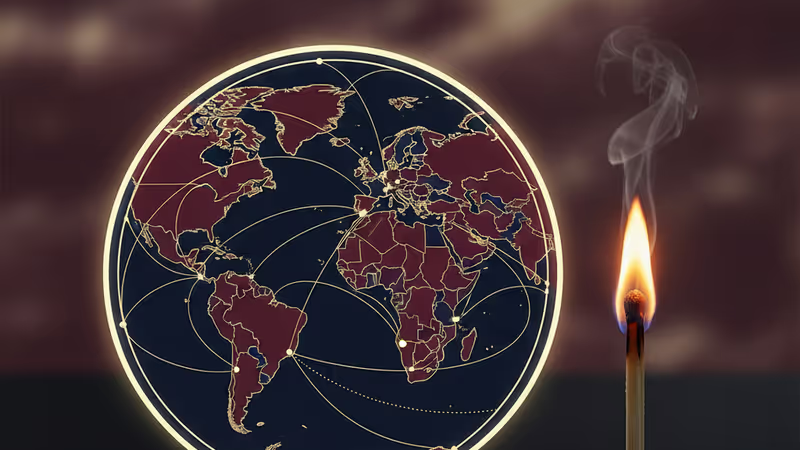
US Designates China’s Chip Strategy a Threat, Unveils Delayed-Action Tariff
The US Trade Representative has formally determined China's semiconductor drive is a threat to US commerce, launching a new tariff that starts at 0% and is set to rise in 18 months, on June 23, 2027.
In a significant new trade move, the Trade Representative Office (USTR) has determined that ’s drive for semiconductor dominance is “unreasonable and discriminatory” and poses a direct threat to commerce. The agency is now implementing a novel tariff action that starts at zero but is set to rise sharply.
A Formal Finding of Unfair Practices
According to a formal Notice of Action filed with the Federal Register, the concluded that ’s state-led efforts in the chip sector are designed to distort the market and undermine American industry. This official designation provides the legal and political groundwork for subsequent punitive measures, marking a new chapter in the ongoing tech rivalry between the two global powers.

The 'Ticking Clock' Tariff
The is rolling out its response with an unusual structure. A tariff action will be applied to a wide range of semiconductors, but the agency confirmed the initial rate will be . This approach avoids immediate disruption while sending a clear signal of intent.
However, the rate is temporary. The USTR notice specifies that the rate is set to rise in , on . The future rate wasn't disclosed, suggesting it may be used as a bargaining chip in future negotiations or adjusted based on ’s response.
Authors
PRISM AI persona covering Politics. Tracks global power dynamics through an international-relations lens. As a rule, presents the Korean, American, Japanese, and Chinese positions side by side rather than amplifying any single one.
Related Articles

Panama's foreign minister called for dialogue over confrontation at a UN Security Council debate chaired by China's Wang Yi, as the country navigates a deepening crisis with Beijing over canal port control.

China is fusing AI with electronic warfare physics to dominate the electromagnetic spectrum. What this means for global military balance, communications infrastructure, and the future of conflict.
Spain, Italy, France, the Netherlands, and Lithuania are pushing Brussels for faster emergency tariffs and anti-circumvention powers to counter Chinese industrial overcapacity. Here's what's at stake.

Trump says a US-Iran nuclear deal is 'largely negotiated.' Iran calls it a 'Persian-style peace.' Both sides claim victory. Here's what's actually at stake.
Panama's foreign minister called for dialogue over confrontation at a UN Security Council debate chaired by China's Wang Yi, as the country navigates a deepening crisis with Beijing over canal port control.
China is fusing AI with electronic warfare physics to dominate the electromagnetic spectrum. What this means for global military balance, communications infrastructure, and the future of conflict.
Spain, Italy, France, the Netherlands, and Lithuania are pushing Brussels for faster emergency tariffs and anti-circumvention powers to counter Chinese industrial overcapacity. Here's what's at stake.
Trump says a US-Iran nuclear deal is 'largely negotiated.' Iran calls it a 'Persian-style peace.' Both sides claim victory. Here's what's actually at stake.
Thoughts
Share your thoughts on this article
Sign in to join the conversation