
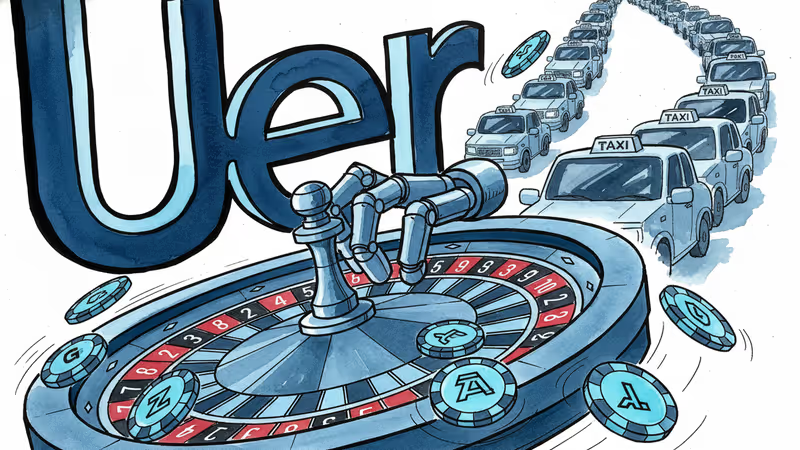
Uber's $1 Billion Bet: Why Waabi's Robotaxi Deal Changes Everything
Waabi's massive funding round signals Uber's bold strategy shift from ride-hailing to autonomous vehicle orchestration. What does this mean for the future of transportation?
$1 billion doesn't just buy you trucks anymore. It buys you a seat at the table where the future of transportation gets decided.
Waabi, the self-driving truck startup founded by former Uber AI chief Raquel Urtasun, just closed one of the largest autonomous vehicle funding rounds in recent memory. The deal structure tells a story: $750 million upfront, plus another $250 million from Uber tied directly to deployment milestones. But here's the twist – this isn't just about freight anymore.
From Highways to City Streets
The funding announcement revealed Waabi's ambitious pivot into robotaxis, with plans to deploy over 25,000 autonomous vehicles. For a company that built its reputation on long-haul trucking, this represents a fundamental shift in strategy and market positioning.
Urtasun's background adds credibility to this expansion. As Uber's former head of AI, she understands both the technical challenges and market dynamics of urban mobility. Her "simulation-first" approach at Waabi – training AI systems in virtual environments before real-world testing – has already shown promise in the trucking sector.
The timing isn't coincidental. While competitors like Waymo and Cruise have faced regulatory scrutiny and operational setbacks, Waabi enters the robotaxi market with fresh capital and a proven simulation platform. The company claims this approach can accelerate deployment while reducing the massive real-world testing costs that have plagued other AV companies.
Uber's Everything Strategy

But perhaps more intriguing than Waabi's expansion is what this deal reveals about Uber's evolving strategy. The ride-hailing giant now partners with more than 20 autonomous vehicle companies worldwide, essentially betting on every horse in the race.
This isn't the behavior of a company confident in any single technology or timeline. Instead, Uber appears to be positioning itself as the orchestration layer for autonomous mobility – the platform that connects riders with whatever self-driving solution eventually wins in each market.
The milestone-based funding structure with Waabi reinforces this approach. Uber pays more only when vehicles actually hit the road, minimizing risk while maintaining upside exposure. It's venture capital thinking applied to strategic partnerships.
The Simulation Question
Waabi's core differentiator lies in its simulation-first methodology. While companies like Tesla and Waymo rely heavily on real-world data collection, Waabi trains its systems primarily in virtual environments that can simulate millions of scenarios impossible to capture on actual roads.
This approach promises faster iteration and lower costs, but it also raises fundamental questions about the transferability of simulated learning to real-world complexity. Can virtual training truly capture the unpredictable nature of human drivers, weather conditions, and urban chaos?
The $1 billion funding round suggests investors believe the answer is yes. But the real test comes when Waabi's simulation-trained vehicles navigate their first rush hour in downtown Toronto or San Francisco.
Authors
Related Articles

Uber and WeRide have launched fully driverless robotaxi service in Dubai — no safety operator, real fares. Here's what it means for the global AV race and your next ride.
Uber partners with China's Pony AI and Croatia's Verne to launch Europe's first commercial robotaxi service. Is this a survival strategy or a sign that the ride-hail giant is ceding its future to others?
Swedish startup Einride raises $113M ahead of NYSE debut, deploying 200 autonomous trucks for major brands. The logistics revolution accelerates.
Dubai signs deals with three unproven US transport companies after previous $450M Hyperloop failure and GM Cruise debacle. Will underground tunnels, flying pods, and air taxis work?
Uber and WeRide have launched fully driverless robotaxi service in Dubai — no safety operator, real fares. Here's what it means for the global AV race and your next ride.
Uber partners with China's Pony AI and Croatia's Verne to launch Europe's first commercial robotaxi service. Is this a survival strategy or a sign that the ride-hail giant is ceding its future to others?
Swedish startup Einride raises $113M ahead of NYSE debut, deploying 200 autonomous trucks for major brands. The logistics revolution accelerates.
Dubai signs deals with three unproven US transport companies after previous $450M Hyperloop failure and GM Cruise debacle. Will underground tunnels, flying pods, and air taxis work?
Thoughts
Share your thoughts on this article
Sign in to join the conversation