
Uber's New Bet: Being the AWS of Autonomous Vehicles
Uber launches Autonomous Solutions division to handle operations for self-driving companies. Is this the missing piece for AV commercialization or Uber's survival strategy?
Nearly Two Dozen Partners, One Big Gamble
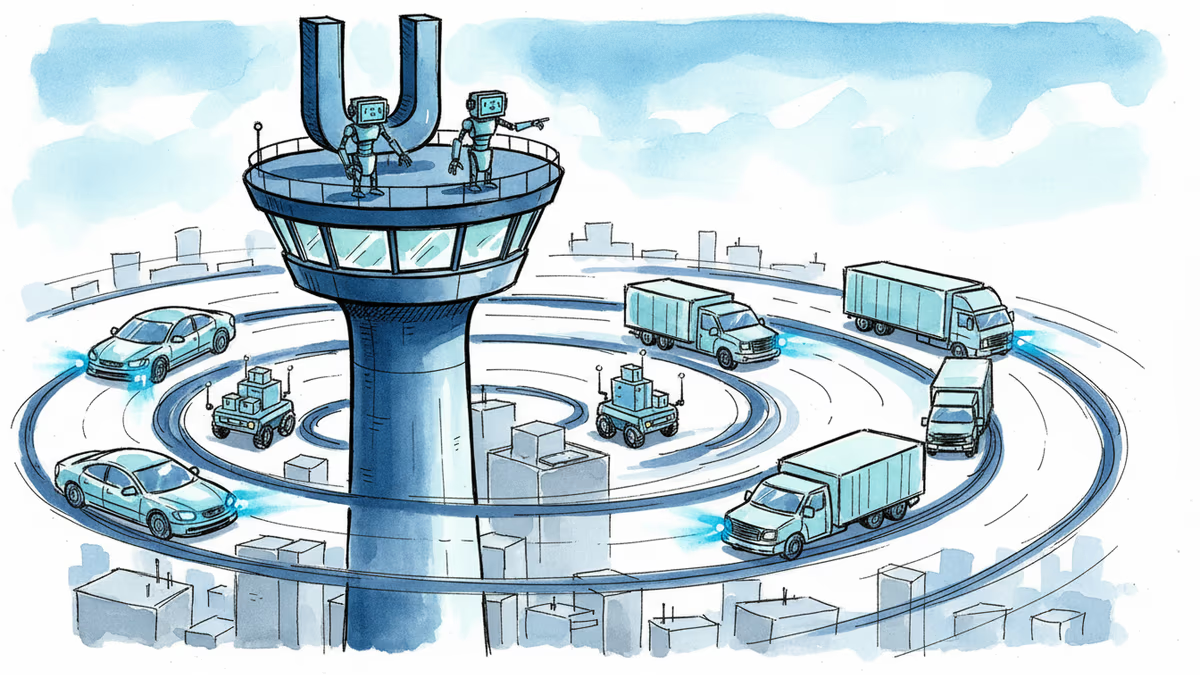
Uber just made a bold declaration: forget building autonomous vehicles, we'll run them instead. The ride-hailing giant's new Uber Autonomous Solutions division, announced Monday, promises to handle everything from fleet management to customer support for self-driving companies. It's essentially offering to be the AWS of autonomous vehicles.
The numbers tell the story of Uber's preparation. Partnerships with nearly 20 autonomous vehicle companies across robotaxis, trucking, and delivery robots. $100 million invested in fast-charging stations for AVs. A specialized engineering team collecting data with Lucid vehicles. Even a plan to scale robotaxi deployments to more than 15 cities by year-end.
"What's going to determine the success or failure of autonomous in the world is whether it can be commercialized," said Uber President and COO Andrew MacDonald. "And Uber is going to be the thing that makes autonomy commercially viable."
The Problem Isn't the Tech Anymore
Here's what's fascinating: after years of focusing on perfecting self-driving algorithms, the industry's biggest challenge isn't technical—it's operational. How do you generate demand for robotaxis? What happens when a vehicle gets confused at a construction site? Who handles customer complaints when there's no human driver to blame?
Sarfraz Maredia, Uber's global head of autonomous mobility and delivery, puts it simply: "AV tech teams should be able to focus on what they do best: building software that can safely power an autonomous world." Everything else—the messy, complex business of actually running a transportation service—that's where Uber sees its opportunity.

The company's already running shared robotaxi services with Waymo in Atlanta and Austin. It has partnerships locked up with Chinese firms Baidu, Momenta, and Pony.ai, plus delivery bot companies like Cartken and Starship. There's even a planned robotaxi service with Volkswagen in Los Angeles by late 2026.
Existential Threat Becomes Business Opportunity
Uber's pivot is both defensive and opportunistic. The company sold its in-house AV development unit in 2020 following internal struggles and a fatal pedestrian accident. That sale to Aurora could have marked Uber's exit from the autonomous future. Instead, it's become the foundation for a different strategy entirely.
The existential question remains: what happens to Uber when robotaxis replace human drivers? The company's answer is to make itself indispensable to the companies building those robotaxis. If you can't beat them, become their essential infrastructure.
This isn't just about ride-hailing. Uber's offering encompasses fleet financing, regulatory services, insurance, and even the humans who might need to remotely assist AVs when they encounter edge cases. That remote assistance piece is particularly sensitive—federal lawmakers recently raised concerns about Waymo using overseas workers for this function.
The Commercialization Bottleneck
The timing of Uber's move reveals something crucial about where the AV industry stands. After billions in investment and years of development, the technology is approaching viability. But turning viable technology into profitable business? That's proving to be the harder problem.
Consider the math: AV companies need to reduce cost per mile while increasing speed to market. They need demand generation, customer acquisition, fleet optimization, and 24/7 operations management. Building great self-driving software is hard enough without also becoming experts in all these other domains.
Uber's betting that specialization wins. Let Waymo, Cruise, and others focus on the AI and sensors. Let Uber handle everything else that makes a transportation business actually work.
Authors
Related Articles
Waymo's new Ojai robotaxi isn't just a vehicle upgrade. It's the company's most serious attempt yet at cracking the cost problem that has kept autonomous vehicles from scaling. Here's what's really at stake.
Auto China 2026 set records with 1,451 vehicles and 181 world premieres. But the real story isn't the size—it's how Chinese automakers stopped competing on price and started competing on brains.
Uber and WeRide have launched fully driverless robotaxi service in Dubai — no safety operator, real fares. Here's what it means for the global AV race and your next ride.
Studded snow tires offer unmatched grip on ice, but they're banned or restricted in many countries due to road damage and air quality concerns. What's the real trade-off?
Waymo's new Ojai robotaxi isn't just a vehicle upgrade. It's the company's most serious attempt yet at cracking the cost problem that has kept autonomous vehicles from scaling. Here's what's really at stake.
Auto China 2026 set records with 1,451 vehicles and 181 world premieres. But the real story isn't the size—it's how Chinese automakers stopped competing on price and started competing on brains.
Uber and WeRide have launched fully driverless robotaxi service in Dubai — no safety operator, real fares. Here's what it means for the global AV race and your next ride.
Studded snow tires offer unmatched grip on ice, but they're banned or restricted in many countries due to road damage and air quality concerns. What's the real trade-off?
Thoughts
Share your thoughts on this article
Sign in to join the conversation