
Waymo Builds Virtual Driving World with Google AI
Waymo partners with Google DeepMind to create hyper-realistic virtual driving environments using Genie 3, enabling autonomous vehicles to train on extreme scenarios like tornadoes and emergencies safely.
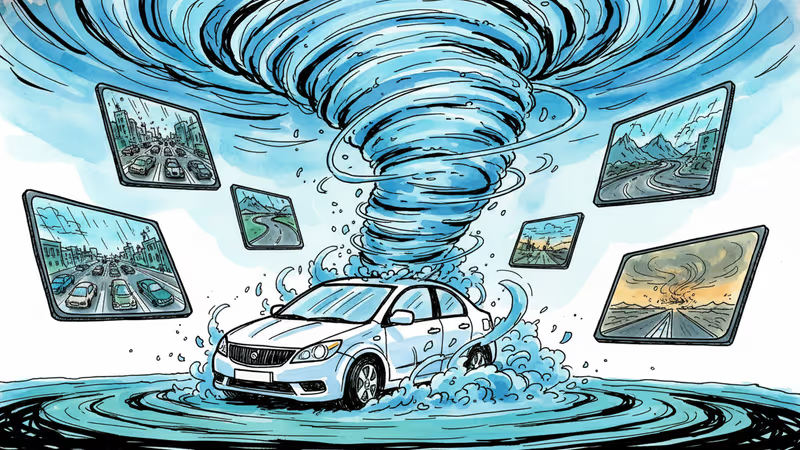
Picture this: an autonomous vehicle cruising down a highway when suddenly, a massive tornado appears on the horizon. What should the driverless car do? Until now, testing such extreme scenarios meant either risking real vehicles or settling for limited simulations.
Waymo has just changed that equation. The company announced it's built a "hyper-realistic" virtual driving world using Google DeepMind's latest Genie 3 AI model. This World Model can generate photorealistic, interactive 3D environments using simple text or image prompts – but it's specifically "adapted for the rigors of the driving domain."
Beyond Gaming Into Real-World Training
While Genie 3 was originally designed for creating interactive game environments, Waymo has transformed it into something far more consequential. Instead of generating knockoff Nintendo games, it's building comprehensive training grounds where autonomous vehicles can encounter every conceivable driving scenario.
The implications are staggering. Traditional autonomous vehicle testing relies on either real-world miles – Waymo has logged over 20 million autonomous miles on public roads – or basic simulations that can't capture the full complexity of driving. But how do you safely test what happens when your car encounters a tornado, flash flood, or unprecedented emergency?
The Safety Validation Revolution
This virtual world addresses one of the industry's most pressing challenges: proving autonomous vehicles are safer than human drivers. The statistical problem is daunting – you'd need to drive hundreds of millions of miles to demonstrate safety with confidence, and any accidents during that testing phase raise serious ethical questions.

Waymo's approach flips this paradigm. Instead of waiting for rare, dangerous scenarios to occur naturally, the system can generate thousands of edge cases on demand. It's like having a flight simulator for cars, where pilots – in this case, AI systems – can practice emergency procedures without real-world consequences.
Industry Implications and Competitive Response
This development puts pressure on competitors like Tesla, Cruise, and international players such as Baidu and Mercedes-Benz. While Tesla relies heavily on real-world data collection from its fleet, Waymo's virtual approach could accelerate development timelines significantly.
The technology also raises questions about regulatory approval. If an autonomous vehicle can demonstrate perfect performance in millions of virtual scenarios, should that carry the same weight as real-world testing? Regulators will need to develop new frameworks for evaluating AI-trained systems.
The Reality Check
Yet challenges remain. Virtual environments, no matter how sophisticated, are still approximations of reality. Can any simulation truly capture the unpredictability of human behavior, the subtle physics of different road surfaces, or the countless variables that make driving complex?
Waymo isn't abandoning real-world testing – they're combining both approaches. The virtual world serves as a training ground for scenarios too dangerous or rare to encounter naturally, while real-world miles validate that the virtual training translates to actual performance.
Authors
Related Articles
Waymo's new Ojai robotaxi isn't just a vehicle upgrade. It's the company's most serious attempt yet at cracking the cost problem that has kept autonomous vehicles from scaling. Here's what's really at stake.
A U.S. Senate investigation found that seven autonomous vehicle companies — including Waymo and Tesla — refused to disclose how often remote operators intervene in their vehicles. Here's why that silence matters.
Alphabet's new pay deal for Sundar Pichai links his compensation to Waymo and Wing performance—signaling where Google is placing its biggest bets. Here's what investors should actually read into it.
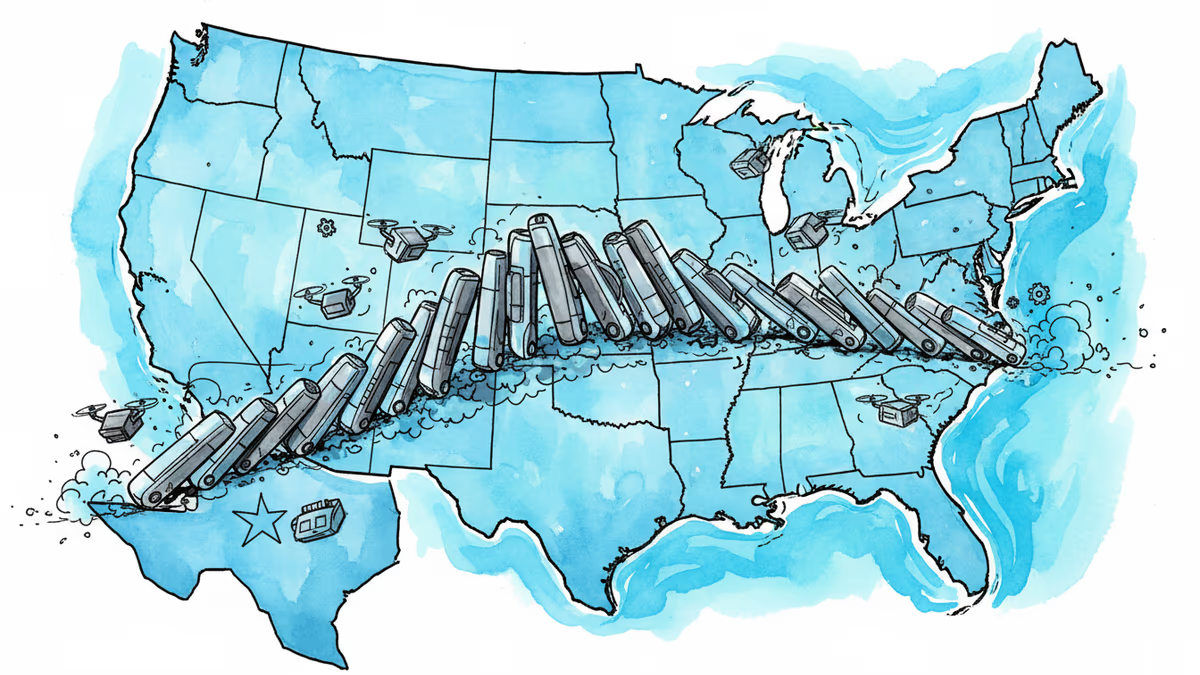
Waymo launches robotaxi services in Dallas, Houston, San Antonio, and Orlando simultaneously, expanding from 3 to 10 cities in just one year. Analyzing the strategy behind this aggressive rollout and what it means for the autonomous vehicle industry.
Waymo's new Ojai robotaxi isn't just a vehicle upgrade. It's the company's most serious attempt yet at cracking the cost problem that has kept autonomous vehicles from scaling. Here's what's really at stake.
A U.S. Senate investigation found that seven autonomous vehicle companies — including Waymo and Tesla — refused to disclose how often remote operators intervene in their vehicles. Here's why that silence matters.
Alphabet's new pay deal for Sundar Pichai links his compensation to Waymo and Wing performance—signaling where Google is placing its biggest bets. Here's what investors should actually read into it.
Waymo launches robotaxi services in Dallas, Houston, San Antonio, and Orlando simultaneously, expanding from 3 to 10 cities in just one year. Analyzing the strategy behind this aggressive rollout and what it means for the autonomous vehicle industry.
Thoughts
Share your thoughts on this article
Sign in to join the conversation