
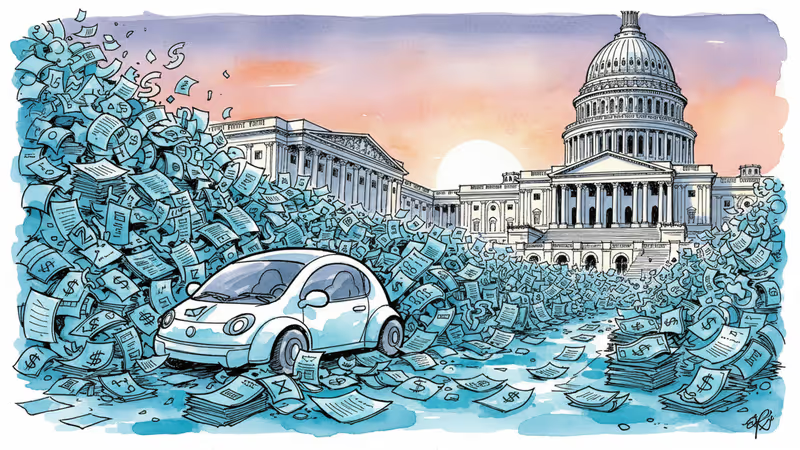
Self-Driving Car Bills Stall Again in Congress
Waymo and Tesla executives urged lawmakers to pass autonomous vehicle legislation, but concerns over Chinese components and safety incidents kept bills from advancing.
After two hours of testimony from Waymo and Tesla executives in the US Senate, autonomous vehicle legislation remains exactly where it's been for years: nowhere. Despite urgent pleas from industry leaders to accelerate self-driving car deployment, lawmakers seemed more interested in grilling companies about Chinese partnerships and safety failures than passing any actual bills.
This isn't just bureaucratic foot-dragging. It's a glimpse into how geopolitical tensions and safety concerns are reshaping the future of transportation technology.
The China Problem Gets Real
Waymo walked into a political buzzsaw when senators discovered the company's decision to use Chinese-made vehicles for its next-generation robotaxis. What should have been a discussion about innovation quickly turned into a national security interrogation.
The timing couldn't be worse. With US-China tech tensions at a fever pitch, any major American tech company working with Chinese manufacturers becomes a lightning rod. Waymo's technical arguments about vehicle quality and cost-effectiveness matter little when senators are worried about data security and supply chain vulnerabilities.
This represents a fundamental shift in how tech companies must think about global partnerships. The days of purely market-driven decisions are over—every supplier choice now carries geopolitical weight.
Safety Incidents Keep Piling Up

The hearing also spotlighted several incidents where Waymo vehicles failed to stop behind school buses during student loading. These weren't minor glitches—they were failures to follow basic traffic laws designed to protect children.
For lawmakers, these incidents crystallize deeper concerns about autonomous vehicle readiness. If self-driving cars can't handle something as straightforward as a school bus stop sign, how can they be trusted with more complex scenarios? The questions about legal liability and remote operation capabilities weren't technical curiosities—they were fundamental challenges to the industry's core promises.
The Innovation Paradox
Here's the irony: while Congress debates, other countries are moving ahead. China is rapidly deploying autonomous vehicles in major cities. European regulators are creating frameworks for cross-border AV testing. The very caution that's supposed to protect American consumers might be handing technological leadership to competitors.
Tesla and Waymo executives made this point repeatedly, arguing that regulatory delays are costing America its early lead in autonomous vehicle technology. But their arguments fell on skeptical ears—lawmakers clearly believe that getting the rules right matters more than getting to market first.
What This Means for Consumers
For ordinary Americans, this regulatory standstill translates to continued waiting. The promised benefits of autonomous vehicles—reduced traffic deaths, increased mobility for disabled individuals, lower transportation costs—remain largely theoretical while lawmakers debate liability frameworks and safety standards.
Meanwhile, the current patchwork of state regulations creates an uneven playing field. Some states welcome AV testing with minimal oversight, while others maintain strict restrictions. This fragmentation makes it harder for companies to scale their services and for consumers to understand what's actually available.
Authors
Related Articles
Waymo's new Ojai robotaxi isn't just a vehicle upgrade. It's the company's most serious attempt yet at cracking the cost problem that has kept autonomous vehicles from scaling. Here's what's really at stake.
Elon Musk confirmed on Tesla's Q1 2026 earnings call that Hardware 3 vehicles will never receive unsupervised Full Self-Driving — locking out millions who paid for the feature.
Tesla expanded its driverless robotaxi to Dallas and Houston, even after reporting 14 crashes in Austin. What does this tell us about how autonomous vehicles actually get built?
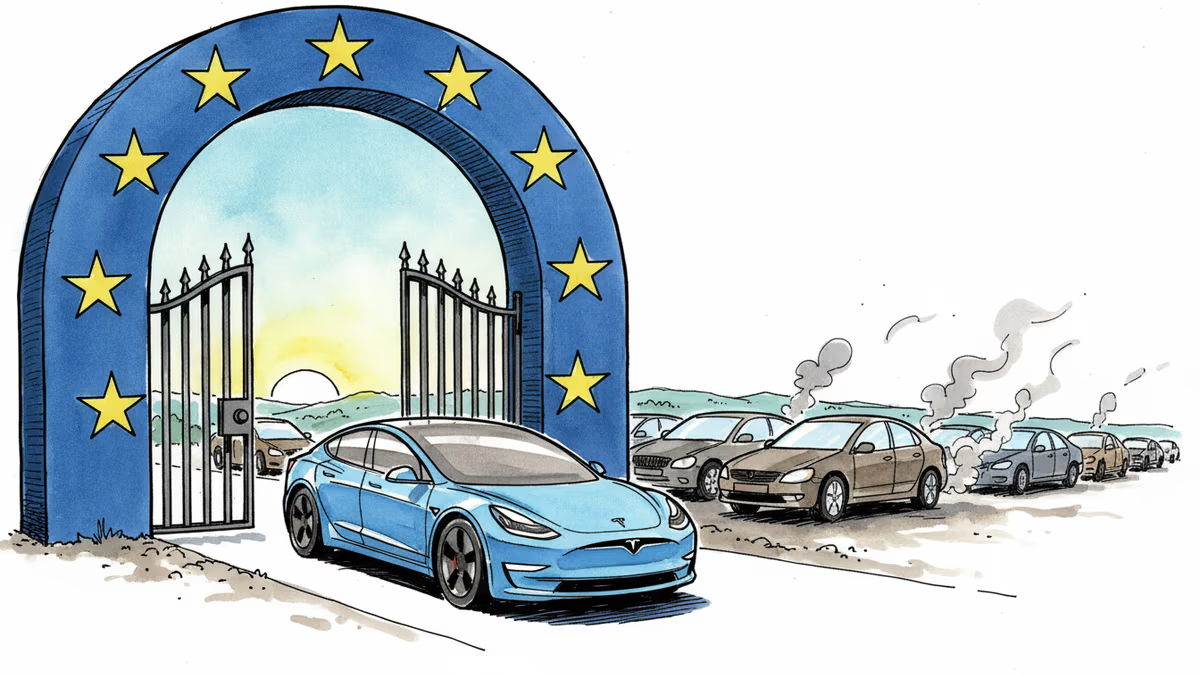
The Netherlands became the first European country to officially approve Tesla's FSD Supervised. With EU's type-approval framework, this could ripple across 27 member states fast.
Waymo's new Ojai robotaxi isn't just a vehicle upgrade. It's the company's most serious attempt yet at cracking the cost problem that has kept autonomous vehicles from scaling. Here's what's really at stake.
Elon Musk confirmed on Tesla's Q1 2026 earnings call that Hardware 3 vehicles will never receive unsupervised Full Self-Driving — locking out millions who paid for the feature.
Tesla expanded its driverless robotaxi to Dallas and Houston, even after reporting 14 crashes in Austin. What does this tell us about how autonomous vehicles actually get built?
The Netherlands became the first European country to officially approve Tesla's FSD Supervised. With EU's type-approval framework, this could ripple across 27 member states fast.
Thoughts
Share your thoughts on this article
Sign in to join the conversation