
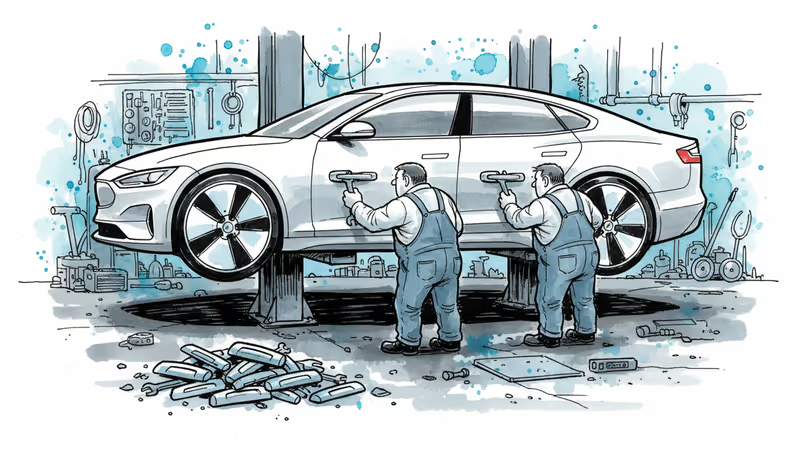
China Bans Tesla-Style Hidden Door Handles on EVs
China mandates mechanical door handles on all EVs starting 2025 to prevent entrapment. A safety-first approach that could reshape global automotive design trends.
Starting January 1st, 2025, over 60% of China's top electric vehicles will need a design overhaul. The country's Ministry of Industry and Information Technology has banned Tesla-style concealed door handles, requiring all EVs sold in China to feature mechanical release handles both inside and outside the vehicle.
The End of Flush-Mount Aesthetics
The regulation targets the sleek, retractable handles that sit flush with vehicle doors—a design Tesla pioneered and dozens of manufacturers have since adopted. These handles disappear into the car's body when not in use, creating aerodynamic efficiency and a futuristic aesthetic that became synonymous with premium EVs.
But beneath the elegant exterior lurked a potentially deadly flaw. When vehicle power fails or systems malfunction, these electronic handles can become inoperable, potentially trapping passengers inside during emergencies like fires or floods.
China's new mandate is crystal clear: all vehicles must have mechanical door handles that function "regardless of power supply status." No electronics, no exceptions—just old-fashioned mechanical leverage that works even when everything else fails.
Safety Trumps Style

This decision sends shockwaves through an industry that has increasingly prioritized form alongside function. Hidden handles weren't just aesthetic choices—they were engineering solutions that reduced drag coefficient and extended driving range, critical metrics in the competitive EV market.
The timing is significant. As EV adoption accelerates globally, China—the world's largest EV market—is setting a precedent that could influence design standards worldwide. Other manufacturers like BYD, NIO, and traditional automakers entering the EV space will need to rethink their approach to door hardware.
What makes China's approach particularly noteworthy is its regulatory directness. While Western markets have largely relied on manufacturer recalls and gradual improvements following incidents, China has opted for preemptive legislation. This reflects a broader philosophy: innovation must never compromise basic safety.
The Ripple Effect
The ban raises fascinating questions about the future of automotive design. Will manufacturers develop new solutions that maintain aerodynamic efficiency while ensuring mechanical reliability? Could this push innovation toward better emergency systems or entirely new door mechanisms?
For consumers, the message is clear: convenience and aesthetics shouldn't come at the cost of basic safety. But for the industry, it represents a significant design constraint that could either stifle creativity or spark ingenious new solutions.
Authors
Related Articles

Huawei's CANN is open source under a license barring software for non-Ascend chips. Inside China's second CUDA, and the two links still outside it: pre-training compute and 5nm capacity.
Waymo's new Ojai robotaxi isn't just a vehicle upgrade. It's the company's most serious attempt yet at cracking the cost problem that has kept autonomous vehicles from scaling. Here's what's really at stake.

China is restricting AI researchers and startup founders from traveling abroad as the U.S.-China AI performance gap narrows to just 2.7%. What Beijing's talent lockdown means for the global AI race.
Mercedes-AMG's new GT 4-door coupe packs three YASA axial flux motors producing 1,153 hp and 1,475 lb-ft of torque. Here's what it means for the EV performance race—and who actually wins.
Huawei's CANN is open source under a license barring software for non-Ascend chips. Inside China's second CUDA, and the two links still outside it: pre-training compute and 5nm capacity.
Waymo's new Ojai robotaxi isn't just a vehicle upgrade. It's the company's most serious attempt yet at cracking the cost problem that has kept autonomous vehicles from scaling. Here's what's really at stake.
China is restricting AI researchers and startup founders from traveling abroad as the U.S.-China AI performance gap narrows to just 2.7%. What Beijing's talent lockdown means for the global AI race.
Mercedes-AMG's new GT 4-door coupe packs three YASA axial flux motors producing 1,153 hp and 1,475 lb-ft of torque. Here's what it means for the EV performance race—and who actually wins.
Thoughts
Share your thoughts on this article
Sign in to join the conversation