
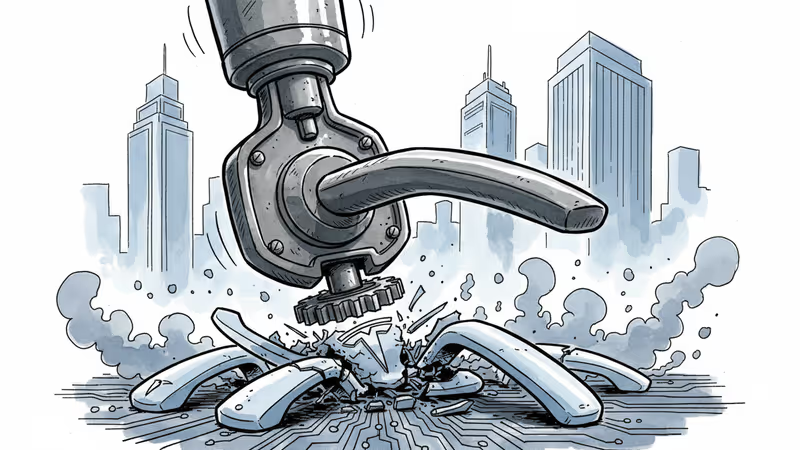
China Bans Tesla's Signature Hidden Door Handles
China mandates mechanical door handles starting 2027, banning Tesla's electronic design after fatal incidents. A pivotal moment for automotive safety standards and design philosophy.
After 100+ industry experts spent months deliberating, China just delivered a blow to one of Tesla's most distinctive design features.
Starting January 1, 2027, every car sold in China must have mechanical door releases, effectively banning the hidden electronic door handles that Tesla popularized. The new safety rules from China's Ministry of Industry and Information Technology mark the first time any country has outright prohibited this design element.
When Innovation Becomes a Death Trap
The regulation stems from a troubling pattern of fatal incidents where occupants became trapped in their vehicles. A Bloomberg investigation last September revealed multiple Tesla crashes where electronic door locks failed to get enough power from the vehicle's battery system, leaving first responders and passengers unable to open doors.
The problem isn't unique to China. The U.S. National Highway Traffic Safety Administration opened a defect investigation into certain Tesla Model Y and Model 3 door handles after similar incidents. While Tesla vehicles do have manual releases, federal investigators noted they're difficult for children to access, and many owners don't even know they exist.
In China, a crash involving a Xiaomi SU7 electric sedan among other fatal incidents prompted regulators to take action. The message is clear: sleek design can't come at the cost of basic safety.
The Industry Speaks (Except Tesla)
The new rule requires each door to have both mechanically operated external handles and interior manual releases. What's particularly telling is who participated in crafting these standards: 40+ domestic manufacturers, parts suppliers, and testing institutions joined the research process that began in May 2025.

Chinese companies like BYD, Geely Holdings, SAIC, and Xiaomi were involved, along with foreign automakers including General Motors, Ford, Hyundai, Nissan, Porsche, Toyota, and Volkswagen. Notably absent from the official "drafter" list? Tesla.
This exclusion speaks volumes about Tesla's relationship with Chinese regulators and perhaps hints at the company's resistance to design compromises.
The Ripple Effect Beyond China
China's move could trigger a domino effect globally. U.S. lawmakers have already proposed similar regulations requiring manual door releases in all new vehicles. European regulators, known for strict safety standards, are likely watching closely.
For automakers, this creates a design dilemma. Do they create China-specific models with mechanical handles while keeping electronic versions elsewhere? Or do they standardize on mechanical releases globally to avoid manufacturing complexity?
The implications extend beyond door handles. As vehicles become increasingly electronic and software-dependent, regulators worldwide are grappling with where to draw the line between innovation and safety. Should critical safety functions always have mechanical backups?
What This Means for Consumers
For car buyers, especially in the premium EV segment, this represents a shift away from the minimalist, tech-forward aesthetic that companies like Tesla have championed. Future EVs may look more conventional, with visible door handles breaking up those clean, uninterrupted lines.
But there's a silver lining: increased safety and peace of mind. Parents won't have to worry about their children being trapped, and emergency responders will have reliable access in crash situations.
Authors
Related Articles
Elon Musk confirmed on Tesla's Q1 2026 earnings call that Hardware 3 vehicles will never receive unsupervised Full Self-Driving — locking out millions who paid for the feature.
Tesla expanded its driverless robotaxi to Dallas and Houston, even after reporting 14 crashes in Austin. What does this tell us about how autonomous vehicles actually get built?
The Netherlands became the first European country to officially approve Tesla's FSD Supervised. With EU's type-approval framework, this could ripple across 27 member states fast.
Tesla's Austin gigafactory shed 4,685 workers in 2025—a 22% drop—even as its global headcount grew. What does this tell us about the future of EV manufacturing?
Elon Musk confirmed on Tesla's Q1 2026 earnings call that Hardware 3 vehicles will never receive unsupervised Full Self-Driving — locking out millions who paid for the feature.
Tesla expanded its driverless robotaxi to Dallas and Houston, even after reporting 14 crashes in Austin. What does this tell us about how autonomous vehicles actually get built?
The Netherlands became the first European country to officially approve Tesla's FSD Supervised. With EU's type-approval framework, this could ripple across 27 member states fast.
Tesla's Austin gigafactory shed 4,685 workers in 2025—a 22% drop—even as its global headcount grew. What does this tell us about the future of EV manufacturing?
Thoughts
Share your thoughts on this article
Sign in to join the conversation