
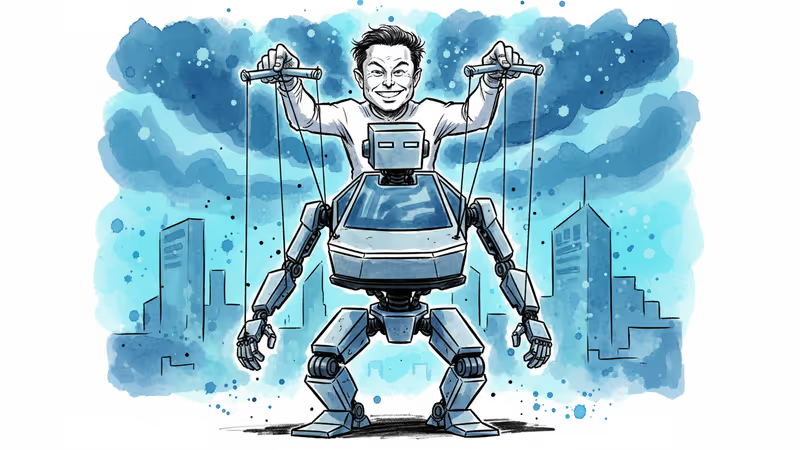
Tesla's $20B Gamble: From Car Company to AI Empire
Tesla announces plans to end Model S and X production while investing $20B in AI and robotics. Can Musk transform his EV company into the AI empire he envisions?
Tesla generates $69.5 billion from selling electric vehicles, yet CEO Elon Musk insists on calling his company an AI and robotics firm. This identity crisis is about to get a $20 billion reality check.
The EV Dependency Problem
Tesla's 2025 earnings expose the gap between Musk's aspirational branding and financial reality. Of $94.8 billion in total revenue, electric vehicle sales and leases—plus regulatory credits—accounted for $69.5 billion. The remaining $25 billion split almost evenly between energy storage and "services and other," which includes Supercharger revenue, parts sales, and Full Self-Driving subscriptions.
This EV dependency became a liability when sales dipped, dragging down the entire company. Tesla's profits plummeted 46% year-over-year in 2025, proving that for all the AI and robotics talk, the company's fate still hinges on how many cars it can sell.
The $20 Billion Transformation
Musk signaled a dramatic shift during the latest earnings call, declaring 2026 a "huge CapEx year" with spending more than doubling to $20 billion—enough to push the company into negative cash flow territory. This isn't just expansion; it's transformation.
The most symbolic move is ending production of the Model S and Model X. While these models represent only 2% of sales volume, their discontinuation marks the end of an era. The Model S, which launched in 2012, didn't just start Tesla—it kickstarted the entire EV revolution.
Tesla plans to fill that production void with Optimus humanoid robots at its Fremont, California factory. The company also intends to scale robotaxi operations to more cities and even floated building a TerraFab factory to secure chip supply.

The Musk Inc. Circular Economy
The most intriguing development is Tesla's plan to invest $2 billion in Musk's AI company xAI. Reports suggest talks are underway to potentially merge SpaceX, Tesla, and xAI in some combination—creating what could be called "Musk Inc."
This represents more than diversification; it's the construction of a circular economy within the Musk empire. Tesla's cash flows to xAI, while xAI's AI technology powers Tesla's autonomous driving and robotics ambitions.
Market Reality Check
While Musk builds his AI empire, competitors aren't standing still. Waymo just secured up to $15 billion in funding (largely from parent company Alphabet), and autonomous vehicle startup Waabi raised $750 million plus a $250 million milestone deal with Uber.
Meanwhile, the EV market that built Tesla continues evolving. Chinese competitors are gaining ground globally, and traditional automakers are finally bringing compelling electric vehicles to market. Tesla's decision to pivot away from EVs comes at a time when the competition is heating up.
The Innovation Dilemma
Tesla faces a classic innovator's dilemma: milk the profitable EV business or bet everything on the next big thing? Musk has chosen transformation over optimization, but the $20 billion question remains whether he can execute this vision before running out of cash or patience from investors.
The company's energy storage business showed positive growth while EV sales declined, suggesting diversification can work. But jumping from energy storage to humanoid robots represents a far bigger leap.
Authors
Related Articles
Waymo's new Ojai robotaxi isn't just a vehicle upgrade. It's the company's most serious attempt yet at cracking the cost problem that has kept autonomous vehicles from scaling. Here's what's really at stake.
SpaceX's IPO filing puts AI at the center, claiming a $26.5 trillion market opportunity. But can Grok compete with OpenAI and Anthropic for enterprise customers?
Mercedes-AMG's new GT 4-door coupe packs three YASA axial flux motors producing 1,153 hp and 1,475 lb-ft of torque. Here's what it means for the EV performance race—and who actually wins.
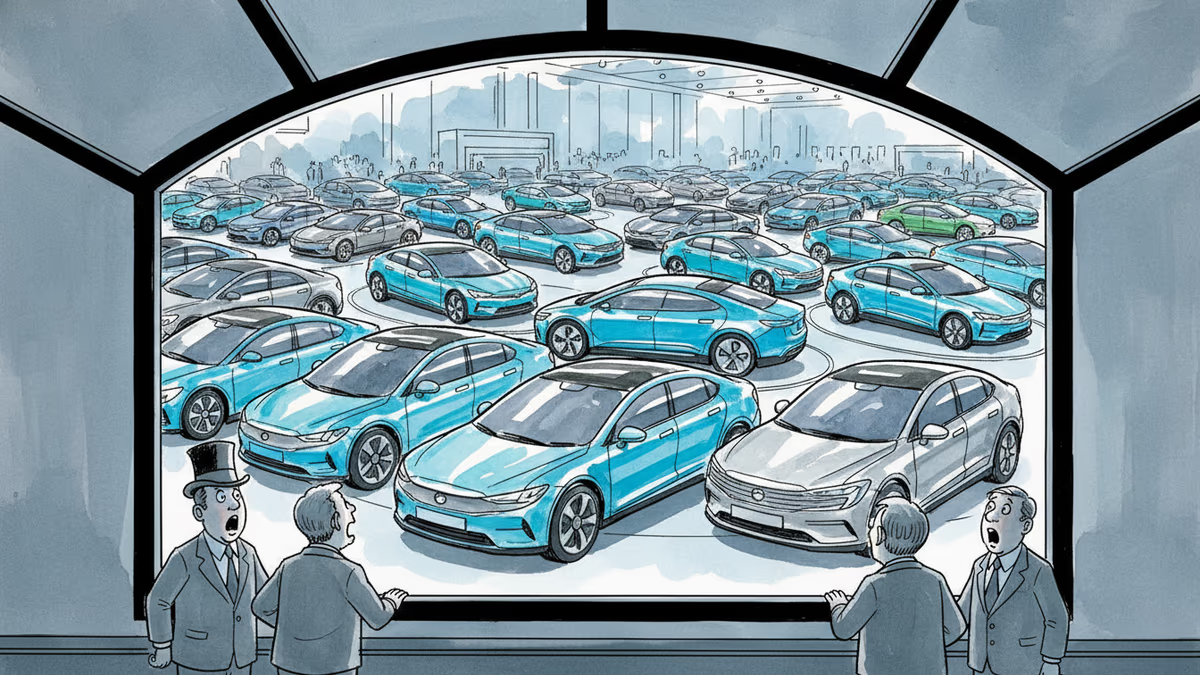
Auto China 2026 set records with 1,451 vehicles and 181 world premieres. But the real story isn't the size—it's how Chinese automakers stopped competing on price and started competing on brains.
Waymo's new Ojai robotaxi isn't just a vehicle upgrade. It's the company's most serious attempt yet at cracking the cost problem that has kept autonomous vehicles from scaling. Here's what's really at stake.
SpaceX's IPO filing puts AI at the center, claiming a $26.5 trillion market opportunity. But can Grok compete with OpenAI and Anthropic for enterprise customers?
Mercedes-AMG's new GT 4-door coupe packs three YASA axial flux motors producing 1,153 hp and 1,475 lb-ft of torque. Here's what it means for the EV performance race—and who actually wins.
Auto China 2026 set records with 1,451 vehicles and 181 world premieres. But the real story isn't the size—it's how Chinese automakers stopped competing on price and started competing on brains.
Thoughts
Share your thoughts on this article
Sign in to join the conversation